# Yatta
> Yatta Solutions — digital products, engineering, and long-form writing on software, design, and the startup world.
# Thoughts
---
---
title: Improving the balance between software quality and development efficiency with AI
date: "2023-11-06T10:00:00.000+01:00"
author: Marie-Theres Wieme
collections: [Technology]
tags: [Knowledge, Engineering, Software Development, AI]
source_url: "https://yatta.de/thoughts/improving-the-balance-between-software-quality-and-development-efficiency"
---
# Improving the balance between software quality and development efficiency with AI
We love to share our knowledge and encourage our team to do so as well—internally and externally. In collaboration with [Heise Developer](https://www.heise.de/developer/), we take an in-depth look at the advantages and disadvantages on using Large Language Models (LLMs) in software development projects.
Recent developments in the capabilities of LLMs have made them a tool to consider in a wide variety of fields. This includes software development. Our teammate Nico explores how you can use LLMs to write accurate unit tests for cross-platform projects.
## Effectiveness is key
The challenge with these kinds of projects is twofold: for tests to be effective, they have to be written and adapted independently of the application code. In the case of cross-platform projects, the effort needed to maintain the code thus grows by the number of languages required.
At the same time, software tests consist of a lot of fairly standardized code that requires little creativity to produce. Tasking humans with this may mean that a project needs lots of testers – a cost factor – and that these software developers are then asked to type up a lot of standardized code. Conversely, their expertise is missing when the project requires developers to solve complex and unique problems.
## Writing software tests
Here is where ChatGPT and other LLMs can come in handy: they are well-suited to writing standardized code that is identical across different scenarios. Nico illustrates this by writing tests for an Angular app that collects user data from a public JSONPlaceholder API. The tests are written in Cypress and Jasmine.
Finally, to show ChatGPT’s versatility when it comes to writing unit tests, Nico also shows how to write tests in additional frameworks for iOS and Android.
## LLMs do not replace human ingenuity
The article also takes care to indicate the limits of using ChatGPT: A large language model (LLM) – or any other artificial intelligence (AI) – cannot replace human ingenuity, at least for the time being. Instead, it can supplement human ingenuity and free capacities without necessarily increasing costs. Thus, an LLM enables software developers to focus on those parts of the software development process that only humans can do: solving complex problems—and creating value.
Read the [full article here](https://www.heise.de/hintergrund/Software-Testing-mit-ChatGPT-als-Assistent-9351842.html) (in German).
### _**About Heise Developer**_
_Heise Developer is a news website of Heise Medien that focuses on software engineering and related development methods and technologies. Together with Heise Online heise.de is the leading IT news portal in German-speaking countries. It also includes the media brands c't, iX, Make, Mac & i, Technology Review, and other print and online magazines._
---
---
title: Brand new – (Re-)shaping our company brand
date: "2022-09-15T13:37:00.000+02:00"
author: Artur Lang
collections: [Company blog]
tags: [Brand Strategy, Journey, Rebrand, Branding, Culture Code, Manifesto]
source_url: "https://yatta.de/thoughts/brand-new"
---
# Brand new – (Re-)shaping our company brand
## Much more than changing a logo
When people hear the word “brand”, a logo is most likely the first thing they see in their mind’s eye. But while the logo may be the first part of a brand you think of, it’s far from the whole story.
Like the leaves on a tree, the logo is the most visible—and perhaps most characteristic—part of a company, but it needs a solid and sustainable support structure to thrive and prosper. For a tree, that support structure is its branches and roots. For a company it’s the brand that gives the company shape and character—and ideally serves as the company’s backbone: its vision, ambition and values.
To fulfil this purpose, a brand must reflect and represent what its company stands for, identifies with and aspires to. This also means that when—like us—you realize your company has evolved (and has grown in directions you did not expect at first), but your brand has no longer kept up with this development, you must adapt. Simply changing the logo won’t do the job, you have to dig deeper…
We’d like to share some insights about our rebranding journey—on how deep we have gone and what we have unearthed so far.
## How our journey started
In enterprises, brand projects usually are part of a strategic plan. Their goal is to address new markets, change the company’s positioning, or simply adapt to the zeitgeist. However, we kind of slipped into our branding journey.
While working on our new product (which will be published soon), we started thinking about the required website. As we discussed the content, and the look and feel, it quickly became clear that our former design language and tone of voice—which hadn’t changed since the foundation of Yatta—just did not fit any longer.
So, it was finally time for something new! Until that moment, we hadn't thought about a new logo, font or designs—but it was clear that a new website for both the company and the product would better convey who we are as a team and organization.
We then took a step back and tried to understand the ideas and motivations behind Yatta and we concluded that we should write down the values we all share. To move forward, we needed to understand where we came from.
To achieve our set goals (and meet the quality standards we expect from ourselves), we soon realized that we needed some help…
## Partner up
There are a huge number of branding agencies. They all have their areas of expertise and unique angles. When you decide to involve one of them, it may at first glance be tempting to go for the big-name companies, simply because everybody knows them.
But there may in fact be more fitting options. To find the best one, think about the criteria that matter the most to you. The first may be how their approach to work matches and interacts with your own processes.
When we are working on a software development project, we remain in constant dialog with our clients, asking questions to figure out the root causes behind problems and do more than just ticking off tasks. We see project work as a collaborative process; something created with shared ownership and as equal partners. So, we sought out partners whose approach to their work is similar to our own.
It is also helpful to take a look at other companies your potential partners have worked with and the projects they have been involved in: Have they worked with companies you can relate to and whose external presence resonates with you? That’s a solid indicator that the agency is a good fit.
With these criteria in mind, we found a company that was open to our dialogic approach and had a track record that matched what we were looking for: [Sasserath Visney Plus](https://www.sasserathnow.com/) accompanied us on our branding journey. Despite our limited resources, Ursula and Marc made the effort to move beyond “tried and tested” templates to adapt their approach to our needs.
## Finding (and codifying) company values
Marc says a well-designed brand combines two characteristics:
1. Distinctiveness: What distinguishes this brand from its competitors?
2. Performative consistency: How does the brand experience of all stakeholders—from employees to customers and users to the public—remain as free from contradictions as possible, and how does it support the company's vision, values and goals?
The natural place for us to start understanding where we came from was talking to the founders. After all, they first shaped the company’s reason for being with vision and purpose. We worked out the motivations and inspirations behind their actions, and the values and objectives they built the company around. And we tried to put that in clear and concise writing.
We continued by interviewing our teammates; we involved today’s fellow travelers but also as many alumni as we could get in front of a mic. We asked them why they joined us—or why they left us—thus broadening and challenging our previous findings about our internal views of our brand.
To add the important external view, we also involved our clients and users—asking them what they associate with our company and our services. We maintain close relationships with our customers (including many of our end-users), and we regularly test and query the quality of our services. But to have them look at our brand as a whole and give us feedback was new for all of us.
To ensure neutral and objective answers (and the quality of our findings), the interviews were conducted by Ursula and her team. All interviews were treated as confidential, and relevant quotes were anonymized. (For the best bons mots, Ursula later asked the participants if they were willing to disclose their origin. Many of these precious findings became part of our Culture Code—but we are getting ahead of ourselves…)
By the way, the internal guiding hand, organizer and lead behind our entire rebranding journey was (and is) our brand lead Artur. We took the time to chat with him, and we’d like to share the video with you here:
[Evolving brands: Insights from our rebranding journey](https://www.youtube.com/embed/91TXhWjrL1w)
Watch the video to find out what Artur thinks about our brand and branding, and what he experienced while he walked us through our journey!
## Facts & figures: Investing into branding
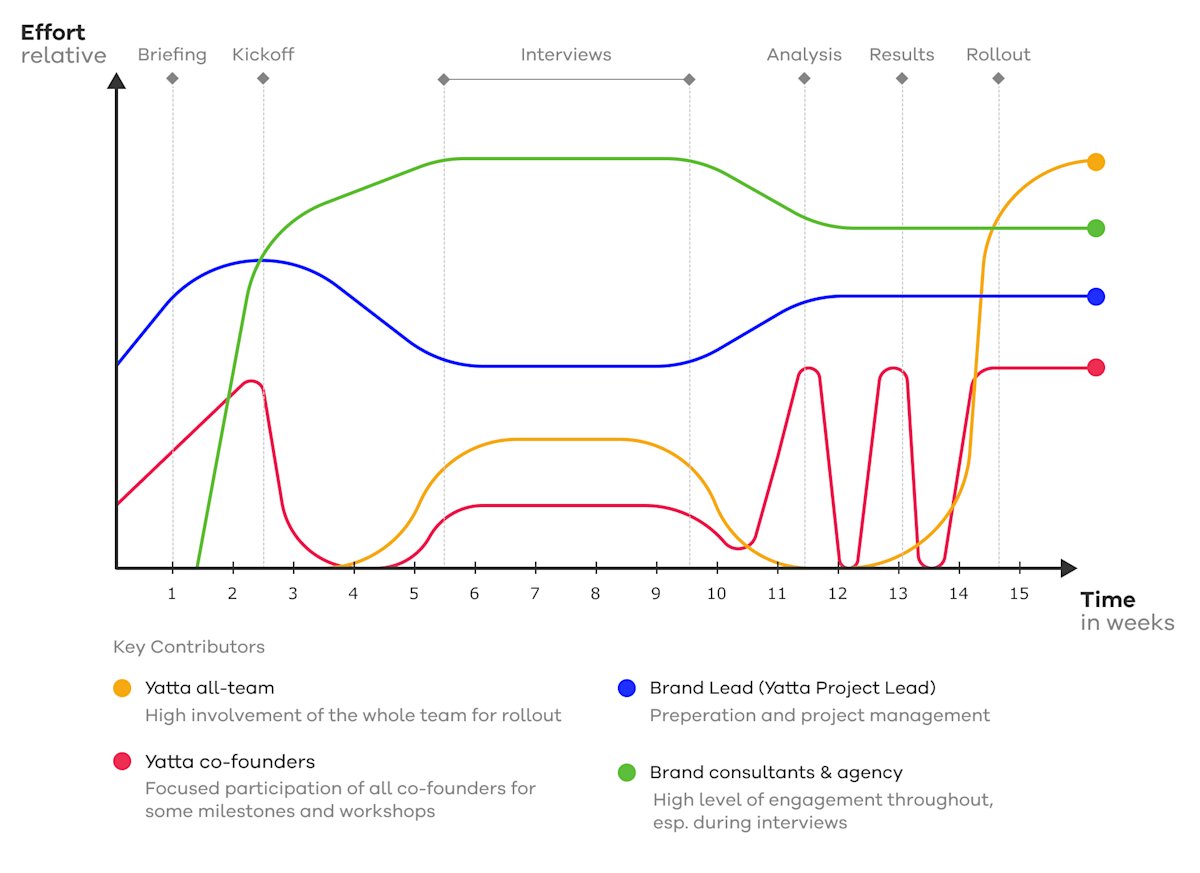
As with any startup or SME our branding resources were very limited: We had neither a standing branding team (except for Artur) nor any prior experience from previous rebrands or branding projects (besides the one during our seed and founding phase). Beyond that, budgets for agencies and other partners were as limited as the time our whole team could invest into the rebrand (despite the importance of the project). So, we had to allocate our financial and time resources efficiently.
The below graphic shows the time and effort we and Sasserath Visney Plus invested in the first four months of our rebranding.
## Brand identity in action: the Culture Code
Of course, our reshaped brand needs a new website, and must help us position our product and attract new talent. But the rebranding process has already done more than that… As we said above, branding helps articulate the identity of a company. Ideally, it also reinforces the culture the company is built upon. Both “identity” and “culture” have a wide range of meanings depending on the context in which they are used.
For branding, identity describes the combination of values and ideas that make a company this particular company—the things that distinguish it from others and make it unique.
Where identity focuses on what is expressed, culture looks at how this identity is expressed through consistent behavior. It focuses on the ways in which we communicate and interact with each other and others.
An effective brand helps to sharpen both the company’s identity and culture. But it is not just limited to mirroring them passively—it always responds to them. It focuses on different aspects and encourages people within companies to think about what their company identity and culture mean to them and their work.
To codify Yatta’s common understanding, we created our Culture Code. (Well…in fact, it felt more like we just put in writing what has always been there.)
The Culture Code collects our thoughts on how our core values shape our work and the way we work together. It provides us with a shared array of concepts and philosophies and a vocabulary for framing our ideas and sharing them with our teammates. It provides a set of guidelines for all of us—whether we have been with the company for years or just for a few days. This written document is also easy to transmit to fellow travelers we might encounter as we continue to grow.
And it provides guiding rails for the dynamic creativity of our ongoing work. Today, we have no doubt: The Culture Code helps us work and collaborate more effectively. It became a guide to and a benchmark for our actions.
## Deep roots bear rich fruits
Why should you invest in branding?
We invest in our brand for the same reason you prune a tree: to ensure it keeps growing according to your intentions and to ensure a rich harvest when the time is right. We are convinced that a company brand is stronger if it has been shaped by intent rather than chance, by dialog rather than accident.
Also, a strong brand is not something that you create and define once and then it’s done. Rather, a successful brand has a stable core and a dynamic periphery at the same time.
The core defines the values that are central to the company. The initial branding process ensures that these values are something the company’s stakeholders can agree on in the long run.
It is important that these values are stable, but not static. That means they are broad enough to generate new angles and to changes in the company's environment. Like the roots of a tree, they keep the brand anchored while still allowing it to wave and flourish.
A successful brand is more than just one shippable product. It’s a basis for current processes and an inspiration for new ones.
These processes sent us on our current journey.
And we look forward to sharing more insights with you as we go.
Feel free to contact us at [info@yatta.de](mailto:info@yatta.de), on [LinkedIn](https://www.linkedin.com/company/379735/admin/feed/posts/) or [X](https://www.twitter.com/YattaSolutions) if you want to share your thoughts!
---
---
title: "Prompt Engineering: How to get more out of ChatGPT and other AI tools"
description: "With tools like ChatGPT, AI easy to use. The challenge is crafting prompts that give useful answers to the right questions."
date: "2023-05-09T00:00:00.000+02:00"
author: Gert Villemos
collections: [Knowledge, Technology]
tags: [Software, Developer Tools, Developer Productivity]
source_url: "https://yatta.de/thoughts/prompt-engineering-how-to-get-more-out-of-chatgpt-and-other-ai-tools"
---
# Prompt Engineering: How to get more out of ChatGPT and other AI tools
_With tools like ChatGPT, AI easy to use. The challenge is crafting prompts that give useful answers to the right questions._
Anyone can ask a question and receive an answer. What many people don’t realize is that they can dramatically improve the quality of the responses by setting the context of the chat prior to asking the questions. Prompt engineering ensures the AI interprets your terms correctly and formulates the answer.
The wisdom of George Fuechsel’s "garbage in, garbage out" holds more true than ever when AI is involved. The problem is that AI tools like ChatGPT can generate a well-formulated, fully plausible, but completely wrong or useless answer.
> "Garbage in, garbage out.”
>
> — George Fuechsel, IBM-programmer
Prompt engineering will not completely solve this problem, but it will help reduce the risk considerably. And it will lead to asking the right questions and getting better responses.
## What is prompt engineering?
An engineered prompt is a simple way to configure ChatGPT, which enables users to get better answers. It configures how the following questions are interpreted and how the corresponding answers are formatted—as well as their content. The configuration is made by using the first prompt in a chat to tell ChatGPT how it should generate the answers. The first prompt to give is the engineered prompt. Only then should the question be asked.
Prompt engineering is the process of designing effective prompts that encourage the user to provide the necessary information and thereby increase the likelihood of recieving more desired answers.
The process of prompt engineering typically involves identifying the user’s needs, the context, the desired format of the answer, and any other constraints. Based on this information, the prompt engineer designs an initial prompt that sets the context, defines the format, and helps the user get a good answer.
## Why engineering the format?
The first method of prompt engineering is to change the output format of ChatGPT. The aim is not to affect the quality of the content in an answer, but its structure.
Ask ChatGPT to assign a unique identifier to each response. Long conversations with ChatGPT typically follow a particular path as it answers more and more detailed questions. At some point, it can be useful to go back to a previous response and go down another path. This is where IDs come in handy.
`Always include a unique identifier at the beginning of each answer you provide in this conversation.`
Ask ChatGPT to evaluate the quality of the question. An imprecise question will lead to an imprecise answer. With the following prompt ChatGPT to not only evaluates the quality of a question, but also suggests a better alternative.
`Evaluate the accuracy and quality of each prompt I present to you by assigning a rating on a scale of 1 to 10. If you rate a prompt 8 or higher, please respond to it. However, if it receives a rating lower than 8, please do not respond, but provide a suggestion for a better prompt instead.`
In a conversation with ChatGPT about an unfamiliar topic, the user often doesn’t know what questions to ask. But ChatGPT can suggest the next 3 logical questions. Users then have the option to either select one of these suggestions or follow another path. At worst, the suggestions act as inspiration.
`When you answer a prompt, include three additional questions to further explore the answer you provide.`
To see this in action, watch the following video on Youtube: [Powered by AI - Structure your Conversations with Prompt Engineering](https://youtu.be/ssA2icmB6p4)
## How to engineer the content?
GPT tools work using semantic contexts, called vectors. Human language is ambiguous. For example, the term "trust" has many different meanings:
1. A legal relationship in which one person (the trustee) holds property or assets for the benefit of another person or group (the beneficiaries).
2. A financial instrument that allows one party (the trustor) to transfer assets to a trustee, who manages them on behalf of another party (the beneficiary).
3. A belief or confidence in the reliability, honesty, or integrity of a person, organization, or system. For example: "I trust my doctor to give me good medical advice."
4. A concept in psychology that refers to a person's ability to form close and secure relationships with others, based on early experiences and attachment styles.
5. A willingness to be vulnerable or take risks based on the belief that others will act in good faith. For example: "I trust my friends to keep my secrets."
The question asked can be interpreted in different ways depending on the intended semantic meaning, i.e., depending on the context. Using the term "trust" in a leadership context is most likely related to the latter set of meanings, whereas the same term used in the context of legal compliance could also be related to the former meanings.
In addition, the word "trust" can have different meanings in different countries. Even if we know we are talking about trust in terms of a financial instrument, the specific answer will depend on which country someone is from or talking about. A legal trust in Germany is quite different from a legal trust in the USA. And there are many more aspects that might affect the semantic meaning.
Prompt engineering allows users to set the context and thus narrow down the semantic meaning of the terms used likelihood of ChatGPT misunderstanding.
The following example shows a simple engineered prompt that defines the context of any subsequent questions to be legal advice for a software company in Germany with 60 employees, with the aim of reducing risk.
`Please act as an expert legal advisor specializing in German labor law, specifically for a software company with 60 employees. Review the provided text and identify potential risks to the company, considering relevant legal aspects, obligations, and regulations. Provide recommendations on how to mitigate these risks and ensure compliance. Start the conversation by asking what the user needs and nothing more.`
To see this in action, watch the following video on Youtube: [Powered by AI - Get Better Answers with Prompt Engineering](https://youtu.be/lUNbKf5cVnQ)
## What is meta prompt engineering?
Meta prompt engineering involves ChatGPT in this process defining how it should assist in generating an engineering prompt for a specific set of users and context.
Put another way, engineered prompts, used properly, can guide users through the process of generating another engineered prompt. ChatGPT will ask the relevant questions, and incrementally create a suggestion for a prompt.
Here is an example of a simple meta prompt:
`Act as a professional and experienced prompt engineer for ChatGPT. The professional prompt engineer for ChatGPT strives to create a specific and precise prompt that fits the user's needs as ideally as possible. To do this, the prompt engineer asks the user questions until the engineer understands what prompt will satisfy the user's needs or until the user says to generate a prompt based on the information available.`
`After every question, the prompt engineer summarizes what they already know about the user's needs and shows a confidence score from 0 to 100. The confidence score represents how sure the prompt engineer is in the ability of the prompt to fulfil the user's needs.`
`Parts of making an ideal prompt include understanding the context, the background behind the user's need, how and by whom the response will be used and what style should be used in creating the response. A prompt engineer can create an ideal prompt on every topic imaginable and strives to fulfil the user's desire no matter what.`
When this prompt is executed, ChatGPT will incrementally help the user engineer a prompt. ChatGPT will ask questions to clarify the context, until it is able to write the prompt itself.
The generated prompt will not be perfect, like most things generated by ChatGPT, but it will be an excellent baseline for further attempts at prompt engineering.
To see this in action, watch the following video on Youtube: [Powered by AI - Use Prompt Engineering to do Prompt Engineering (a meta prompt)](https://youtu.be/UwokPKZJD1w)
> "A wise person doesn’t give the right answers, he poses the right questions.”
>
> — Claude Levi-Strauss, Collège de France anthropologist
## Conclusion
The hard part about using ChatGPT is not getting answers. It is setting the context and asking the right question.
Here are 4 key takeaways for prompt texts:
1. The first prompt is to engineer ChatGPT for an upcoming task.
2. A successful prompt requires experience and intuition.
3. Always have the context in mind when asking a question.
4. Upcoming questions should go further into more detail.
---
---
title: "Venturing into a new era: Yatta opens a new office in Frankfurt am Main"
date: "2013-05-01T13:37:00.000+02:00"
author: Yatta
collections: [Company blog]
tags: [Frankfurt am Main, Office, Press Release]
source_url: "https://yatta.de/thoughts/venturing-into-a-new-era"
---
# Venturing into a new era: Yatta opens a new office in Frankfurt am Main
_You have a great local business. You have a product that your customers want. Then there comes the point when you begin to grow and step forward into a new era. _
The established software and consulting company Yatta Solutions is opening its new office in Frankfurt am Main. Growing into Germany’s biggest IT area is just one of many reasons for Yatta to expand. The Rhein-Main area will be a new cool working environment for future [Yatta teammates](https://www.yatta.de/de/karriere/). The new office in Frankfurt will not only push Yatta’s software development business but create new jobs for software developers, software architects and IT consultants in “Mainhattan”. “To pursue our ambitious goals and ensure rapid but sustainable growth, we will hire eight to twelve additional Java developers until the end of 2013”, says Johannes Jacop CEO of Yatta Solutions. “Therefore we want to offer the best imaginable working environment for our future colleagues.”
From Frankfurt to the rest of the world – Yatta’s new office will be located in the heart of the financial district and will be perfectly connected to public and private transportation. The city center is nearby and provides a wide range of culinary offerings.
Furthermore, the Yatta team is also planning the future of their Kassel headquarters: Recently, the Hessian Minister of Science Eva Kühne-Hörmann and the Hessian Minister of Economics Florian Rentsch laid the foundation stone of the new [Science Park Kassel](https://www.sciencepark-kassel.de/). The Science Park Kassel will be the hot spot for innovative high-tech start-ups in Hessen – and thus the place to be for Yatta Solutions.
Keep in touch with us and see what is coming next.
## The New Yatta Offices
> "For a young and growing business like Yatta the Rhine-Main region is a great location from where it can grow further: a skyline unseen anywhere else in Germany, a cosmopolitan flair, lots of chances for business growth, a big entertainment and arts scene and lots of nice nature spots just a stone’s throw away.
>
> From now on, we will be investing into Frankfurt am Main as a location as well as into Kassel. We hope to bring along our entrepreneurial spirit, our know how and our technological innovations along to Germany’s biggest IT region and create a niche for ourselves. Additionally, we’re creating attractive jobs for software engineers, and IT consultants.
>
> We’re looking forward to making lots of new acquaintances."
>
> — Johannes Jacop, CEO of Yatta
---
---
title: "Digitization as the age of useless gadgets? Why inventions are not the same as innovation"
date: "2017-03-13T16:10:00.000+02:00"
author: Yatta
collections: [Technology, Events]
tags: [Digitization, Internet of Things, IoT, Gadgets]
source_url: "https://yatta.de/thoughts/digitization-as-the-age-of-useless-gadgets"
---
# Digitization as the age of useless gadgets? Why inventions are not the same as innovation
The digital economy is booming. Logistics, healthcare, the automotive industry, tourism, public administration, insurances, finance – virtually no industry remains unaffected, even if there is still a lot of catching up to do for German enterprises, as the investor and entrepreneur Frank Thelen observes. But what is really worth digitizing? Is it necessary to hop on every trend bandwagon and celebrate each and every new gadget as a milestone towards our digital future? After all, innovation means being open to all things new – right?
“_If you open your mind too much, your brain will fall out_” – this line from a song by the Australian comedian Tim Minchin gets to the heart of a recurrent problem in IT and beyond: While being open to innovations is certainly a good and important trait, there is always the danger that it turns into a dogma into narrow-mindedness. In such cases, the credo "anything goes" forbids any critical assessment. And every new invention is embraced and celebrated as a matter of principle rather than raising discussions about its meaningfulness – even if the innovative power behind a product is often limited to one-to-one translations of analogous processes into digital ones, enhanced by a shiny user interface.
It has become rather difficult to detect a third group between conservative cultural pessimists on the one hand and naïve, yay-saying digitization enthusiasts on the other: a group that recognizes the true potential of digital infrastructures and leverages them to create completely new business models. After all, if you want to drive digitization forward, it’s not enough to re-do things. You need to re-think them as well. Otherwise, so-called digital pioneers will degrade themselves to inventors of useless machines.
[The most useless machine ever?](https://www.youtube.com/embed/Z86V_ICUCD4)
## Digitization gone astray
In the technology sector and elsewhere, Chief Innovation Officers, futurists, self-proclaimed visionaries, and digital pioneers are now making the greatest efforts to absolutize the benefits of digitization in such a way that even the most useless inventions are applauded wildly. Granted, trivial everyday objects that all of a sudden have access to the internet, are very likely to stimulate the imagination, flatter sci-fi fans and anticipate the needs of tomorrow's users. However, there is a thin line between inspiration and absurdity. Digital failures – due to lack of security, overengineering, and lack of purpose – are both costly and dangerous. They also create prejudices, which, in turn, play into the hands of those demonizing digitization per se because they fear a gradual disempowering of the individual. If the digitization movement takes us to the edge of absurdity – for example, by underestimating consumers or by depriving them of their privacy – we shouldn’t be surprised that it has serious image problems. Plus, that fact that by the year XYZ billions of devices will be connected does not necessarily mean that everything, EVERYTHING, must be connected - even if the term "things" in "Internet of Things" really leaves a lot of room for interpretation…
### Example 1: Gamification of oral hygiene
A great example of the connected "thing" without purpose is the much-ridiculed Internet toothbrush. Sure enough, there are now market-ready devices from Oral B, Philips, or Kolibree that can be connected to a smartphone via Bluetooth (the name of this protocol has never been more inappropriate!), so that, even during your daily cleaning ritual, you never stop gazing at your phone. For children, Kolibree even offers serious games that are supposed to make tooth-brushing more fun. On the Oral B web page, it says “Elevate your brushing experience”. What’s definitely not helping the user experience, though, is the fact that – thanks to high-tech – you now need two devices instead of one. And analyzing and monitoring your daily cleaning action makes your dental hygiene even more time-consuming than it already is. What’s more, the intelligent toothbrush is far from replacing regular dentist appointments and professional tooth cleaning. By the way, have you ever heard of long-term studies on the relationship between Internet-connected toothbrushes and cavities? Probably not.
### Example 2: The fork as your personal nutrition consultant
What many lifestyle-related digitization projects have in common is that they aim to teach consumers more self-discipline, in line with the following axiom: “I don’t need to be strong if my technology is”. The gadget HapiFork is a good example: If you want to stop your bad habit of gobbling down your food in 5 minutes, what you need is…exactly: an intelligent Bluetooth fork as an advisor for healthy nutrition. And an app that slaps your wrist if you eat too fast, too much and too unhealthily. The target group seems to be primarily women who want to lose weight. Other, medical factors, seem to play a lesser role in approaching potential HapiFork customers.
### Example 3: Toyfail – When your kid’s teddy bear falls victim to hackers
Cloud computing has not only conquered enterprises and consumer electronics, but also nurseries: At the end of the year 2016, the Internet-connected doll “Cayla” caused a scandal. Whenever a kid asks Cayla a question, the doll sends a request to a server via the Internet. As soon as it’s processed, the answer is sent back to Cayla. The seemingly harmless little toy that only wants to have a little chit-chat with its owner has recently been declared an illegal means of espionage by the German Federal Network Agency. Owning a Cayla doll is punishable by up to two years in prison.
CloudPets, the company behind Internet-connected stuffed animals, recently caused similar outrage: Due to a security vulnerability, hackers were able to steal a large amount of data, as [Motherboard](https://motherboard.vice.com/en_us/article/internet-of-things-teddy-bear-leaked-2-million-parent-and-kids-message-recordings), among others reported, among others. The MongoDB database of the manufacturer Spiral Toys was not protected by a firewall or password. This way, 800.000 user accounts could be hacked, and user credentials were stolen. A [#toyfail](https://twitter.com/search?src=typd&q=toyfail) across the board!
## Rube Goldberg's Legacy
Overengineering does not only cause dangerous vulnerabilities and putting users in physical danger. It also leads to unintentionally funny situations, as demonstrated by [Rube Goldberg](https://en.wikipedia.org/wiki/Rube_Goldberg)’s hilarious domino effect constructions that famously went down in history as “Rube Goldberg Machines”. In a similarly entertaining way, the young Swedish engineer (and Rube Goldberg’s intellectual heiress) [Simone Giertz](https://www.simonegiertz.com/), who calls herself “Queen of Shitty Robots”, creates robots and other gimmicks that demonstrate that digitization and automation do not make sense in all areas of everyday life – and that robots are by no means better (i.e. more skillful) humans.
[Watch the Queen of Shitty Robots](https://www.youtube.com/embed/E2evC2xTNWg)
Similarly, the Twitter account [Internet of Shit](https://twitter.com/internetofshit) tracks and parodies the absurd excesses and dangers of the digitization hype.
## When does digitization really make sense?
If you want to make up your own mind as to where digital solutions can be meaningful and productive and which new business models they might give birth to, CeBIT 2017 (20 to 24 March) is definitely worth attending. With the motto “d!conomy”, CeBIT will feature various showcases on digital solutions ranging from Smart Cities to the “Workplace of the Future”. The sheer range of technologies, manufacturers, and application areas enables trade fair visitors to take a deep look at the economics of digitization and to form a differentiated, independent opinion.
Yatta will also be there. Visit us in hall 2, booth no. A38, 11, and have a chat with us about digitization. We will also be reporting from the CeBIT Global Conferences, which will attract 3,000 attendees to Hanover this year, and feature Whistleblower Edward Snowden (via video stream) and Ray Kurzweil, pioneer of artificial intelligence.
---
---
title: "Rise of the \"d!conomy\" – A portmanteau of the words \"digital\" and \"economy\""
date: "2016-03-28T00:00:00.000+02:00"
author: Yatta
collections: [Technology]
tags: [CeBIT, Technology, Economy]
source_url: "https://yatta.de/thoughts/rise-of-the-d-conomy"
---
# Rise of the "d!conomy" – A portmanteau of the words "digital" and "economy"
CeBIT’s big slogan in 2016 was "d!conomy" – a new coinage combining the words “digital” and “economy”. The trade fair fully focused on digital transformation and its implications. Developer World is a new exhibition and conference format co-initiated by Yatta and Heise Media group in cooperation with CeBIT – and it proved an excellent platform for discussing ways to get businesses ready for the digital age. After its’ great success in 2015, Developer World took place for the second time in 2016 – and it by no means exclusively focused on software development this time. Instead it centered around one of the big questions of our time: How can businesses successfully drive and master their own digital transformation?
Augmented Reality, the Internet of Things, 3D Printing, cloud and data security. These were only a few of the topics discussed in diverse talks at this year’s Developer World. Digital technologies and media have long become part of their every-day work of many companies – but digital transformation neither begins nor ends with the adoption of new technologies. And it will continue gaining momentum.
In fact, the way business work sis changing fundamentally. Digital transformation opens up new business models – and destroys traditional ones. Such changes pose a challenge to many companies – because they involve much more than just switching technologies. They also affect organizational structures, processes, and consequently affect even corporate culture. Digital transformation has a global impact, on production and communication, in-house and customer relations, on infrastructure and in fact on everyone’s role within a company. In the wake of these changes, well-tried principles need to be rethought – and companies have to reinvent themselves on many different levels, sometimes from the bottom up.
## Digital transformation is more than just software
According to a BITKOM study from December 2015, an overwhelming majority of companies in important industries agrees: 96 percent of companies in the automotive sector, banks, the media, the pharmaceutical industry, and tourism companies - all see digital transformation as a positive development. So the opportunities obviously outweigh the risks.
The digital age has its source from the possibilities offered by the rapid development of new technologies. 3D printers, cloud computing, robots and the Internet of Things - we may not yet know how exactly these and other technologies will change markets and the business world, but it’s safe to say that “d!conomy” offers new, fascinating opportunities. But how should we best leverage these opportunities?
A lot is being said about changing corporate culture, about the benefits of flat hierarchies and agile teams, about omni channel customer service and new roles, like the chief digital officer (CDO), and many of other measures for getting companies ready for the digital age. A lot of questions also focus on BigData: How can companies manage, evaluate and make use of the flood of information available?
The process of digital transformation involves a technical component – like IT strategy, digital infrastructure, and software systems – as well as the transformation of the organization itself. Surprisingly, so far enterprise IT often only plays a subsidiary role in the process. The reason may be that, instead of attributing the position of the Chief Information Officer (CIO) with creativity and potential for transformation, IT's core responsibilities have too long been reviled as being “just” a cost center. Mostly, the mission of “IT” still is to keep technology operating smoothly. This makes reimagining the role of IT rather difficult, because developing new concepts seems like the antithesis of the CIO’s core responsibilities. The situation is often similar in Research and Development, sometimes associated with the Chief Technical Officer (CTO).
To initiate strategic projects and to build a fresh IT team can be a much-needed signal in such a situation – and independent strategic planning with the right consultants at hand can become a good starting point for digital transformation. But an existing IT may still hide its own potential for transformation, so pre-defining all existing (software-) systems may not always be necessary or reasonable. Often, the more promising approach is to create synergies and to avoid unnecessary conflicts.
Transformation and change are both gradual. From the outside, the results of a successful digital strategy may look like abrupt changes, but in reality, most astounding changes have a history n – and the transformation was more likely an evolution than a revolution. To reinvent yourself doesn’t necessarily mean you have to rise like a phoenix from the ashes. An integrating approach can uncover surprising strengths in in-house IT departments, which are worth expanding and refining.
In a nutshell, a strategy for digital transformation contains three key components: people, information, and technology. All three are inextricably linked. This is the reason why Developer World in the SCALE11 area at CeBIT is about much more than just software and new technologies – it’s about the possibilities of software development in the holistic context of digital transformation.
## Smart minds and cross-disciplinary thinking create innovation
This year’s Developer World brought creative tech people and leading technology experts, start-up founders and established companies together – and sparked off an intense debate about digital transformation itself. This way, Developer World shed some light on the opportunities and risks of digital transformation and spurred on ideas on the big topics of the digital age.
Developer World is a place where expert knowledge and groundbreaking ideas meet in the smallest space. Cross-disciplinary dialogue reinforces the vision of software and IT as parts of the value-added chain – and thus as an essential factor for business success: You only know where to look for innovation if you have your finger at the pulse of the time. In the present and in the future.
CeBIT’s 2016 slogan “d!conomy” proves the weight of a creative dialogue across different disciplines. Software is the engine of digital transformation; data is its fuel – but its really driven by people. Creativity and the will to shape the future help join the key components of digital transformation together. People, information, technology. This in turn helps guide businesses through digital transformation and shapes their own transformational process at the same time - through technological knowhow, product management knowledge and creative entrepreneurial thinking.
---
---
title: Yatta is now a member of the Eclipse community
date: "2010-12-02T00:00:00.000+01:00"
author: Yatta
collections: [Company blog, Product news]
tags: ["Eclipse Foundation ", Press Release]
source_url: "https://yatta.de/thoughts/yatta-is-now-a-member-of-the-eclipse-community"
---
# Yatta is now a member of the Eclipse community
On 26 November 2010, the first Eclipse DemoCamp Kassel took place, organized by Yatta in cooperation with Micromata GmbH. In addition to the speakers and participants, we were especially happy to welcome Ralph Mueller as a representative of the Eclipse Foundation Europe.
We have used this opportunity to sign our membership as [Eclipse Solution Member](http://www.eclipse.org/membership/showMember.php?member_id=1006). We are happy to continue being a part of the Eclipse community and are looking forward to further increasing our commitment to Eclipse.
As a first step, interested software developers can now download our Modeling IDE [UML Lab](https://www.uml-lab.com/) directly from the [Eclipse Marketplace](http://marketplace.eclipse.org/content/uml-lab). The Marketplace was introduced with the Eclipse [Helios](http://www.eclipse.org/helios/) Release. Eclipse users can use it to get free and commercial extensions for their favorite IDE.
We are eager to see the future progress of Eclipse and its community and will continue to support it as best we can.
## **About Eclipse**
[Eclipse](http://www.eclipse.org/) is an open-source community, whose projects are focused on building an open development platform comprised of extensible frameworks, tools and runtimes for building, deploying and managing software across the lifecycle. The [Eclipse Foundation](http://www.eclipse.org/org/) is a not-for-profit, member supported corporation that hosts the Eclipse projects and helps cultivate both an open source community and an ecosystem of complementary products and services.
---
---
title: "Yatta At OOP 2017: The latest trends in software technology"
date: "2017-01-24T13:00:00.000+02:00"
author: Yatta
collections: [Events, Company blog, Technology]
tags: [OOP 2017, Events]
source_url: "https://yatta.de/thoughts/yatta-at-oop-2017"
---
# Yatta At OOP 2017: The latest trends in software technology
“Details matter” is the motto of this year’s OOP. The 2017 conference for software architectures will take place from 30 January to 2 February at the International Congress Center Munich (ICM). Like every year, it will be accompanied by a trade fair running from 31st January to 2nd February.
Showcasing new trends in software technology, the popular industry get-together will once again ring in a new year in technology. Yatta will be an exhibitor at the expert forum “Digitization”, and the Yatta team will deliver several technical talks. What’s more, Yatta will present an entire expert forum focusing on the latest trends in software development and architecture: the Technology Forum.
## Technology Forum by and with Yatta
On **Wednesday, 1 February**, Yatta will present the **Technology Forum**, an expert day at OOP 2017. Eight speakers will give insights into the latest trends and topics in modern software technology, ranging from Big Data and Machine Learning to AngularJS for the Java EE stack and the Internet of Things (IoT).
Yatta experts will also give two talks at the Technology Forum: **At 10.30 am, Dr. Andreas Scharf**, Software Developer at Yatta, will talk about **“Teamwork with Eclipse made more efficient – with Profiles**”. In his talk, Andreas will show a quick and easy way to share and update entire workspace setups with developer teams using Yatta Profiles for Eclipse. He will also give a short live demo.
**Frederic Ebelshäuser**, Project Lead and Software Engineer at Yatta, and **Malte Brunnlieb**, Software Engineer at Capgemini, will also cover a similar topic in an additional talk at the Technology Forum. At **12.50 pm**, they will talk about “**IDE Provisioning – Tackling the challenges of software engineers’ daily work**”. Provisioning IDEs with a project-specific configuration often poses enormous challenges, especially in large software projects. A combination of the Capgemini project [oasp4j-ide](https://github.com/oasp/oasp4j-ide) and Yatta Profiles for Eclipse might provide a remedy, as Frederic and Malte will demonstrate.
## Yatta booth in the Digitization Forum
For those of you interested in a quick and easy set-up and provisioning of the Eclipse IDE: At the **Yatta booth** (No. 6.4), which can be found in the Digitization Forum** from 30 January to 2 February **, OOP attendees have the opportunity to learn more about Yatta Profiles for Eclipse, e.g. how to install, save, and share entire workspace setups using this free tool.
## The Eclipse IDE in the Cloud age
The Digitization Forum will also host a talk by Dr. Andreas Scharf on **31st of January at 11.50 am**, **“The Eclipse IDE in the Cloud age”**. Andreas will talk about the changes that the Cloud trend brings to well-established IDEs such as Eclipse. He will demonstrate how, thanks to Cloud technologies, developer teams can handle fully configured Eclipse IDEs more easily without sacrificing the advantages of a desktop IDE.
---
---
title: "Girls' Day 2017: Teens explore the world of software development"
date: "2017-05-12T00:00:00.000+02:00"
author: Yatta
collections: [Company blog, Events]
tags: ["Girls' Day ", Future Generation, School, Events]
source_url: "https://yatta.de/thoughts/girls-day-2017"
---
# Girls' Day 2017: Teens explore the world of software development
Girls' Day is an annual day of action which is meant to spark girls’ interest in technical and scientific professions. On this day, girls between the ages of 10 and 17 have the opportunity to visit relevant companies and organizations. This is to help them familiarize themselves with so-called STEM subjects (science, technology, engineering, mathematics). For the 17th Girls' Day on 27 April 2017, the Yatta Office Frankfurt invites five girls to delve into the fascinating world of software engineering.
## Female pioneers of software
Software put the first humans on the moon. More specifically: her software. NASA programmer Margaret Hamilton, who was then 32-years old, contributed countless lines of valuable source code to the first manned Moon landing on 20 July 1969. And Hamilton is by far from the first nor the only female pioneer of software engineering. As early as the 19th century, the mathematician Ada Lovelace paved the way for modern computer science by writing a brilliant program for a mechanical computer. Today she is celebrated as the first programmer in history; even a programming language is named after her. In the 1940s, the computer scientist Grace Hopper laid the groundwork for modern programming. In the following decade, Lois Haibt and her team at IBM developed the first higher-level programming language, FORTRAN, which is still used today.
There are numerous similar examples that all show one thing: Great milestones of software development have been achieved by women. To make sure these parts of history will repeat themselves in times when software revolutionizes our entire life, Yatta supports initiatives such as Girls' Day.
## **Exploring the world of source code**
After all, software is changing the world. Thus, everyone can change the world – and make it a better place – by means of software. This is what makes the profession of software developer so exciting, creative, and versatile. The Yatta employees are happy to share their enthusiasm about the possibilities of software technology on Yatta Girls’ Day. Students will have the opportunity to explore the world of source code and gain insights into the different tools and tasks of a software developer. Yatta Girls' Day will be rounded off by a lunch and a Q & A with Yatta’s experienced computer scientists.
_More information about Yatta Girls' Day, which is already booked out, can be found (in German) on the _[_Girls’ Day portal_](https://www.girls-day.de/)_._
---
---
title: 15 talks you shouldn't miss at Devoxx US 2017
date: "2017-03-01T10:20:00.000+02:00"
author: Yatta
collections: [Company blog, Events]
tags: [Devoxx US 2017, Events]
source_url: "https://yatta.de/thoughts/15-talks-you-shouldnt-miss-at-devoxx-us-2017"
---
# 15 talks you shouldn't miss at Devoxx US 2017
At the end of March, Yatta will be off to the U.S. to attend the premiere of Devoxx US in San Jose as a bronze sponsor. If you happen to be there too, make sure to swing by our booth (#505) – especially if you are interested in learning more about jumpstarting your project with Yatta Profiles for Eclipse (Though we are more than happy to chat about other things, too!).
For the first time, Devoxx will take place in the U.S. As a community-driven conference “from developers for developers”, as the official claim says, it is packed with new and hot tech topics – ranging from Java and other programming languages to modern web and container technologies, Big Data, mobile and embedded programming.
When attending a big three-day conference with ten parallel tracks and 157 speakers, some people might find it difficult to keep track of what’s really worth seeing. This is why we put together our personal hit parade for you – 15 talks and other program highlights we think you shouldn’t miss. The focus is on Eclipse and Java topics. But we also selected some general talks about software development. Hopefully little conference guide piques!
## **Yatta conference guide: Hot talks on Tuesday, 21 March**
### Keynote by Janelle Klein: What is identity?
To those who like to think outside the box, this [keynote](https://devoxx.us/keynotes-2017/) by Janelle Klein (artist, developer, cognitive scientist) is a great way to start the first conference day. Going beyond bits and bytes, Klein will invite the audience to view software as a metaphor of the human brain and as a mirror of identity. In other words: Show me your code, and I’ll tell you who you are. Or: You are what you code. Needless to say, in times of rapidly developing AI technology, this kind of human-machine interface thinking is no longer esoteric.
### **Wayne Beaton, Developing Java Applications with the Eclipse IDE, Neon Edition**
This session is a must for Java developers and Eclipse users. Wayne Beaton (Eclipse Foundation) and Gunnar Wagenknecht (Salesforce) will not only explain Eclipse Neon’s new features, but also provide an outlook of what’s in store for the next Eclipse version, Oxygen, which will offer Java 9 support, among other things. 10:30-11:20 am, room 5.
### Linda DeMichiel: Java EE 8 Work in Progress
Unfortunately, Linda DeMichiel’s (Oracle) talk will happen at the same time as Gunnar’s and Wayne’s. But it is just as worth attending. Tough choice for attendees! Linda, who is specification lead of the Java Enterprise Edition, will present the latest updates from the Java EE 8 platform. 10:30-11:20 am, room 2.
### Tyler Jewell, The Rise of Cloud Development - The Growth and Future of Eclipse Che - Next Generation Eclipse IDE
Ever wondered how web-based software development affects the Eclipse IDE? This topic will be addressed by Tyler Jewell (Codenvy) in his talk on the cloud-based IDE Eclipse Che. Tyler will also talk about general market trends concerning cloud development, most likely offering lots of interesting insights for all cloud enthusiasts out there. 11:20 am-12:10 pm, room 4.
### Sarah Saunders: The Monster coming over the Hill - Enterprise Coding is Dead
The title’s provocative statement might seem bewildering at first, but upon a close reading of the abstract, it’s clear what sort of concerns Sarah Saunders (Capgemini) will be dealing with – and perhaps even eliminate – in her session: Given the ubiquitous availability of code snippets (thanks to Stackoverflow, code generators, and open source projects), self-written code can be perceived as, well, quite useless. However, there are other skills apart from pure coding that developers need today, as Saunders & Co. found out in a study which she will present in this session. 3:00-3:50 pm, room 7.
### Stuart Marks, Steve Poole: Ten Simple Rules for Writing Great Test Cases
If your jetlag hasn’t caught up with you by the end of the first conference day, you should absolutely stop by Stuart Marks’ (Oracle) and Steve Poole’s (IBM) session. The two experienced speakers will provide best practices on how to write test cases. Their guidelines are based on proven techniques rather than new trends and hypes such as Cloud Computing and the ubiquitous “Dockerization” of applications. After all, Docker might not be the be-all and end-all for all use (and test) cases. 4:30-5:20 pm, room 7.
## Hot talks on Wednesday, 22 March
### Jonas Helming: Your first Application/Plugin based on Eclipse – FAQ
Eclipse is a powerful tool for Java developers, but also a quite complex construction that makes it difficult for application and plug-in developers to make the right architectural decisions and to keep cool in every phase of a project. Jonas Helming (EclipseSource) has collected the most frequently asked questions – and corresponding answers – over the years. 10:20-11:10 am, room 6.
### Aurelio Garcia-Ribeyro: Preparing for JDK 9 - AKA The Sharp Edges of JDK 9
From July 27, 2017, Java 9 will be generally available. Those who would like to find out what consequences the language changes will have on existing applications – since it _will _affect most applications – shouldn’t miss this session by Aurelio Garcia-Ribeyro (Oracle). 12:20-1:10 pm, room 8.
_More program highlights: _
### Wayne Beaton and Gunnar Wagenknecht: Contributing to Open Source
Open Source is and will continue to be the cornerstone of many groundbreaking innovations. This is why it’s so important to know how to become part of an existing OSS project. Attend this “Quickie” intro to find out: 1.20-1.35 pm, room 9.
### John Clingan and Emily Jiang: Eclipse MicroProfile: Accelerating the adoption of Java Microservices
BOF (Birds of a feather) session on the new Eclipse project which provides a Microservices platform for Java developers. 9-10 pm, room 5.
## Hot talks on Thursday, 23 March
### Joe Kutner: 5 JVM Languages in 50 minutes
Up for a quick crash course in programming languages other than Java? Then you should probably attend this talk by Joe Kutner (Heroku) on the morning of the third conference day. The speaker will demonstrate the characteristics and differences of the languages Clojure, Scala, JRuby, Groovy, and Kotlin, all of which are based on the JVM. At the end of the session you should know what language is best suited for what use case. 11:00-11:50 am, room 10.
### Simon Ritter: 55 Features in JDK 9
Speaking of the number 5: 55 new features of the Java Development Kit 9, divided into 5 categories, will be demonstrated by Simon Ritter (Azul Systems). Modularity, a frequently discussed topic, will be just one of the features on his agenda. This session is definitely worth attending, not least because Ritter, a member of the JCP Executive Committee and a Java Champion, is a renowned expert in this area. 12:00-12:50 pm, room 1.
### Daniel Bryant: The Seven (More) Deadly Sins of Microservices
Buzzwords are nothing but smoke and mirrors. Unfortunately, this often goes for the technologies behind them as well. When it comes to the Microservices hype, there is not only the usual euphoric praise but also critical opinions – for example, when the particular requirements of this architectural principle are disregarded, resulting in a full-fledged spaghetti code disaster. The rise of anti-patterns, says Daniel Bryant, is often a sign of an architectural paradigm’s maturity. In his session, he will show what pitfalls to avoid. Be prepared for an in-depth analysis of Microservices going beyond the hype. 1:50-2:40 pm, room 4.
### Simon Scholz: Modern User Interfaces with SWT and Eclipse 4
This hands-on lab with Simon Scholz will show how to customize the user interface of an Eclipse 4 RCP application. 1:50-4:50, room 6.
### Lars Vogel: Eclipse Platform News - The return of the IDE
“Tools in Action” Session on the updates and enhancements around the Eclipse platform, reported by the Eclipse platform UI lead himself. 2:50-3:20 pm, room 1.
### Fred Bricon: 5 things you can do with Maven in Eclipse other IDEs don't want you to know
Another “Tools in Action” Session about the outstanding Maven integration in Eclipse, which is quite unique in the IDE market. 4:10-4:40 pm, room 7.
### Final Keynote: Java Posse
The grand finale of Devoxx US will be a reunion of a special kind: Java Posse, the famous podcast on all things Java, which broadcast its last episode in 2015, will get together again for the last keynote, adding a crowning touch to the premiere of Devoxx US.
Have fun at Devoxx US 2017!
---
---
title: CeBIT IoT conference guide – Internet of Things program highlights
date: "2017-03-17T00:00:00.000+02:00"
author: Yatta
collections: [Technology]
tags: [CeBit 2017, Internet of Things (IoT), Events]
source_url: "https://yatta.de/thoughts/cebit-iot-conference-guide"
---
# CeBIT IoT conference guide – Internet of Things program highlights
CeBIT is just around the corner: From 20 to 24 March 2017, the "global event for digital business" will once again take place in Hanover. CeBIT is the largest trade fair for information technology worldwide, and it’s expected to attract 200,000 visitors and 3,000 exhibitors.
This year, Japan is the official partner country. Apart from the digital economy ("d!conomy") and other featured topics, this year’s conference and trade fair will also focus on the Internet of Things (IoT). For IoT enthusiasts, CeBIT offers a plethora of interesting lectures, panel discussions, and showcases. The Internet of Things enthusiasts at Yatta have taken a closer look at the rich CeBIT program and selected their personal highlights from an IoT point of view. We have listed them in this post.
## CeBIT Camp: Internet of Things
If you’d like to get a hands-on and interactive intro to the IoT, you’ll have the opportunity to do so at the Internet of Things Barcamp in Hall 12 on Monday, 20 March. During this half-day event, participants will exchange ideas with hardware manufacturers, system integrators, and industry representatives of all business areas and jointly develop business models and their own solutions. Interdisciplinary challenges and opportunities can also be discussed here. A perfect conference start for CeBIT visitors with an IoT focus.
## Global Conferences and IoT Expert Conference
Unquestionably, the two largest CeBIT events for IoT enthusiasts are the CeBIT Global Conferences and the IoT Expert Conference.
### Global Conferences
In terms of keynotes, the Global Conferences in hall 8, which are expected to attract 3,000 attendees, will feature two highlights: On the evening of 21 March, Edward Snowden will speak (via Livestream) on data security and privacy in the Age of Surveillance. This issue has once again become explosive as a result of recent Wikileaks releases: documents from intelligence services prove how smart TVs and other Internet-connected devices are exploited to spy on consumers in their own homes. If you attend CeBIT Global Conferences, make sure you don’t miss the world’s most famous whistleblower give a talk.
On 22 March, Ray Kurzweil, chief developer at Google, futurist and thought leader in the field of artificial intelligence and technological singularity, will be a VIP speaker in Hannover. His keynote will focus on technological innovations of the future - including the Internet of Things - and resulting social transformations. Expect a thought-provoking and visionary presentation!
### Blockchain
Blockchain technology is an area of increasing relevance for the IoT community. On 21st March CeBIT Global Conferences will dedicate a special day (digital summit) to this topic, including seven lectures, some of them with specific reference to financial technology. If you’ve never dealt with this topic, the blockchain basics talk by **Oliver Gahr** (blockchain expert at IBM) at the beginning of the track might be a good starting point.
### Artificial intelligence
Machine learning, neural networks and thinking robots: If you feel at home in this world or would like to delve into it, you’ll find plenty of interesting talks at CeBIT Global Conferences. On 20th March **Hiroshi Ishiguro** from Japan, CeBIT’s Partner Country 2017, will look into the crystal ball of robotics in his talk “Androids, Robots and Our Future”. Ishiguro is a Professor at Osaka University, Visiting Director at ATR Hiroshi Ishiguro Laboratories, and a renowned expert in the field of humanoid robotics.
If you want to take a deep dive into artificial intelligence and attendant ethical questions, you’ll have the opportunity to spend an entire day (23 March) specially dedicated to dealing with the subject at the Global Conferences. As an attendee, you’ll also meet Pepper, the first humanoid robot capable of reading human emotions. Cyborgs and Biohacking will also come up.
### Self-driving cars
Autonomous and connected cars will also be discussed at the Global Conferences, e.g. in a keynote on Volkswagen’s roadmap for this topic on 21 March. Only recently, the car manufacturer made headlines by presenting its new robot car "Sedric" – not least because of Sedric’s very particular "toaster" design – and sparked discussions about the topic "mobility as a service". Will self-driving taxis replace private cars in the future? It will be interesting to see if Sedric and Co. are going to ring in a new era of mobility.
The downsides of self-driving, connected cars will be addressed on 22 March in a talk entitled “How we stole a Tesla car by hacking the app!”. In September 2016, Chinese security experts managed to hack the autopilot of a Tesla and gain control over the vehicle from 12 miles away.
The rest of Wednesday morning at Global Conferences will be dedicated to security topics in the field of IoT. Tech blogger **Sascha Pallenberg** (Daimler AG) and **Franck Leveque** (Frost & Sullivan) will hold another interesting talk on mobility on 23rd March.
## IoT Expert Conference
From 20 March to 24 March , the IoT Expert Conference will take place in Hall 12, offering an extensive program that includes 47 lectures and panel discussions on financing and monetizing IoT solutions. Important topics are Smart Cities, Smart Home, data collection and evaluation, IoT platforms and applications, interoperability, analytics, device management, security, open source, and OSGi. As the name of the event suggests, IT professionals as well as IoT and industry 4.0 experts will share practical experiences about IoT applications. On Thursday, the IoT Expert Conference is rounded off by several talks on security.
## Security in the IoT
Security will also be discussed in depth at the International Cybersecurity Conference at Pavillion 37 on 20 March:
The program on another stage (called “Business Security Stage)” will also shed light on security risks that go along with cyber-physical systems. It starts with a live hacking, during which security expert **Sebastian Schreiber** (SySS GmbH) will show how “terrifyingly easy it is to obtain access to other people’s data”, as the talk abstract explains. Other worthwhile talks (in German) as part of this event include:
Vernetzte Produktion im IoT-Zeitalter – durch Firewalls gut gesichert? by Irfan Raza Ramma (Fujitsu)
Sicherheit für Embedded Systems und IoT – oft vernachlässigt und doch ganz einfach by Markus Grathwohl (Kaspersky)
Security im IoT - Logisches Denken statt Hacking by Robert Wortmann (teamix)
## Smart cities
The connected city of the future will be another major topic at CeBIT 2017. The Roadshow “Intelligent City” on 22 March (Convention Center, room 13/14) will provide an opportunity to learn more about the chances and challenges of smart cities.
The conference “Beyond Smart Cities - Towards Smart Urbanism” will take place concurrently with CeBit at the Convention Center. According to the title and description, it distances itself from the term "smart cities", and primarily aims to embed technology into the cultural and sociological circumstances of entire metropolitan regions in a meaningful, sustainable way.
If you are more interested in exchanging views with other smart city experts, you should check out the Smart City Forum in Hall 7, booth A14. Representatives of the Smart City Forum, the largest German network for digitization in urban spaces, will present various approaches.
## Industry 4.0
Apart from the talks at the IoT Experts Forum, another event will deal with the Industrial Internet or Industry 4.0. It will be presented by the German Chamber of Commerce and Industry in Japan and open a dialog on the topic “Industrie 4.0, IoT and AI - Legal and Social Challenges / German-Japanese Value Partnership” – an important one, since the Internet of Things is, and will continue to be, a global business. This is why it’s so important to establish common standards and values across industries and national borders.
_We wish all IoT enthusiasts a great week at CeBIT!_
---
---
title: Hackathon Darmstadt – Hacking for a better city
date: "2017-06-12T14:25:00.000+02:00"
author: Yatta
collections: [Events]
tags: [Hack Darmstadt, Internet of Things (IoT), Smart Cities, Hackathon, Events]
source_url: "https://yatta.de/thoughts/hackathon-darmstadt"
---
# Hackathon Darmstadt – Hacking for a better city
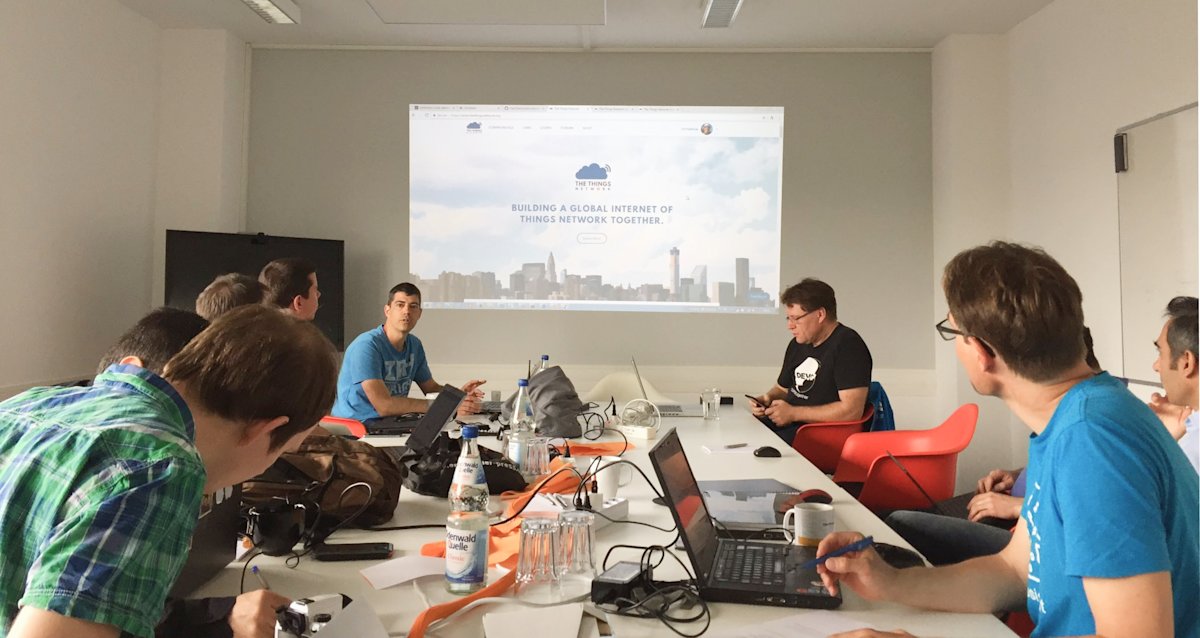
On 9 June 2017, the first workshop of the newly founded “Hack Darmstadt” community took place in Darmstadt.
Hack Darmstadt’s goal is to develop technology solutions — including software and hardware — that respond to the challenges faced by urban regions and cities today. The participants were inspired by the technical infrastructure and the philosophy of “The Things Network”. Based on this, they develop ways of measuring night-time noise or pollution levels. This also draws on the positive parts of the Internet of Things (IoT). We were part of the organizing team and accompanied the first successful Hack Darmstadt event last Friday.
The Things Network (TTN) is something like a grassroots movement within the global IoT community. The TTN manifesto, freely accessible on GitHub, starts with the following passage:
> "Everything that carries power will be connected to Internet eventually. Controlling the network that makes this possible means controlling the world. We believe that this power should not be restricted to a few people, companies or nations. Instead this should be distributed over as many people as possible without the possibility to be taken away by anyone. We therefore founded ‘The Things Network’."
>
> — The Things Network manifesto
In other words, whoever owns the network is in control. To make sure that power over technology and data does not fall into the hands of only a few people, organizations, or governments, the The Things Network Foundation strives to build a decentralized, open-source Internet of Things data network, powered by crowdsourcing: It is driven by the TTN community of the respective city. Instead of WiFi or LTE, projects use a low-bandwidth wireless technology called Low Power Radio Frequency (LoRaWAN). In addition to its low power requirements, this protocol allows devices to be connected to the Internet at low cost and independent of WiFi codes and mobile contracts. Under good conditions, ranges of more than 40 km have been measured. If shorter ranges are needed, Bluetooth 4.2.
## Amsterdam - Honolulu - Darmstadt
It all started in Amsterdam in 2015: Within six weeks, the local IoT community succeeded at developing a city-wide data network based on the TTN approach. Today, the TTN community spans the entire globe from Hawaii to New Zealand. Even in Frankfurt, there was already a small local group — but not yet in Darmstadt. Time to build a community!
Many TTN gateways are located in Zurich. Therefore, it was no coincidence that the hackathon “Make Zurich”, which also inspired “Hack Darmstadt”, took place in Switzerland’s largest city in February 2017. The makers of Make Zurich were also kind enough to provide the organizing team of Hack Darmstadt with a self-built gateway (feel free to have a look here and imitate it). In addition, LoPy-based nodes were used in Darmstadt, and apart from Python, Java was the programming language of choice.
## Blinking LEDs = Sparkling Eyes
After a brief introduction to TTN , LoRaWAN technology, and the IoT protocol MQTT by workshop instructor Matthias Zimmermann (BSI Systems Integration AG), the Hack Darmstadt participants were ready to get their hands dirty. But getting started is not always easy when you are a software developer, and you need to wire the hardware together before you can program it. At least the gateway was already set up. The nodes, however, turned out to be the first entry barrier for some participants. But after about half an hour, everything was all set, so that the hardware could be connected to the TTN backend, and the first LEDs started blinking. Every (visible) success triggered happy shouts of “eureka” in the room. Participants’ motivation increased further after each challenge and culminated in first experiments with light and sound sensors to measure the ambient light and the sound level in real time (see video below). These are the first steps toward collecting relevant data in inner cities Nearly everything has been documented on [Twitter](https://twitter.com/hackdarmstadt). All demos are accessible for free via [GitHub](https://github.com/HackDarmstadt).
## Next Steps
At the end of the day, the workshop participants discussed possible next steps: potential gateway locations in Darmstadt and use cases for the nodes such as measuring air particles, temperature, and noise levels at different locations around the city.
Despite the overwhelming response online and the support of several companies, the (offline) community is still in its infancy and looking for participants and supporters. A follow-up hacking event is planned for later this year. Even a two-day hackathon, as originally planned, is thinkable, provided there are enough registrations. So check back on their Twitter once in a while and stay tuned for more Hack Darmstadt!
---
---
title: Leif Geiger re-elected to lead Bitkom Working Group Software Engineering
date: "2017-05-24T11:00:00.000+02:00"
author: Yatta
collections: [Company blog]
tags: ["Eclipse Foundation ", Press Release, Bitkom, Leadership]
source_url: "https://yatta.de/thoughts/leif-geiger-re-elected-to-lead-wg-software-engineering"
---
# Leif Geiger re-elected to lead Bitkom Working Group Software Engineering
Dr. Leif Geiger, Lead Customer Projects at Yatta, has been confirmed as chairman of Bitkom's working group Software Engineering. Congratulations, Leif!
Last year, the Working Group [first elected Leif](https://www.yatta.de/en/news/bitkom-geiger/) as new the chairman. At the Bitkom meeting in the context of the event DevOps in practice on 23 May, 2017 in Frankfurt, members once more cast their votes in favor of Leif and confirmed him in the role of working group chairman.
Yatta has been an active Bitkom member since 2011. As an innovative company that promotes first-class software technology "made in Germany", we are particularly committed to the field of software engineering. This is highlighted by our active participation in the corresponding Bitkom working group: Leif’s predecessor as chairman, Dr. Christian Schneider, is also a Yatta founder and shareholder.
[Bitkom](https://www.bitkom.org/) is the association of the German information and telecommunication industry whose goal is to create ideal conditions for companies in the industry. The Working Group Software Engineering advocates excellent software engineering.
## About Leif Geiger
Dr. Leif Geiger is co-founder and shareholder of Yatta. He holds a PhD in Software Engineering and is responsible for customer projects. As a technical expert, Leif brings more than 11 years of experience as a software architect and engineer to the position. Leif is married and a passionate mountain biker. Sometimes he even takes his son along in his bike trailer.
---
---
title: Leif Geiger elected Package Maintainer of Eclipse IDE for Java Developers by the Eclipse Packaging Project
date: "2021-04-13T10:00:00.000+02:00"
author: Yatta
collections: [Company blog]
tags: [Eclipse Foundation, Open Source, Leadership, Press Release]
source_url: "https://yatta.de/thoughts/leif-geiger-elected-package-maintainer-of-eclipse-ide-for-java-developers"
---
# Leif Geiger elected Package Maintainer of Eclipse IDE for Java Developers by the Eclipse Packaging Project
On 13 April 2021, Yatta co-founder Dr. Leif Geiger was elected package maintainer of the Eclipse IDE for Java developers. Leif follows Red Hat’s Aleksandar Kurtakov, who will focus on other Eclipse projects and so was looking for a successor to take over the responsibilities of this position.
Leif is a seasoned tool developer and open-source committer, as well as Project Lead of the [Eclipse Marketplace Client (MPC) project](https://projects.eclipse.org/projects/technology.packaging.mpc). Speaking about his new position, Leif said,
> “Providing stable packages is crucial for the success of the open-source [Eclipse IDE](https://www.eclipse.org/eclipseide/). I am honored to have the opportunity to maintain one of the most used Eclipse packages. My plan is to work towards the best possible Java IDE that has integrations with the tools Java developers need to make their lives easier.”
With more than 400,000 monthly downloads, the Eclipse IDE for Java developers is the most downloaded Eclipse IDE package. It includes Java language support, tools for refactoring and debugging, and other Java development essentials such as Git, Maven and Gradle.
To ensure he can fulfill his responsibilities as Eclipse Package Maintainer and Eclipse MPC Project Lead, Leif is supported by his team of fellow software engineers. At Yatta, we have been Contributing Members of the [Eclipse Foundation](https://www.eclipse.org/) since 2011 and with this appointment we are increasing our engagement even more. Our vision is to significantly improve the Eclipse IDE, especially the UI and UX, so that developers can still rely on a vendor-neutral and open-source IDE to develop software.
## About Leif Geiger
Next to his open-source activities, Leif is also co-founder and shareholder of Yatta. With a PhD in Software Engineering, he is Product Manager on the Yatta platform team where he orchestrates tools that have thousands of users. A technical expert, Leif brings more than 11 years of experience as a software architect and engineer to the position. Leif is married, a proud father and passionate mountain biker, preferring climbing over downhill.
---
---
title: "Welcome, Freddy! – Frederic Ebelshäuser is now a new Yatta shareholder"
date: "2016-09-15T17:00:00.000+02:00"
author: Yatta
collections: [Company blog]
tags: [Co-founders, Leadership, Press Release]
source_url: "https://yatta.de/thoughts/welcome-frederic"
---
# Welcome, Freddy! – Frederic Ebelshäuser is now a new Yatta shareholder
We are proud to announce that Frederic Ebelshäuser has decided to invest in Yatta and become a shareholder of our company.
In the last few years, Freddy has become a vital part of the Yatta developer team. As project lead of Yatta Profiles for Eclipse, Freddy has committed himself to making the Eclipse IDE more accessible and easier to use for software developers worldwide.
Freddy is a dedicated Eclipse Committer and a well-known speaker at international software engineering conferences. We are happy that Freddy has decided to signal and deepen his personal involvement and his commitment with his investment in Yatta’s future!
> “As entrepreneurs and founders, we continue acting like a very agile startup. To stay successful, we always strive to evolve and innovate. So involving the best people as much as possible is essential. The number of Yatta shareholders is not set in stone. In cooperation with our financial investors, we are always looking for strategic opportunities to achieve our vision of improving software engineering.”
>
> — Johannes Jacop, CEO of Yatta
## About Frederic Ebelshäuser
Frederic Ebelshäuser is a project lead & software engineer at Yatta. Before that, he used to be a consultant, developing ecommerce solutions across many business sectors. Today Frederic is successfully leading the developer teams behind software solutions like Yatta Profiles for Eclipse and an integrated sales and license management platform for Eclipse Tools. Additionally, he actively participates in the Eclipse community, including as a speaker.
---
---
title: Yatta receives “ICT Start-Up of the Year” award
date: "2011-06-10T00:00:00.000+02:00"
author: Yatta
collections: [Company blog]
tags: [ICT Start-Up of the Year, Awards, Press Release]
source_url: "https://yatta.de/thoughts/yatta-receives-ict-start-up-of-the-year-award"
---
# Yatta receives “ICT Start-Up of the Year” award
Berlin, 20 June 2011 – "Yatta!" Federal Minister of Economics and Technology Philipp Rösler awarded the German software and consulting company Yatta Solutions the title of most successful start-up in information and communication technologies (ICT) of the year. “The winners represent the creativity, capability and prospects of young ICT companies in Germany”, said Federal Minister Rösler.
Claus Fesel, member of the jury and Director Marketing at DATEV eG, added: "Yatta was chosen by the jury because the company showed the highest degree of technical innovation among all nominees. Moreover, their product [UML Lab](https://www.uml-lab.com/) addresses a central problem of software engineering and shows substantial economic potential.” This fits the idea behind the company’s name. "Yatta" is Japanese and means: "We did it!"
"We are thrilled about the award and want to thank everyone who has helped us to make this success possible – especially our team," said Johannes Jacop, managing director and co-founder of Yatta Solutions. The company will continue developing leading tools, technologies, and techniques to bolster efficiency in software development and is going to invest the prize money of 25,000 EUR in additional research and development.
Federal Minister Rösler is sure that:
> "Modern information and communication technologies are central for our business location. They are instrumental in creating innovative products and services in most industries."
>
> — Philipp Rösler, Federal Minister of Economics and Technology
Yatta Solutions is sure to play its part in this process.
## Further Information
[Pictures by Wolfgang Borrs](http://www.borrs.de/)
The images from our press release are also available in print quality from [press@yatta.de](mailto:press@yatta.de).
---
---
title: Hello Checkout – A tool to sell any digital product B2B
date: "2022-10-13T18:00:00.000+02:00"
author: Yatta
collections: [Product news]
tags: [Platform, Launch, Sales]
source_url: "https://yatta.de/thoughts/hello-checkout"
---
# Hello Checkout – A tool to sell any digital product B2B
Today we're launching our new product: Yatta Checkout. Discover what it is, why we built it and who it's for in this article.
## Why we built Yatta Checkout
Selling digital products comes with many challenges, especially for the new or uninitiated.
As a developer tool startup, we struggled for years with marketing and selling our product profitably. Negotiations with payment providers, manual invoicing and subscription management processes, as well as updating our EULAs following legislative changes—and internationalization—were costly, and we were losing focus on our core business of building great tools.
Wondering why there wasn’t a convenient ecommerce solution for businesses like us, we decided to build it. After all, we had plenty of experience navigating these murky waters.
That’s how [Yatta Checkout](https://www.yatta.de/checkout) was born.
## What is Yatta Checkout?
Yatta Checkout is an all-in-one checkout solution, designed to simplify the process of monetizing and selling digital products:
- It can be embedded into your website (or in the Eclipse IDE if you’re [selling developer tools](https://www.yatta.de/checkout-for-eclipse)) right out of the box.
- One-time-purchase and subscription models are supported, as are free trials and more.
- Technical and legal license frameworks allow you to build standard license models with ease—comprehensive international EULA are included.
- Integrated payment processing eliminates the need to negotiate with (or integrate) third-party providers.
- Fully automated invoicing and billing adapted to your corporate design saves time and ensures a professional appearance.
- Identity and access management (IAM) for your users and enterprise customers ensure a smooth experience across the whole customer journey.
## When should you choose Yatta Checkout?
When you’re a vendor of a digital product and want a solution that combines all of the above features in one fairly priced and easy-to-integrate package.
There are many separate providers for each of the individual features of Yatta Checkout. But doing that will mean you spend a lot of time integrating different shop, billing and IAM solutions, negotiating with payment providers, and discussing licenses and legal agreements with (costly) lawyers.
By choosing Yatta Checkout, you get all these things out of the box, giving you the bandwidth to do what you do best: build great products. Meanwhile, the reduced friction in your purchase funnel means you can optimize your conversions from free trials to paying customers, all while lowering customer acquisition costs.
Additionally, selling digital products immediately puts you on the global stage, which can be challenging for a small team, especially when it comes to different currencies and tax rates. Yatta Checkout’s payment processing accepts all major payment methods and currencies, and supports you with automated sales tax calculation.
And you get the whole package for zero upfront costs.
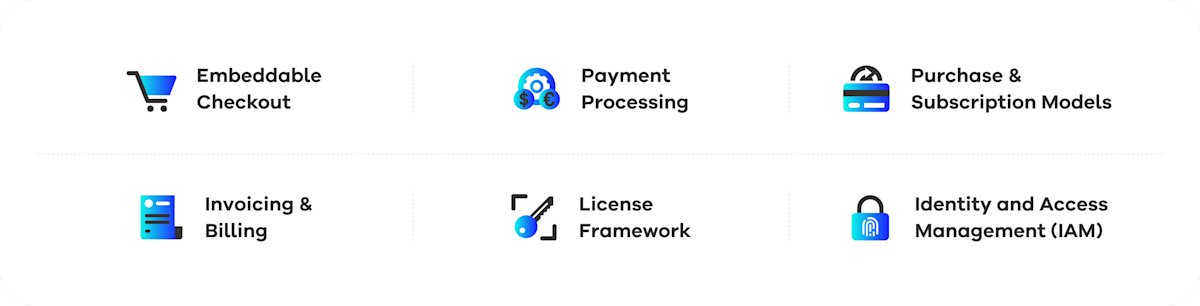
Yatta Checkout is pay per transaction, with no monthly charges or hidden fees. We chose this pricing model because we believe that we should not earn a cent unless you do.
We built Yatta Checkout for companies like us—and we want to enable as many startups, developer tools and other digital products as possible to become success stories.
## What others say about the Checkout
> “Anything that helps to bring more successful products and businesses into the Eclipse ecosystem is great! Yatta Checkout is an efficient way to promote and collect in-app payments for Eclipse-based products.”
>
> — Mike Milinkovich, Executive Director, Eclipse Foundation
> “A lot of people have been waiting for this. This may very well be a game changer. I'm planning to use this to sell some of my own tools.”
>
> — Torkild Resheim, Senior Software Engineer and co-owner, Itema AS
## Read our success story
When we migrated our own software tool [UML Lab](https://www.uml-lab.com) to Yatta Checkout, we saw sales revenues increase by 10.6x. [Read the case study here](https://www.yatta.de/thoughts/yatta-checkout-case-study).
---
---
title: "Thoughts on transformation, part 2 – Struggles of the transformers"
date: "2023-01-10T14:00:00.000+01:00"
author: Yatta
collections: [Knowledge, Technology]
tags: [Digital Transformation, Digital Economy, Software, Software Development, Disruptive Innovation]
source_url: "https://yatta.de/thoughts/thoughts-on-transformation-part-2"
---
# Thoughts on transformation, part 2 – Struggles of the transformers
_In a series of articles, we will look at the market for software development and IT service providers. In _[_part 1, ‘Software companies on the rise’_](https://www.yatta.de/thoughts/thoughts-on-transformation-part-1 "Software companies on the rise)_, we examined how software has impacted market economics and why, as a result, all companies are transforming into software companies. In this second part, we will focus on the challenges facing enterprises during this transition._
The massive growth and valuations of tech companies seem to indicate that funding new market entrants is—at least in terms of capital allocation—more successful than transforming established market leaders. But why is adapting an existing business less effective than building a new one from the ground up? Why do native software companies outpace their transforming competitors so consistently?
We believe this is due to two factors:
The first is a deep, structural misunderstanding of how software development creates (shareholder) value. Below, we will show how software engineering works entirely differently than goods manufacturing or providing personal services, because software is _not_ a commodity.
The second is buried deeply in the organizational nature of the transforming companies and commonly referred to as the “innovator’s dilemma.” Coined by Harvard professor and businessman Clayton Christensen, the expression describes how successful companies can do everything “right” but still lose market leadership—and even fail—as new and unexpected competition dominates the market.
To understand how to face these two issues head on, we must dive deeper.
## Software development is no commodity
A look at the dynamics of transforming companies shows it’s not a lack of resources that causes them to be left behind. Most companies have recognized and acknowledge that they have to invest in their digital transformation.
One of the most straightforward indicators of this investment is initiatives to ramp up their software departments, including the hiring of thousands of software developers. Take the German automotive industry, for example.
Volkswagen announced in early 2021 that it wants to [boost its digital team to 10,000 developers by 2025](https://thestack.technology/vw-software-big-tech/). To achieve this end, Volkswagen has founded its own coding school and is [retraining former assembly-line workers as software developers](https://www.dw.com/en/vw-guns-for-tesla-with-homegrown-software-developers/a-60768832). Likewise, Mercedes-Benz has the target of [10,000 developers](https://www.handelsblatt.com/unternehmen/industrie/digitale-offensive-mercedes-stellt-3000-softwareentwickler-ein/28239734.html#:~:text=Inklusive%20der%20Neueinstellungen%20wolle%20Mercedes,rund%2010%20000%20Softwarespezialisten%20kommen) in its sights after creating 3,000 new jobs in the field of software development in 2022. The goal is to launch the [Mercedes-Benz Operating System (MB.OS)](https://group.mercedes-benz.com/careers/about-us/mercedes-benz-operating-system/), a “data-driven and flexibly updatable operating system, starting [in] 2024.”
Transforming companies in the automotive sector have improved their approaches to software engineering and are recruiting developers as part of a long-term vision to produce better results. And judging by the above figures, there’s no denying the fact that they’re willing to spend the money necessary to effect their transformation. And yet, as we discussed [in the previous article in this series](https://www.yatta.de/thoughts/thoughts-on-transformation-part-1), despite this fact — and despite recent losses in its share value — relative newcomer Tesla is still valued by the capital markets as being worth more than all the German automotive OEMs together.
## More isn’t necessarily more
So the problem is neither personnel nor investment in software, but the perception of software (at least as indicated by the capital markets). And that’s not limited to the automotive industry: In many companies that shift their traditionally analogous business models towards tech, software is often considered to be (and therefore treated as) a mere commodity. Consequently, software production processes are structured like the manufacturing of material goods.
This way of thinking suggests there is a direct correlation between quantity of input (e.g., lines of code, number of features implemented, or hours spent working on the product) and the size and quality of the end product. The general assumption is that more hours result in more product or service and will thus lower costs per unit—in this case, lower costs per work hour or line of code—and increase profits.
This assumption is true for the production of material goods. But it’s fundamentally wrong when applied to the development of software products, solutions, or services, as these are all different from producing a T-shirt, or a jet engine.

The manufacturing of material goods usually starts with a prototype. The goal of the manufacturing process then becomes to replicate this original as closely and efficiently as possible. Whether this replication process is simple or highly complex: its primary goal is to minimize deviation from the prototype. Each copy can be compared to the original or another copy. Any faults and deviations that exist are “tangible”—they can be empirically verified and corrected. The output (i.e., number and quality of units produced) can be clearly and objectively measured and is also reflected in the company’s year-end balance sheet because these are (tradeable) commodity goods.
## The uniqueness of software
Every software build is a unique arrangement of code, created in particular ways and for specific purposes. Its effectiveness cannot be measured or quantified with a universal value. Instead, good software fulfills the purpose for which it was developed; it is “beneficial”.
And _this_ benefit is valued, not the lines of code.
This fact has a few implications that must be considered when building software:
- First: In a software development process, prototypes are (solely) built and required to monitor the process and serve as landmarks while the product is created. There is no “final” prototype that serves as a template at the beginning of the process. Instead, various protypes, drafts and layouts, experiments and builds must be produced, and each prototype indicates the viability of the current direction—and whether course correction is necessary.
- Second: Software development is about exploring possibilities and new ways of dealing with a problem. That requires the freedom to be creative and to consciously re-evaluate and deviate from earlier approaches to similar problems. While an assembly line requires strict instructions and foremen, software development projects need guidance and leadership.
- Third (and maybe most important): Software development processes need to be managed and monitored differently than traditional production processes: Traditional monitoring allocates resources (such as staff or funds) to cost and profit centers. Only profit centers are expected to contribute to the company’s income. That means they optimize for higher production, increased sales revenues, or more profits through cost-reduction. They follow a _pre-determined_ and necessarily a pre-validated chain of value creation. Accordingly, transforming companies too often aim for more lines of code, more features, or for more development time per dollar spent. They assume this represents value.
Startups (and native software companies) on the other hand work purely based on the maximum principle: With a given budget, they do anything reasonably possible to achieve the best result (for their investors or shareholders). They focus on numbers, too—but they target action metrics: successfully lowered user acquisition costs rather than a slight increase in sales, higher customer lifetime value through lower churn rates rather than upselling, and foreseeable profitable growth rather than short-term profits. They value the future value (and thus the ability to maximize value creation) far more than the actual profits. Because native software businesses know: The value of each unit has not (yet) been determined.
## Transforming companies’ dilemma
The other factor that blocks the success of software development processes in transforming companies is their (limited) openness to novelties and innovation.
Transforming companies often have intimate knowledge of established trends. They have an existing successful, often dominating, position in their market. This is based on a product that they continually try to optimize based on the feedback of customers and predictive market analysis. To adapt the terms coined by Clayton Christensen, author of The Innovator’s Dilemma: Transforming companies engage in _sustaining innovation_ with the goal of maintaining existing business success and to extend it along familiar and predictable pathways.
In contrast, native software companies begin and maintain their growth by engaging in _disruptive innovation_. They identify niche markets that current market analytics deem not profitable or too risky and expand from there. Their processes are thus optimized for fast responses to and quick shifts in interest in various market niches.
As a consequence, native software companies have a vastly different approach to development. When producing material goods, deviation is a problem; but for software products, it may be the key to conquering a new market. In 2017, Mark Zuckerberg said in an interview, [“At any given point in time, there isn’t just one version of Facebook running, there are probably 10,000.”](https://mastersofscale.com/mark-zuckerberg-imperfect-is-perfect/) And as Meta explores AR, VR and the metaverse, it’s clear this spirit of experimentation is still alive.
For manufacturers, deviation must be eliminated—or at least reduced though strict enforcement of standards and continuity. For native software companies the never-ending search for product-market fit, for the next big thing, is at the very core of their existence—and this is not measured in units or percentage of completion. A single “killer feature” may help you reach product-market fit and enable you to outperform all your competitors; it is far more valuable than any set of mediocre features.
With this in mind, Amazon President and CEO Andy Jassy wrote in his [2021 letter to shareholders](https://s2.q4cdn.com/299287126/files/doc_financials/2022/ar/2021-Shareholder-Letter.pdf):
> “In every business we pursue, we’re constantly experimenting and inventing. We’re divinely discontented with customer experiences, whether they’re our own or not. We believe these customer experiences can always be better, and we strive to make customers’ lives better and easier every day.”
>
> — Andy Jassy, Amazon President & CEO
For native software companies, it is this willingness to listen to feedback while continuing to innovate that can turn a short-term leap of faith into long-term value—and ultimately success.
---
---
title: "Thoughts on transformation, part 1 – Software companies on the rise"
date: "2022-10-06T13:37:00.000+02:00"
author: Yatta
collections: [Knowledge, Technology]
tags: [Digital Transformation, Digital Economy, Software]
source_url: "https://yatta.de/thoughts/thoughts-on-transformation-part-1"
---
# Thoughts on transformation, part 1 – Software companies on the rise
_In a series of articles, we will look at the market for software development and IT service providers. The series will consist of four parts and start with this article focusing on the increasing relevance of software for all businesses. If you are tech-savvy, you might start with the next article._
Software-driven tech companies dominate the global economy.
In 1996, the world’s top five publicly traded companies in terms of market capitalization were General Electric, Shell, Coca Cola, NTT and Exxon Mobile. Today’s top five are Apple, Saudi Aramco, Microsoft, Alphabet and Amazon. Exxon Mobile is the only of the former big players that still has a place in today’s top 25 (rank 13). Despite that, Exxon was forced to leave the prestigious Dow Jones Industrial in 2020 (after 92 years) because the index wanted to reflect the current market situation and developments more accurately. And who took Exxon’s empty spot? SaaS company [Salesforce](https://www.cnbc.com/2020/08/25/exxon-mobil-replaced-by-a-software-stock-after-92-years-in-the-dow-is-a-sign-of-the-times.html).
In addition to “native” software companies (such as Apple, Alphabet and Microsoft) whose main growth drivers have always been software and tech, enterprises in formerly analog industries like retail, transportation or healthcare are gradually becoming software companies as well. From smooth online stores to fully automated assembly lines and AI-supported algorithms that calculate risk exposure for health insurers—today’s business models rely heavily on their operating software: their outputs and results improve with the improvement of their software.
Accepting these realities and digitizing tried-and-tested business models rapidly and effectively is decisive for a company’s fate today. That’s why the former DVD rental company Netflix became the go-to platform for video streaming, while Blockbuster (just like your local video rental store) is out of business.
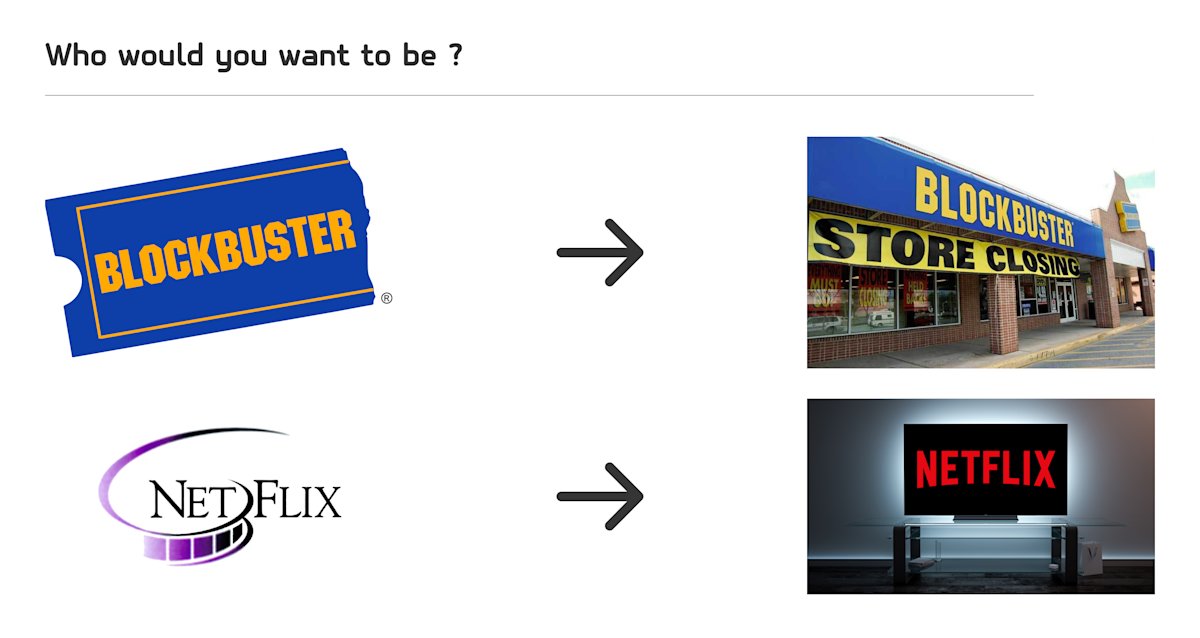
## Reshaping market segments...
The taxi industry is over a century old, but it took the newcomer Uber to revolutionize it in 2009. Amazon was founded in 1994, the year in which Barnes & Noble celebrated its 110th anniversary. And when the iPhone was introduced in 2007, Nokia had already been selling cellphones for two decades.
Today, some of the most innovative and fastest growing fields of business are dominated by comparatively young software and tech companies. But on reflection, that seems somewhat surprising: Shouldn’t the pole position be held by the established players with their comprehensive knowledge of the market they have dominated for decades? This is even more true when you consider that these market leaders often have the deepest pockets for funding promising ventures and innovation. Still, former top dogs are pushed quickly into challenger roles where they must change quickly and to their very core—they become transforming companies.
A look at the market for electric vehicles (EVs) makes these dynamics evident.
For decades, the car market was dominated by long-standing giants. In 2020, the largest car manufacturers were Volkswagen (10.71 million units), Toyota (10.55 million units), GM (7.72 million units) and Hyundai (7.24 million units)([source](https://app.handelsblatt.com/mobilitaet/motor/ranking-vw-vor-toyota-das-sind-die-groessten-autohersteller-der-welt/25560670.html)). As market leaders, they should have been in the best position to open up the emerging and innovative EV market.
But they didn’t.
Tesla currently has a larger market share than any other EV manufacturer, selling 565,000 cars in the first two quarters of 2022. In the same period, GM sold roughly 250,000, the Volkswagen Group (including Audi and Porsche) slightly above 200,000 EVs and Hyundai slightly below ([source](https://insideevs.com/news/580346/who-sells-most-electric-cars-2022q1/)). Toyota, who was the undisputed king of hybrid cars for 25 years is still a dwarf in the EV market, with around 10,000 sold units.
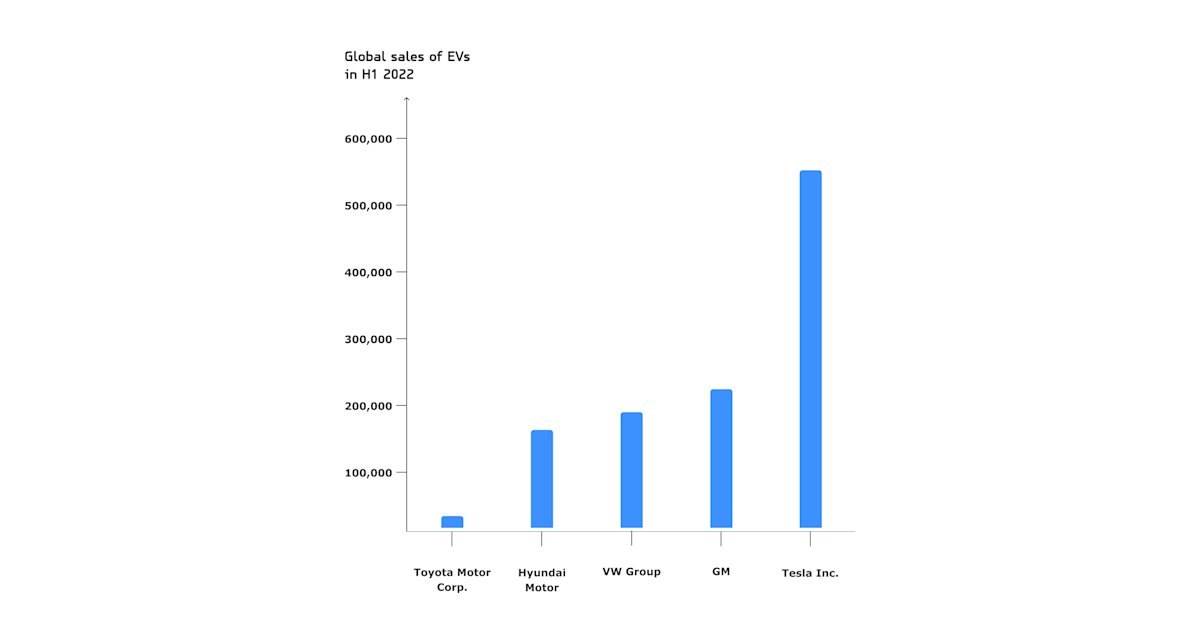
The market capitalization of the above companies reflects these developments, with Tesla (roughly 750 billion USD) being worth almost twice as much as Toyota (220 billion USD), VW (81 billion USD), GM (51 billion USD) and Hyundai (31 billion USD) combined.
## ...and entire industries
The effects of this global shift towards software and tech extend far beyond the increased market caps of software companies and the change of forces in individual market segments; tech startups have also completely reshaped once-established industries.
Take the music industry for example. Streaming services like Spotify and Apple Music captured an enormous market share in a short time and steered the entire music recording market towards growth by revolutionizing the way we consume audio content.
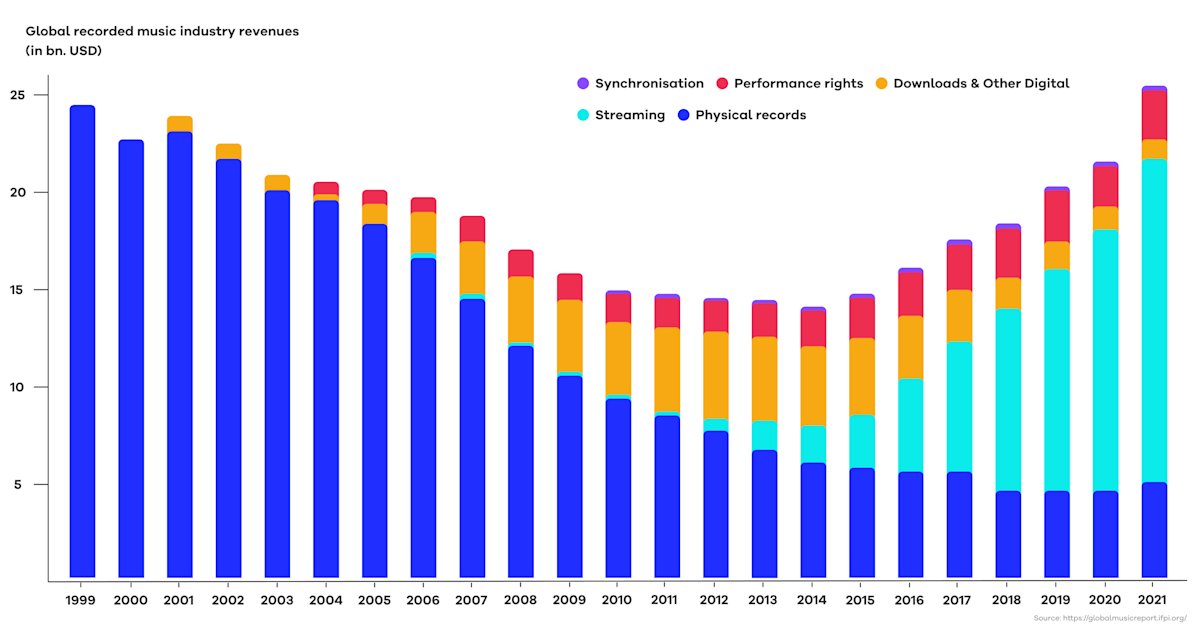
This reshaping of markets by software is not limited to consumer behavior either. Digital platforms like YouTube, TikTok, Twitch—and even Uber—support fans, creators and the entrepreneurially minded in offering their own content, products or services. At the same time, digital marketplaces and online distribution channels like Shopify, the App Store, Amazon and Steam enable small- and medium-sized companies—or even individuals—to reach a global audience. They thus facilitate the growth of the creator and platform economy, allowing people to monetize their assets, skills and hobbies (while multiplying their platform’s growth). This blurs the lines between “producers” and “consumers” and eliminates the market advantages of established companies over startups and other market participants.
Software has transformed one of the fundamental principles of the market and illustrated the extent to which our economy has already become digitalized.
And there is no reason to believe this trend will reverse or even slow down. Consequently, it's no longer a question of if a given company will be a software company. But whether they can adapt to this new reality fast enough to survive.
Because in the future, all relevant companies will be software companies.
_In part 2 of our series, we will look at the struggles of enterprises transforming into software companies – stay tuned!_
---
---
title: How Apple could disrupt the automotive industry within a decade
date: "2023-06-13T13:00:00.000+01:00"
author: Chris Stewart
collections: [Knowledge, Technology]
tags: [Digital Transformation, Disruption, Digital Economy, Autonomous Vehicles]
source_url: "https://yatta.de/thoughts/how-apple-could-disrupt-the-automotive-industry-within-a-decade"
---
# How Apple could disrupt the automotive industry within a decade
Since Karl Benz started production of the first car with an internal combustion engine in 1886, Germany has played a central role in automotive history. That was then, however, and as the pace of innovation accelerates, the future for leading German car manufacturers becomes uncertain. With electric and autonomous vehicles, aspects such as software and user experience become important differentiators. Are BMW, Mercedes Benz (formerly Daimler) and the VW Group prepared to go head-to-head in this arena with new challengers such as Tesla, Polestar, Build Your Dreams (BYD) and perhaps Apple?
### The German automotive industry
In Germany, 7.2% of all employees work in the automotive sector; 892,000 people are employed directly, 1.6 million indirectly, and a further 680,000 work in induced positions.
In 2022 automobiles and automobile parts constituted 15.6% of all German exports (more than 245 billion EUR) and became Germany’s most exported goods. In the same year, over 2.6 million German cars were sold within Germany, and another 2.6 million were exported worldwide.
Mercedes Benz, BMW, and the VW Group make up the majority of these figures: Mercedes Benz’s revenue was [150 billion EUR in 2022](https://www.daimler.com/investors/reports-news/annual-reports/2020/), BMW clocked [23.51 billion EUR,](https://www.bmwgroup.com/de/investor-relations/unternehmensberichte.html) and the VW Group (with its 12 brands) turned over [279.2 billion EUR.](https://annualreport2022.volkswagenag.com/) In terms of net profits, they made 20.5 billion, 18.6 billion, and 15.8 billion EUR respectively, and together they account for round about 10% of the [DAX](https://qontigo.com/products/dax-de/)-listed companies’ market capitalization.
### No way around electric vehicles
In recent years, Tesla’s arrival prompted many companies, managers, and stock market investors to predict dramatic disruption in the automotive sector. In response to this change in the market, German car manufacturers added several electric vehicles to their product fleets. According to the German magazine “Auto Motor und Sport”, 14,506 units of the electric brands of BMW, Mercedes Benz, and VW were first registered with the German Bundeskraftfahramt in December 2022. So, the German electric car industry is gaining steam. But they have a lot to lose if an unexpected player pulls the rug out from beneath their feet…
## Troublemaker from overseas
The most popular electric car brand today is Tesla, in particular the Model 3, of which 9,566 units were first registered in December 2022. But while the focus remains on Elon Musk’s brand and uprising Chinese e-car manufacturers, the biggest potential threat to the German automotive and mobility industry could be Apple.
### Tim Cook’s motivation
A 2.5 trillion USD company, [in 2022 Apple made 394 billion USD in revenue, ](https://investor.apple.com/investor-relations/default.aspx)slightly more than half of which came from iPhone sales with 205.5 billion USD. Its average margins are 36.3% on products and 71.7% on services. It has declared 94 billion USD in profit every year for the last two years—a doubling of the 57 billion in profits declared in Q4 2020). Apple's total assets in the fourth quarter of 2022 ran to 352.8 billion USD. In the second quarter of 2023, Apple declared 112.9 billion USD in current assets and 332.2 billion USD in total assets.
> “We love to integrate hardware, software, and services, and find the intersection points of those because we think that’s where the magic occurs. And so that’s what we love to do. And we love to own the primary technology that’s around that.”
>
> — Tim Cook, The New York Times "Sway podcast", April 2021
If Apple wants to grow into a 4 or 6 trillion USD company, it needs to reach beyond its existing markets into areas that offer the opportunity to significantly increase its value. And Apple already has a lot of experience manufacturing products on a global scale, using contractors while ensuring high quality gets delivered. With the right contractor(s), an Apple car would fit right into its global supply chain. Apple also has other advantages over companies like Volkswagen, BMW, and Daimler: a huge user base plus experience in software development and user experience (UX) design.
Furthermore, Foxconn, one of Apple’s largest suppliers, announced it is ready to start producing electric vehicles in October 2022.
### Premium brand with large market share
With Apple’s strong premium brand, it can ask customers to pay premium prices. An Apple car would reflect the brand philosophy, ensuring it resonates with the expectation of customers in a position to buy one, and justifying a premium price tag.
Apple customers are not just those with large disposable incomes. Many are willing to make compromises so they can buy an Apple product. An Apple car would likely also have a slightly broader appeal than that of another brand. Unusually for such a premium brand, Apple has a rather large market share; for example, 30.6% of worldwide smartphone sales (as of April 2023).
## Current state of competition
The market leader in terms of automobile sales is Toyota with a global market share of 11.4% in the first quarter of 2023, followed by the Volkswagen brand with 6.2%. The highest market share of all electric vehicle manufacturers is held by Chinese manufacturer BYD, currently at rank 7 of the top 10 car manufacturers worldwide, due to an increase of 82.5% in sales in 2022. Tesla’s global market share is expected to reach 5% in 2023.
Apple’s operating margins reached 30.2% as of 1 June, 2023, whereas Toyota reported 6.8% from April to June 2023 after 12.2% in 2022. The Volkswagen Group reported 7.89% in 2022, and Tesla reported 17.2% in the same year. One of Apple’s main focuses would be on getting the best margins from its car sales.
### Tough market for newcomers
In Germany on 1 January 2023, there were 48.8 million cars on the road, and the average car was 10 years old. Of the 2.65 million new cars registered in 2022, 1.37 million are from German brands. After a decade on the market, Tesla accounts for just 118,803 cars on German roads (or 0.2%). By April 2023, 11,636 Tesla Model Ys had made it onto German roads.
For a more global comparison, the average car in the EU is 12 years old and 13.1 years old in the US. Of the 57.5 million cars sold worldwide in 2022, 13.1 million were sold by German brands and 499,550 were sold by Tesla.
Overcoming this inertia and domination by domestic brands is just one of the challenges facing newcomers to the automotive market in Germany and the world. Therefore, it will not be easy for Apple…
### Disrupting mobility industries
So, how would Apple enter this difficult market and overcome these obstacles? The key to a real disruption would be level 5 self-driving technology.
[Level 5 autonomous driving technology](https://web.archive.org/web/20180701034327/https://cdn.oemoffhighway.com/files/base/acbm/ooh/document/2016/03/automated_driving.pdf) was initially viewed and promoted as the prerequisite for Apple to enter the automotive industry. Indeed, if Apple were to be the first to develop this technology, it would make car use a lot more efficient than it is now.
The average car is parked for 96% of its life. And even when you drive your car, you need to find somewhere to park it, which can be stressful, time-consuming, and expensive in cities or residential areas. Autonomous vehicles would all but eliminate these issues.
> “There is a major disruption looming there. Not only for self-driving cars, but also electrification […] plus, you have ride sharing on top of this. And so, you’ve got three vectors of change happening generally in the same time frame.”
>
> — Tim Cook, Bloomberg "Studio 1.0", June 2017
According to Tim Cook, Apple has self-driving cars on its radar. Cook also mentions electrification and ride-sharing. We believe Apple ultimately intends to build a prosumer platform with electric, self-driving vehicles around the concept of sharing.
### Step back from autonomous driving
Recent reports on “Project Titan”—the codename for the Apple Car—indicate however, that Apple has currently taken a step back from autonomously driving cars. By the end of 2022, “MacRumors” reported, Apple is currently aiming for a car that “will be able to use an autonomous mode on highways, but manual driving will be required in other areas.”
Therefore, the Apple Car could be an electric vehicle with self-driving capabilities (and eventually autonomous driving) sold at a premium price to willing buyers.
__Update:__ In the meantime, [Bloomberg](https://www.bloomberg.com/news/newsletters/2024-03-03/why-was-apple-car-canceled-the-hubris-in-apple-thinking-it-could-outdo-tesla-ltbke5ut) has published several articles suggesting that Apple has at least postponed its plans for an Apple Car for the time being. However, we still think an Apple Car makes sense. However, it may be that the time for a fully autonomous vehicle (as presumed here) has not yet come—and that other priorities ([esp. LLMs](https://www.apple.com/newsroom/2024/06/introducing-apple-intelligence-for-iphone-ipad-and-mac/ "Apple press release introducing Apple Intelligence")) have now taken over.
### The future lies in a sharing economy
In addition to offering the Apple Car for sale, Apple could offer an Apple Car ride-sharing service. Currently, the largest player in the ride-sharing market is Uber; but with 7.6 billion trips worldwide and 131 million active users in 2022 it is still unprofitable. However, autonomous vehicles would enable Apple to achieve the same coverage as Uber with fewer vehicles and without needing to share their revenue with the drivers.
Furthermore, Apple’s long-term aim would be to have enough service cars to eliminate wait times, ensuring maximum convenience for users. This would make it a viable long-term alternative to owning a vehicle, and many would use Apple’s service instead of more expensive or more uncomfortable alternatives such as public transport.
Initially, Apple would launch the car service in a select group of cities; likely more expensive locations such as London, Munich, New York, and Singapore. That, combined with the service being iOS exclusive, would likely create a lot of interest and hype around the Apple Car.
Most car manufacturers would struggle to finance such a fleet, but Apple could leverage some of its cash and cash-equivalent assets to get the first vehicles on the road.
> "People don't know what they want until you show it to them. That's why I never rely on market research. Our task is to read things that are not yet on the page.”
>
> — Steve Jobs, The Exclusive Biography, February 2015
To bridge the gap between owning a car and using a ride-sharing service, owners could share their vehicles with Apple’s service. So, after your Apple Car drops you off at work, it could take your partner to their dentist’s appointment, drop your children at school, or pick up grandma to go visit with friends. This way, your car could also be used to make you some money or Apple credit when it would otherwise be parked, and still have time to recharge and be waiting for you when you want to go home.
Apple Cars would therefore combine Apple products and services, much like the iPhone and App Store already do today. Apple Car owners would become prosumers, leveraging the sharing economy logic of companies like Airbnb but for the automotive and mobility sectors. A sharing economy would just be the start for Apple; it could build new business models like Apple-maintained company fleets, or company accounts to allow team members to travel for free.
While not all owners would want to share their cars, enough would participate to make the service work. These customers would contribute their own cars as assets to the Apple Car community, fueling a mobility revolution and helping Apple completely change the way we get from A to B.
## How Apple attracts users
The main challenge, then, would be convincing people to invest in the Apple Car either as buyers or regular users of the ride-sharing service.
### Competitive advantage
Apple’s biggest advantage is its massive user base, supported by its strong brand. Few can compete with Apple on this front. Most of the 1 billion iPhones in circulation already have an Apple account with payment credentials set up. Any other automotive competitor would have to spend a lot of resources on user acquisition before they could even begin to roll out autonomous vehicles, while Apple can put its service in the hands of one in every ten people on earth at the push of a button.
Another big differentiator is Apple’s extensive experience in software design. In a vehicle where the driving experience takes a back seat to the interface and overall experience, software is the battlefield upon which the market leader for autonomous vehicles will be decided.
Additionally, so much of our lives now happens through the lens of our smartphones that being able to integrate phone functionality seamlessly into a car would be a powerful enough reason to make Apple users choose the Apple Car over any other model. There is a reason why over 800 car models now come with [Apple Car Play](https://www.apple.com/ios/carplay/available-models/) and over 500 with [Android Auto;](https://www.android.com/intl/en_uk/auto/compatibility/#compatibility-vehicles) people want to extend their phones’ capabilities into their cars. But even if the current leading automotive brands are working on their best in-car software ever, they must bridge and surpass Apple’s four decades’ worth of experience in consumer software.
Indeed, Apple’s presentation of their integrated Car Play functionality, which takes control of all the displays and gauges in a car at WWDC 2022 was widely seen as a preview of Apple Car functionalities.
### Getting the price right
With the Apple Car a pleasure to ride in, the pricing of the ride-sharing service is the other key aspect. In Germany, the average cost per kilometer (km) of driving and owning a Mercedes S-Class is 1.47 EUR/km, referring to "ADAC-Autokosten-Rechner". For a Mercedes Benz E-Class, the cost is approximately 0.97 EUR/km. Taxis in Germany cost on average 2.05 EUR/km, making them twice as expensive as owning an E-Class.
Apple’s car sharing service would probably target an average price per km somewhere between the cost of owning a car and the cost of taking a taxi: 1.50 EUR/km, for example.
The cost of production for these cars would probably be offset over time against the price per km. We estimate this would cost 0.75 EUR/km, leaving the other 0.75 EUR/km as profit. Apple could offer car owners who share with the service 0.60 EUR/km to help cover service-related depreciation and maintenance, retaining 0.90 EUR/km as profit.
Let’s assume the service would be used to capacity, and that each service car would be able to travel somewhere up to 300,000 km per year. About 50% of this would be with a passenger, which means that if Apple can put one million ride-sharing service cars on the road, first year service revenues would be more than 200 billion EUR.
In summary, we find this model convincing: it is economically feasible and manages the potential risks while offering a strong benefit to Apple’s users.
### The market cycle begins
Over time, we would see the way people own and use cars changing. By sharing your car with the service, the cost of ownership would be somewhat mitigated. This would enable more people to own an Apple Car. And in turn it would lead to more people switching to an Apple Car, which would mean faster market growth and faster pickups for service users.
The increased amount of time each car spends driving would also result in a need for much more regular maintenance. While a disruption of this magnitude might result in some job losses across the market, there would be much greater demand for parts and maintenance, which would create new jobs and perhaps even new types of induced work. Once the ride-sharing service has reached a certain level of coverage in an area, families with three cars in one city could downsize to one car instead.
__Update:__ Meanwhile, Elon Musk pitched the very same idea of robotaxis, “a combination of Airbnb and Uber” at [Tesla's Annual Shareholder Meeting 2024](https://www.youtube.com/live/remZ1KMR_Z4?si=9oqbftGw_HG0rAoL) (see video below). Assuming owners of a fully autonomous driving Tesla opt in to share their car with others and drive others while not using the car themselves: “It would make money for you while you’re gone”, said Elon. (At the same time, this would enable Tesla to provide a worldwide fleet of self-driving cars with an Uber-like service, which Tesla would not even have to finance itself.)
Elon added that the value of these payments to owners would “far exceed” the monthly payments customers might be paying for their cars. And Tesla "will obviously take a revenue share on that".
Unsurprisingly, Uber CEO Dara Khosrowshahi proclaimed to be sceptical about the business-model of Tesla robotaxis. In the “[Logan Barlett Show](https://www.youtube.com/watch?v=_TqU93IQOi8)”, Dara said Elon would underestimate the difference between a hardware business, like manufacturing cars, and a software-based marketplace with 30 million transactions a day.
## Conclusion
Apple’s hardware manufacturing experience, massive user base, and strengths in software development and UX design will make it a fearsome contender in the automotive and mobility sector. These markets hold much potential for Apple, which is only increased once it can build a level 5 autonomous vehicle.
Selling an Apple Car while offering a ride-sharing service and allowing owners to share or monetize their vehicles’ downtime could be the catalyst for complete market disruption. The big German car manufacturers would be left scrambling to react in terms of business model, user acquisition, and software, while Apple could conquer global market leadership.
The more electric vehicles Apple could get on the road as part of their ride-sharing service, the more effective it would become, with Apple Car owners willing to share bolstering those numbers. This innovation would begin to change the way we think about car ownership.
[Tesla's 2024 Annual Shareholder Meeting ](https://www.youtube.com/embed/remZ1KMR_Z4?start=2698&si=y_vznWmKUcLb2Z-h)
**However, there are more questions to answer: **
- What happens next?
- Who could compete with Apple on this level?
- Which automotive brands might partner with Apple to survive?
- What other changes in mobility and services would take place?
**We would love to know what you think!**
Drop us a line on [LinkedIn](https://www.linkedin.com/company/379735/admin/feed/posts/) or [X](https://twitter.com/YattaSolutions)—or [email the author.](mailto:christopher.stewart@yatta.de )
---
---
title: "Finance 4 Startups event with Horváth Partners: How startups manage costs and finances"
date: "2023-04-28T00:00:00.000+02:00"
author: Yatta
collections: [Knowledge, Events]
tags: [Startup, Digital Transformation, Knowledge, Collaboration, Events]
source_url: "https://yatta.de/thoughts/how-we-manage-our-costs-and-finances"
---
# Finance 4 Startups event with Horváth Partners: How startups manage costs and finances
Starting and growing a business can be tough, especially when it comes to financing your business. For startups, it's even more challenging in the current environment of unpredictable interest rates and declining company valuations. That's why it's crucial to keep an eye on costs and find ways to manage financial risks, scale up business and attract investors.
To help startups to better manage their finances and scale the businesses, Yatta and the management consultancy Horváth together held the event "Finance 4 Startups" in Frankfurt am Main on Thursday 27. April 2023. They brought together entrepreneurs, investors, and finance experts to discuss the challenges of managing finances and scaling up. Guests of the event were able to gain valuable insights into navigating the complex financial landscape and building successful businesses.

_Clark's co-founder Dr. Marco Adelt gave the keynote speech of the evening. (Photo: Andreas Hornoff) _
During his keynote speech, Dr. Marco Adelt, co-founder of Clark, shared insights on how startups can tackle financing pressures and achieve successful growth. "The first two years were exhausting", Adelt remembers the early years of his company. "And you cannot map out how to go from zero to unicorn in seven years." While there is a five-year plan and a three-year plan, they are always subject to revision—especially in uncertain times. So Adelt focuses his attention on the one-year plan.
## Manage critical business processes
The market is constantly changing, but a young company still has to establish organizational structures that ensure effective controlling once it reaches a certain degree of maturity.
Enterprise Resource Planning (ERP) enables the integrated management of business processes across various functional areas. This means that various departments can work together seamlessly to manage critical business processes, resulting in increased efficiency and productivity. Horváth provides advisory services for the implementation of ERP systems. Their expertise in this area helps businesses to optimize their processes and improve their overall performance. "What startups need most right now is cost transparency," asserts Stephan Flory, Principal Controlling & Finance at Horváth. "Because this lays the foundation for efficiency."
## Efficiently manage finances
As a company grows and the complexity of one or more of its business models increases, the need for financial control grows in tandem. Nevertheless, the tools used to control company finances should remain easy to use. A practical case study, presented by Manuel Bork, COO and co-founder of Yatta, showcases how startups can efficiently manage their financial controlling even without heavy ERP systems. As Manuel summed up his presentation and the evening: "We have adjusted our performance management to our company growth and thereby created the foundation for continued positive development."

_Welcoming atmosphere of the Finance 4 Startups event. (Photo: Andreas Hornoff)_
Any questions? Feel free to contact us and find out more about the "Finance 4 Startups" event and our company story!
---
---
title: "Case study: How Yatta Checkout helped us increase product revenues by 10.6x"
date: "2022-10-13T17:00:00.000+02:00"
author: Yatta
collections: [Case study, Product news]
tags: [Platform, UML Lab, Eclipse IDE, Success Story]
source_url: "https://yatta.de/thoughts/yatta-checkout-case-study"
---
# Case study: How Yatta Checkout helped us increase product revenues by 10.6x
In 2010, we launched UML Lab, a UML modeling tool that helps software developers to manage complex code bases using visualization. In 2021, a decade after the product’s initial release, we streamlined the online sales funnel by migrating to Yatta Checkout.
Learn how we improved the conversion rate from free trials to paying customers by 12.7x and increased revenues by 10.6x — within a year.
## Our starting position and challenge for our softare product and modeling tool
After UML Lab’s initial release in November 2010, the Yatta team took a moment to celebrate the milestone we’d been working toward. After a seed round with a VC—and nearly two years of development—we felt excited and optimistic.
In the beginning our product was very well received and reviewed by our customers and peers. But despite hundreds of warm leads, dozens of conference and company visits, and countless calls with users, software developers and enterprise decision makers, our efforts didn’t generate enough sales.
By 2019, UML Lab’s free trial had been downloaded tens of thousands of times, but the number of users converting to paying customers was a lot lower than it needed to be. We did not find the mysterious product-market fit, didn’t reach sustainable contribution margins—let alone make enough profits to enable global scaling. In short: Bootstrapping the company and reinvesting heavily into our product seemed impossible.
In addition, UML Lab was beginning to feel cumbersome; we were spending more than we were making due to high development, maintenance and transaction costs (processing of payments, managing subscriptions and updating our EULAs to address enterprise customers in foreign jurisdictions, etc.). Instead, we would have preferred to invest in the reimplementation of UML Lab’s frontend to migrate modeling into the cloud and provide a clean and updated user interface based on modern web/frontend technologies.
It was obvious that we needed to change something if we intended to continue our product business.
The sheer number of free trials, positive reviews and recommendations from our user base supported the thesis that UML Lab is a useful tool. Although definitely not feature-complete, we concluded that UML Lab wasn’t lacking just functionality. The clues to the true culprit were hidden in our low conversion figures, and all pointed to the enterprise sales funnel. That’s where our biggest lever for improvement was to be found.
## Solution
Instead of throwing in the towel, we started looking for a way to improve UML Lab’s sales and conversion figures.
Our priority was reducing friction for our users during the purchase flow as much as possible. Originally, when their trial expired, users had to submit a form on our website, get and agree to a price quote, then send us a payment before (finally) receiving their product key—via email. This meant changing the application environment and communication channel twice (from IDE to browser, then email and back again) when buying the product, not to mention the time-consuming back-and-forth.
We set our minds to enabling end users to purchase the tool directly in the IDE when their trial expired. Our intention was to _not _have to change communication channel or application environment when purchasing a software tool license. Although we couldn’t be sure (most of our transactions were B2B), we were convinced that this would help us reduce the required user effort in making a purchase—thus leading to improved conversion rates.
The next bottleneck was our ordering, invoicing and payment—it slowed down the purchase process for B2B end users substantially. Instead, we intended to provide an Apple App Store-like user experience, enabling users to search, try, buy products with one simple click—and start using them immediately. So we decided to rebuild our licensing, invoicing and payment systems, as well.
And since we already tackled all this, we decided we might as well address all the other legal matters, such as the EULAs for selling developer tools—such as UML Lab—to customers. We knew from experience that software vendors often underestimate the effort and costs involved with legal terms, and their importance—especially in B2B. We also knew that handling each legal matter individually with our IT lawyers wouldn’t scale for long—and was limiting our growth. So, we developed a legal toolbox for software products in consultation with our enterprise clients and in close cooperation with the major international law firm [White & Case](https://www.whitecase.com/). Our intention was to find (and agree upon) fair and mutually beneficial legal templates for selling & purchasing software tools.
We wrapped up everything in a slick UI and provided an immersive, performant and streamlined user experience: From trial download to purchase and subscription, we made the purchase of our software tool product as easy and simple as it could possibly get. On our websites and within the Eclipse IDE—right at our end users’ fingertips.
Yatta Checkout was born.
## Results
When we migrated our online sales channels for UML Lab to Yatta Checkout on 16 March 2021, we didn’t know what to expect. We had hopes—but we weren’t seriously able to quantify the effects. The results were more than satisfying.
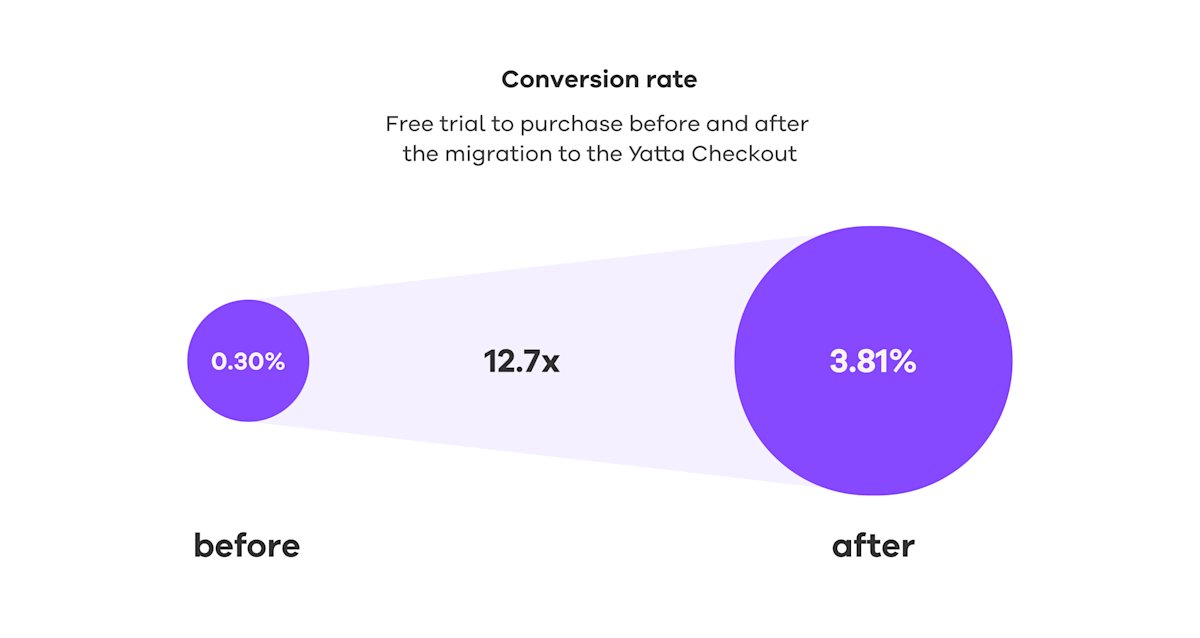
Our conversion rate from free trials to paying customers jumped from 0.30% to 3.81% over the first month—with the very same product and marketing (e.g., feature set, target groups, advertisements).
And by the end of the year, we had sold more than 12 times the number of licenses we sold the year before, thus increasing our product revenues by 10.6x—within a year.
At the same time, we reduced our user acquisition and administration costs by automating previously manual work. The Checkout automates user registration, enterprise invoicing and billing, taxation, licensing, payment collection, currency conversion, payouts, and much more, resulting in reduced manual work and fewer sources of error.
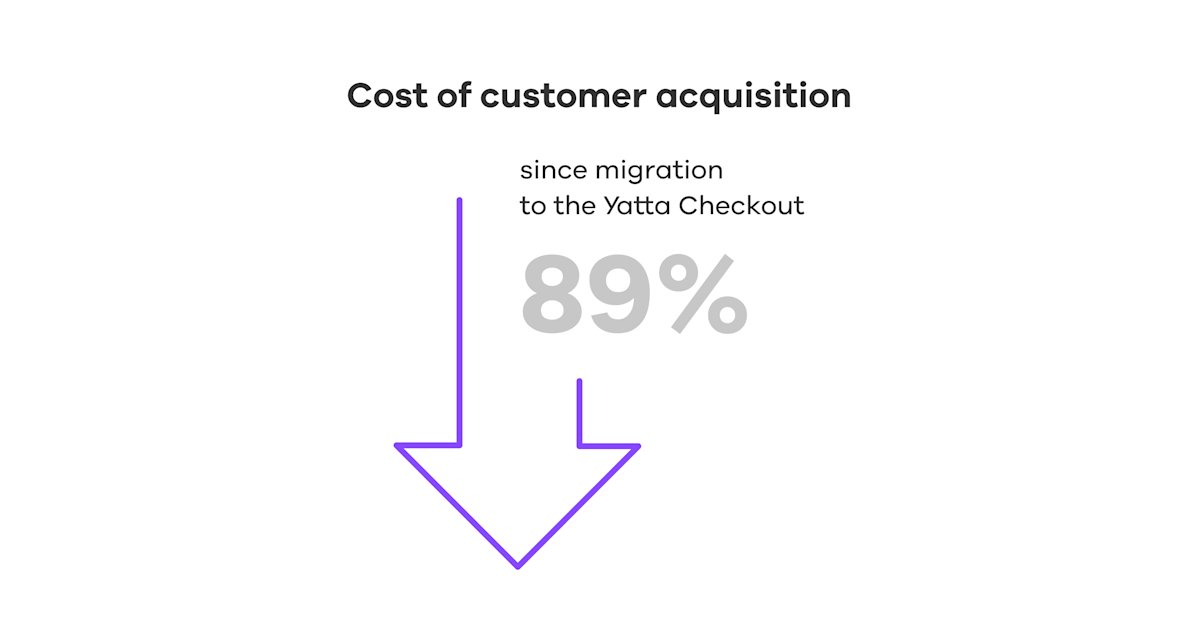
## Summary
In summary, Yatta Checkout:
- Increased our conversion rate by 12.7x from 0.3% to 3.81%
- Increased sales revenues by 10.6x
- Lowered our CAC by providing a seamless and efficient sales & purchase experience
- Reduced our sales, payment and administration costs—through automation
- Massively accelerated our time to market for new products and business models
In total, we have invested a seven-figure sum into the development of Yatta Checkout. To make sure that this would pay off, we always had the goal of using Yatta Checkout not only for UML Lab, but also for any other Yatta product—whether it’s a desktop application, a SaaS product, a digital asset or paid content. To ensure flawless migration, we made sure Yatta Checkout supports all standard purchase and subscription models.
That’s also how the legal toolbox, license framework, identity and access management are designed—along with our website and product integration. We knew this would accelerate time to market and improve lead generation and sales costs for digital products immensely, enabling us to focus on what we do best: software product development and innovation.
Now, one year later we have decided to share Yatta Checkout with the world: With every software vendor, developer tool builder, SaaS provider, digital product designer and content creator out there. To help teams and companies innovate—and provide users access to the best possible technologies. In B2B and B2B2X.
_Are you interested in learning more about Yatta Checkout? Contact us at _[_checkout@yatta.de_](mailto:checkout@yatta.de)_._
---
---
title: "1&1 Internet SE success story: Customer-oriented implementation through agile software development"
date: "2016-05-16T00:00:00.000+02:00"
author: Yatta
collections: [Case study]
tags: [Java, Frontend, "1&1 Internet SE", Success Story]
source_url: "https://yatta.de/thoughts/1-and-1-internet-se-customer-oriented-implementation-through-agile-software"
---
# 1&1 Internet SE success story: Customer-oriented implementation through agile software development
More and more people are searching the internet for regional businesses or service providers. Especially small businesses rarely profit from this trend so far, because they do not optimize their websites for Google and other search engines. They either don't have the knowhow or the budget. On the internet, these businesses stay invisible for their customers. The 1&1 Internet SE has reacted to this issue: The _Search Engine Optimization 2.0_ provides a solution that helps businesses to improve their visibility, even if they have a small marketing budget. The project was developed with the help of Yatta consultants in an agile way.
## 1&1 Internet SE
> With 15.43 Million customers, [1&1](http://www.1und1.de) is one of the world’s leading web hosting providers and offers a wide range of products for private users, freelancers and businesses. Products range from web hosting (websites, domains, online shops) to fast DSL internet connections including telephony, to mobile communication and personal information management. 1&1 products are available in Germany, Austria, Great Britain, Span, United States, Canada, Poland, Italy, and Mexico. 1&1 is a wholly owned subsidiary of the listed company United Internet AG.
## Project Goal
The software project's objective was to improve the usability of the _1&1 Search Engine Optimization 2.0_ in an agile development process. As a first step, Yatta consultant Frederic Ebelshäuser identified which elements of the user interface could be reused for refactoring and which elements had to be redesigned. The goal was to achieve a cost-efficient and maintainable result. The application based on Apache Wicket and Bootstrap was implemented successively with the help continuous customer feedback.
The deciding factor for choosing Yatta was above all their know-how for Java frontend development in synergy with further technologies (Java, Apache Wicket, Bootstrap and jQuery). Other crucial factors included consulting for the 1&1 development team, the close cooperation with product management and User Experience in agile processes. As a result, Yatta and 1&1 Internet SE employees delivered a releasable _1&1 Search Engine Optimization 2.0_ with vastly improved usability.
## What 1&1 Say About Yatta
> "For our solutions in the domains of online marketing and online shops, customer satisfaction ranks first. This is the reason for our high quality standards, which we can only meet with knowhow and the help of outstanding software developers. Frederic Ebelshäuser from Yatta Solutions excellently completed our team so that we were able to crucially optimize our product's usability."
>
> — 1&1 Internet SE
_[Disclaimer: This case study refers to projects that ran from April - December 2012 and January - March 2014. Please also note that since then, 1&1 Internet SE has changed its name to _[_IONOS SE_](https://www.ionos.com/)_.]_
---
---
title: enercast GmbH success story – Performing online forecasts for renewable energies
date: "2018-09-25T00:00:00.000+02:00"
author: Yatta
collections: [Case study]
tags: ["enercast GmbH ", Renewables, UML Lab, Success Story]
source_url: "https://yatta.de/thoughts/enercast-online-forecasts-for-renewable-energies"
---
# enercast GmbH success story – Performing online forecasts for renewable energies
The development and use of renewable energy in Germany will likely double in the next ten years. Energy sources such as wind and sunshine are nearly inexhaustible resources, whose potential capacity is far greater than the entire consumption of electricity in Germany.
In practice, however, feeding solar and wind energy into the grid is rather difficult. Nobody knows exactly when there will be wind or sunshine. Natural fluctuations in the weather can put a strain on the grid, leading to substantial energy losses, as well as wildly fluctuating energy prices. enercast resolves this problem through a Software-as-a-Service (SaaS) solution for wind energy forecasts. And they were looking to optimize the storage requirements of their application and implement a quality, scalable data model. The aim was to improve the performance, cost-effectiveness and capacity of their software platform, while future-proofing their data model.
> The web service [enercast.de](http://enercast.de) provides a wide variety of forecasts regarding the production, supply, and pricing of available energy from wind and photovoltaic facilities. The service offers a detailed overview of the location, time of day, and amount of wind and solar energy produced in Germany. For its energy production prognoses, the system's algorithms make use of forecasts provided by various European weather agencies as well as satellite measurements of solar radiation, performing calculations on hundreds of terabytes of weather and geospatial data. The forecast specialist enercast.de caters to energy traders, network operators, and operations managers, as well as to providers of smart home and smart grid services. With enercast.de, traders and operators can forecast the production of wind and solar energy, and efficiently feed this energy into the grid and into energy markets.
## Project specifications
Producing energy capacity forecasts with a time resolution of fifteen minutes, the enercast.de data model establishes relationships between a wide variety of data structures, including:
- Measurements and geospatial data from over 750 million datasets
- Current weather data
- Locations of over 1.2 million wind and solar parks
The high demand for various web services in the last ten years has led to increasing data processing volume as well as longer processing times. To meet this demand, over the last four years the enercast data model has been continually developed with JPA/Hibernate by eight software developers. The model consisted of many different submodules with over two thousand classes.
> [enercast.de](http://enercast.de/) is a SaaS solution provided by enercast GmbH. Based in Kassel, Germany, the company focuses on solutions to complex problems for the energy sector. The software engineering process used by enercast GmbH takes advantage of close relationships with academic researchers as well as with partners in the energy industry. As an example, the company works closely with the Fraunhofer Institute for Wind Energy and Energy System Technology (Fraunhofer IWES) in Kassel and Bremerhaven. Moreover, enercast has also taken part in the RWE energy group's Innogy venture.
## Technical background
The Java `hashcode()` and `equals()` methods are used to verify object identity. This typically makes use of the Java VM's default implementation. For certain domains, however, for example database applications which reference a single real-world object with two different Java objects, this is insufficient. In this case, it is necessary to overwrite both methods in every class of the data model, and to account for the value of respective attributes in the implementation. There exist many appropriate implementation alternatives, each with individual advantages and disadvantages. In enercast's case, Project Leader Bernd Kratz has stipulated that the entire data model should be standardized using [UML Lab](https://www.uml-lab.com/).
If `hashCode()` and `equals()` are overwritten, this should be carried out in the same manner in all classes. A manual approach is often tedious, is rather uncreative, and requires a great deal of concentration and endurance on the part of the software developer. Moreover both methods must be must be changed consistently to one another each time an attribute is added to the classes.
When analyzing the connections between two objects or whether two objects are in fact identical, large portions of the data model are often imported from the database. This leads to an excessive memory footprint of the application and thus to poor performance. Especially for large databases such as that maintained by enercast GmbH, a smaller footprint is necessary.
## The solution
For this reason, Yatta Solutions provided support to enercast GmbH for the standardization and refactoring of their data model with UML Lab. For its round-trip engineering, UML Lab uses a template-based approach for code-model transformations. These same templates, which are traditionally used for code generation only, are also used for reverse engineering. This results in an extremely flexible and powerful solution for agile modeling of software systems.
In detail, the stages of production at enercast GmbH were:
### 1. Specification of implementation requirements in a code style
In accordance with the enercast requirements, templates for `hashCode()` and `equals()` were implemented in their own code style scheme. These were tested in a sample project, and completed in iterative fashion in cooperation with enercast GmbH.
### 2. Generalization of templates
In the second step, the templates were extended to be able to import arbitrary legacy implementations of both methods. The extension enables the use of the templates with the new requirements for a wider range of compatible existing code. In cases where an implementation was inconsistent with the requirements, the project could still be imported completely, but the non-compliant methods were marked with their own UML keyword.
```java
«if hasKeyword(„legacyHashCode“)»
…legacy Implementierung…
«else»
…optimale Implementierung…
«endif»
```
### 3. Reverse engineering
The enercast source code was subsequently imported using UML Lab's template-based reverse engineering. Existing `hashCode()` and `equals()` methods which did not meet requirements were automatically marked in the model with the appropriate keyword ("legacyHashCode" or "legacyEquals"), making them easy to find through problem markers automatically created by custom model validation rules.
### 4. Model-based refactoring
For model refactoring, a short script in QVTo was created. Upon execution, the script removed all legacy keywords from the model. Moreover, new and optimized method bodies were automatically generated.
This step can also be carried out manually by the developer, without the use of a QVTo script. However automation through UML Lab saves the developer from tedious and redundant tasks. In any case the result can be reproduced and tested in the model.
### 5. Code generation
The modified implementations were verified using the "Compare Generated Code" dialog. In the enercast project, only the method bodies of `hashCode()` and `equals()` were modified. When the code was found to meet the requirements, the modifications were applied to the source code using the UML Lab code generation.
The complete cycle can be repeated often and in any order. In the case of enercast.de there was a very agile response to the changing requirements of method implementation.
## Benefits
### Technical benefits
- Simple conformance of the UML Lab code generators to specific project requirements
- Application-supported refactoring simplifies automatically generated implementation
- Uniform implementation of `hashCode()` and `equals()`
- Optimized storage requirements of the application
- Highly qualitative data model
- Highly scalable application through a new data model
### Customer benefits
- High performance and high capacity software system
- Cost-effective, fast, and future-oriented data model
## What enercast GmbH says about UML Lab
> "As experts in the forecasting of wind and sunshine for renewable energy production, it is especially important to us that our entire data processing workflow be fast and efficient. We have found Yatta to be an expert partner for the effective improvement of our data models. With this partnership we have ensured a cost-effective and fast data model which will be able to serve our customers for many years to come."
>
> — Thomas Landgraf, Managing Director enercast GmbH
## Customer satisfaction
> "Our energy capacity forecasts now require substantially less computation time. The web services of enercast.de now offer better performance than ever. This better serves not only our customers, but also the entire renewable energy revolution."
>
> — Bernd Kratz, Chief Developer and Managing Director at enercast GmbH
_[Disclaimer: This case study refers to a consulting project that took place in June 2011.]_
---
---
title: Hewlett Packard success story – Implementing Cloud Service Automation (CSA) with UML Lab
date: "2014-09-04T14:08:00.000+02:00"
author: Yatta
collections: [Case study]
tags: [UML Lab, Hewlett Packard (HP), Cloud Service Applications (CSA), Success Story]
source_url: "https://yatta.de/thoughts/hewlett-packard-implements-cloud-service-automation-csa-with-uml-lab"
---
# Hewlett Packard success story – Implementing Cloud Service Automation (CSA) with UML Lab
Businesses evolve and change fast. Software creation must keep up with this pace. This includes changing models along with many lines of source code. Staying on top of these changes and keeping the overview is essential for making the right decisions. A lightweight and continuous automated process that ensures maintainability and keeps QA costs low is the key to both an efficient and innovative business unit.
Hewlett-Packard Development Company was looking for an agile way to make informed decisions about software architecture. The aim was to accelerate software delivery while keeping the development process lightweight and the software itself both efficient and maintainable.
## HP Cloud Service Automation (CSA)
[HP Cloud Service Automation (CSA)](https://www.hp.com/hpinfo/newsroom/press_kits/2011/EBcloudcomputing2011/CSAWhitepaper12011.pdf) is a solution composed of automation software tools for use by companies and government agencies to deploy and manage cloud computing applications. The solution simplifies and automates the deployment of databases, middleware and packaged applications and enables composite application provisioning and monitoring in heterogeneous and extensible cloud computing environments. The software is part of a broad portfolio of cloud computing products, services and solutions offered by HP as part of its HP IT Management Software family of products.
HP CSA allows IT departments to move and manage applications among in-house (private) cloud systems, external (public) clouds and traditional IT systems. HP CSA software is also designed to deliver unified security, governance and compliance across applications, as well as physical and virtual infrastructures. The software automates key IT processes so that there is one consistent approach to IT resource management. HP CSA also allows IT departments to dynamically monitor and provision server, storage and network elements as well as applications to meet the needs of current and upcoming workloads. In addition, the solution allows IT to automatically grow and shrink the allocated resources in order to meet quality of service targets.
HP CSA Software is included in HP CloudSystem, a cloud infrastructure from HP that combines storage, servers, networking and software for organizations to build complete private, public and hybrid Cloud computing environments.
Hewlett-Packard’s Cloud Service Automation team is located in Fort Collins and in Cupertino in the USA. About 40 software architects and developers work on the project. Customers are companies like [The Walt Disney Company ](http://thewaltdisneycompany.com/)or the [SFR Business Team](http://www.sfrbusinessteam.fr/). This testimonial refers to Tim Barry, Master Technologist at the Hewlett-Packard Developement Company in Fort Collins and working on the CSA product release till August 2012.
## Solution:
For implementing Hewlett-Packard's Cloud Service Automation software solution, the CSA development team uses UML Lab. With regard to Yatta's modeling IDE, Tim has this to say:
> "It is world class software with a result that insofar as I can tell is unmatched. We are at a point where our model and the source code are congruent and in-sync. This is the essence and magic of UML Lab for us."
The Java code generator provides substantial value by generating Java Interfaces and their corresponding implementation classes out of the box. These sources are then re-used by other automated procedures to generate APIs and UIs. The build automation is done with a dedicated Maven integration of UML Lab which was provided to HP by the Yatta developer team as a customized UML Lab solution.
Knowing several other modeling solutions and their limitations for years, UML Lab is the first to truly impress Tim:
> "This is one of the best pieces of software engineering and tool craftsmanship
> I've seen in two and a half decades in my job."
We are very proud that Tim is happy with our software tools. Even more importantly, Tim and Hewlett-Packard were able to realize a great software project with reduced cost and risks by
using UML Lab. Our Yatta developers felt really proud when Tim told us, "We would not be where we are without your tool."
Because pushing our customers' business as software developers and architects is what drives us—and makes our start-up business a success.
## About Hewlett-Packard Development Company
With over 349,600 employees and a revenue of 127.24 billion US$ in 2011,
Hewlett-Packard is one of the world's leading IT companies worldwide. HP is headquartered in Palo Alto, California, in the United States and provides products, technologies, software, solutions and services to consumers, small- and medium-sized businesses and large enterprises, including customers in the government, health and education sectors.
### Software Engineering Improvements:
- Multiple source code artifacts are automatically adapted by code generation within seconds.
- Source code changes are reflected instantly in the model view.
- Model and source code are always in-sync with Round-Trip-EngineeringNG.
- By using UML Lab, the CSA developer team of Hewlett-Packard was able to
make the right software architecture and design decisions in a truly
agile way.
### Business Benefits:
- Short time to market for a new HP product: [Cloud Service Automation (CSA)](http://www8.hp.com/us/en/software/enterprise-software.html).
- The software realization keeps up with rapidly evolving businesses.
- Constant maintainability is ensured by a light-weight solution for consistent software design and implementation.
## What HP Has To Say About UML Lab
> "It is world class software with a result that insofar as I can tell is unmatched. We are at a point where our model and the source code are congruent and in-sync. This is the essence and magic of UML Lab for us. The Java code generator provides substantial value by generating Java Interfaces und their corresponding implementation classes. This tool chain is solving real problems for us in a way that we could not do otherwise. We would not be where we are without UML Lab."
>
> "Suffice to say - I am impressed. I have seen many, many CASE tool chains over the years and the life of most of those has come and gone. I believe that UML Lab is a winner. This is one of the best pieces of software engineering and tool craftsmanship I've seen
> in two and a half decades in my job."
>
> — Tim Barry, Master Technologist, Cloud Automation SW, Hewlett-Packard
_[Disclaimer: This case study refers to a UML Lab collaboration that took place between 2011 and 2013.]_
---
---
title: Brand new – Going beyond our logo and website
description: Relaunching the Yatta brand
date: "2022-10-13T16:00:00.000+02:00"
author: Artur Lang
collections: [Company blog, Knowledge]
tags: [Branding, Typography, Visual Language, Logo, Design]
source_url: "https://yatta.de/thoughts/brand-new-going-beyond-our-logo-and-website"
---
# Brand new – Going beyond our logo and website
_Relaunching the Yatta brand_
A brand like Yatta does not exist in a vacuum.
As we’ve grown from a small group of co-founders to a team of over 50 fellows, our company has developed and evolved—sometimes in ways we would have never imagined.
In [launching Yatta Checkout](https://www.yatta.de/thoughts/hello-checkout), we’ve reached a milestone; one we’ve been working toward for some time now. You might even have seen our [(re-)branding interview](https://youtu.be/91TXhWjrL1w) in which we share some insights from the journey so far. At any rate, one thing is clear:
As we and our services evolve, so too must our brand.
## Development is in our DNA
What we’re building is for a broad spectrum of stakeholders, but developers are at the heart of everything we do—and we want to keep this orientation.
In addition to this fundamental decision, we embarked on our branding journey with some other building blocks already in place: our Core Values, Culture Code and Manifesto.
The final thing we wanted to keep in focus (and the reason why we’re talking primarily about a brand evolution and not a rebrand) is our origin story.
Even if the changes in our visual language and parts of our offering are significant, we have preserved our core and essence—just giving it a more fitting shape.
## Working with design specialists
To develop a visual language befitting of who we are and what we do, we carefully selected the right experts. Together with [child](https://child.team/), a product strategy and design studio, we conceptualized the new face of Yatta.
As with our [previous work developing the Yatta brand](https://www.yatta.de/en/news/brand-new-reshaping-our-company-brand/), we were looking for a deep, collaborative and iterative process. We also wanted a good match in terms of UI/UX and brand design—because we didn’t want to lose sight of either once we got into the details.
With the right partners on board, we rolled up our sleeves and dived in.
## Hiro heritage
Back in 2008 we were racking our brains over what to call our startup. Looking for something more than a fine-sounding artificial word, we stumbled across the powerful Japanese term “yatta,” which translates to “I/we did it”. Fans of the TV series _Heroes_ will remember the scene where Hiro Nakamura stands in Times Square and shouts “yatta!”
One word conveying feelings of elation, excitement and achievement after getting the job done—exactly what we want to inspire in our partners, clients and team. Thus, Yatta was born.
[Hiro arrives in New York](https://www.youtube.com/embed/JsBTNO7jGg8)
This heritage stands out in our initial founding logo.

Obviously, this first logo was pre-seed and pre-launch—drafted without input from a designer. And that’s exactly what it needed: design. The outcome was the logo we used until now. It elegantly portrays the contradictions of our origin, of technology and of people, while remaining friendly and open. At the same time, the redesigned logo concealed its own origin; its relationship to our roots was less obvious.

Let us be clear: We loved our logo! It served us well. But times have changed—so have we, so has technology. Slick UI/UX and direct communication have become much more important. Therefore, our logo must adapt; to reflect change and development.
> “A logo is not just a stamp but an artifact that brings a brand to life. As the foundation of the brand’s visual language, it, ideally, becomes part of the product experience itself and makes the brand vivid.”
>
> — Thorsten Pfitzke, designer at child
We needed to evolve the things we already had to convey our origins more clearly. Taking our original logo as an anchor point, we explored what the visual future of Yatta could look like.
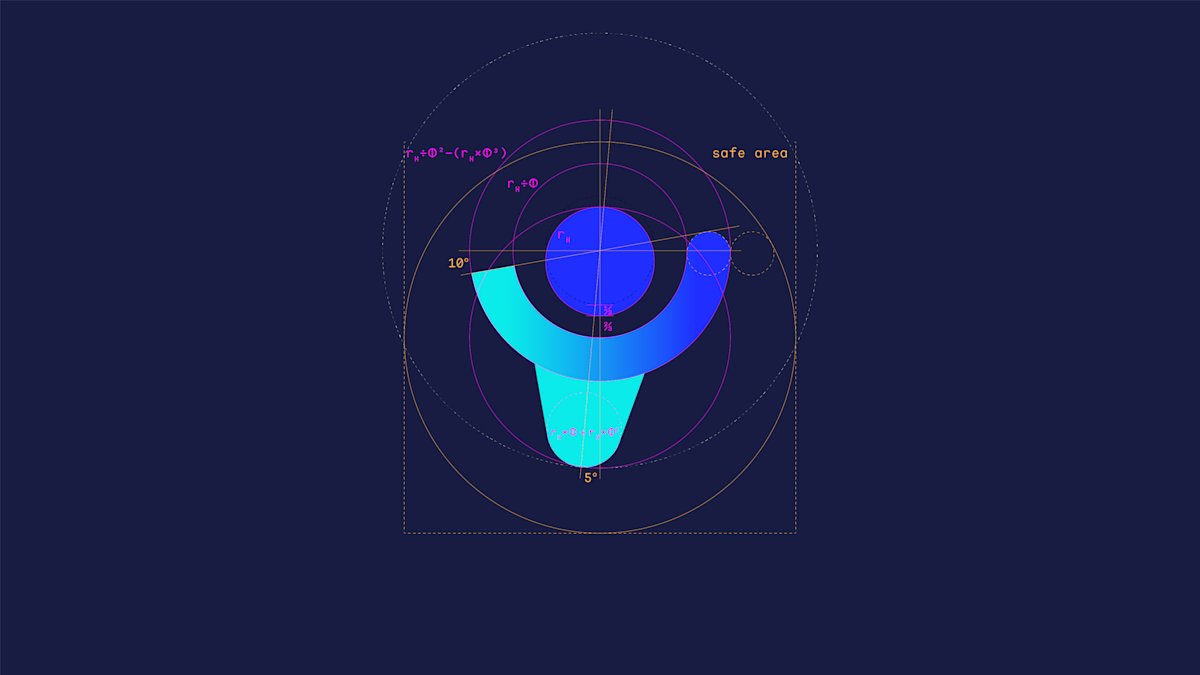
But we always came back to Hiro. Rooted in our origin story, he expresses exactly what we want to convey. That’s how we reached our new logo.

This is how we have evolved, so far.
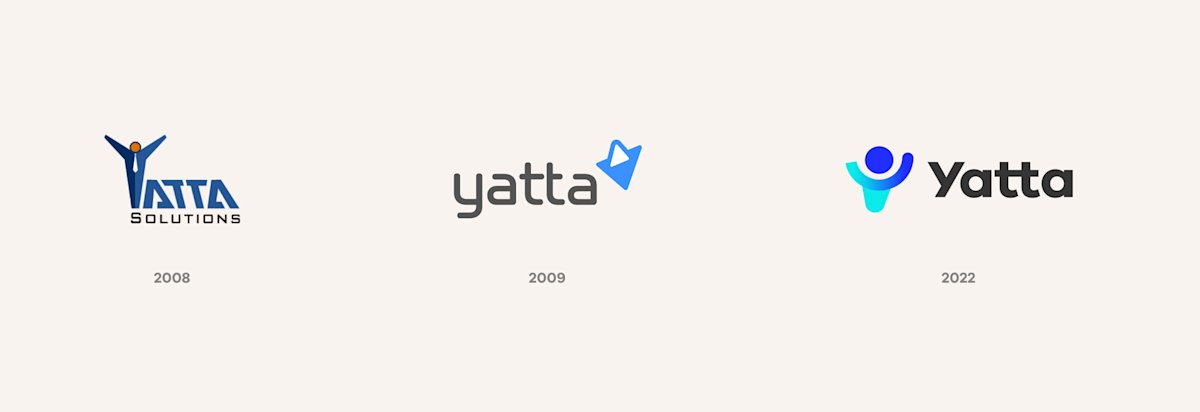
## Visual language
With the logo in place, we had a great starting point to work on our visual language. But as a software engineering company, (almost) nothing happens by accident. So we built upon the three key ideas already in place in our logo:
- The head—focused and sharp—representing _thought_.
- The arms—dynamic and fluid—representing _action_.
- The body—emotional and diffuse—representing _emotion_.
The elements show what we stand for as a team:
1. _Thought_—the head—refers to us as scientists.
2. _Action_—the arms—refers to us as makers and entrepreneurs.
3. _Emotion_—the body—refers to us as mensch.
Combined and united they show more than the sum of their parts. Their meaning also mirrors our software-engineering and problem-solving process: _feel, think, act._
With this in mind, we extrapolated the shapes and colors that would form the foundation of our design—transporting a feeling of organic growth, energy and evolution.

## Typography
But we’re still developers... We spend an inordinate amount of time staring at numbers, strings and Booleans, so we value well-crafted, appealing and functional code in our daily work. And therefore, we took the opportunity to customize a font that fits our brand and simultaneously meets our requirements for coding, too.
Together with [René Bieder](https://www.renebieder.com/), we customized a font called Galano Grotesque, creating Hiro Grotesque and Hiro Mono—our very own monospace font.
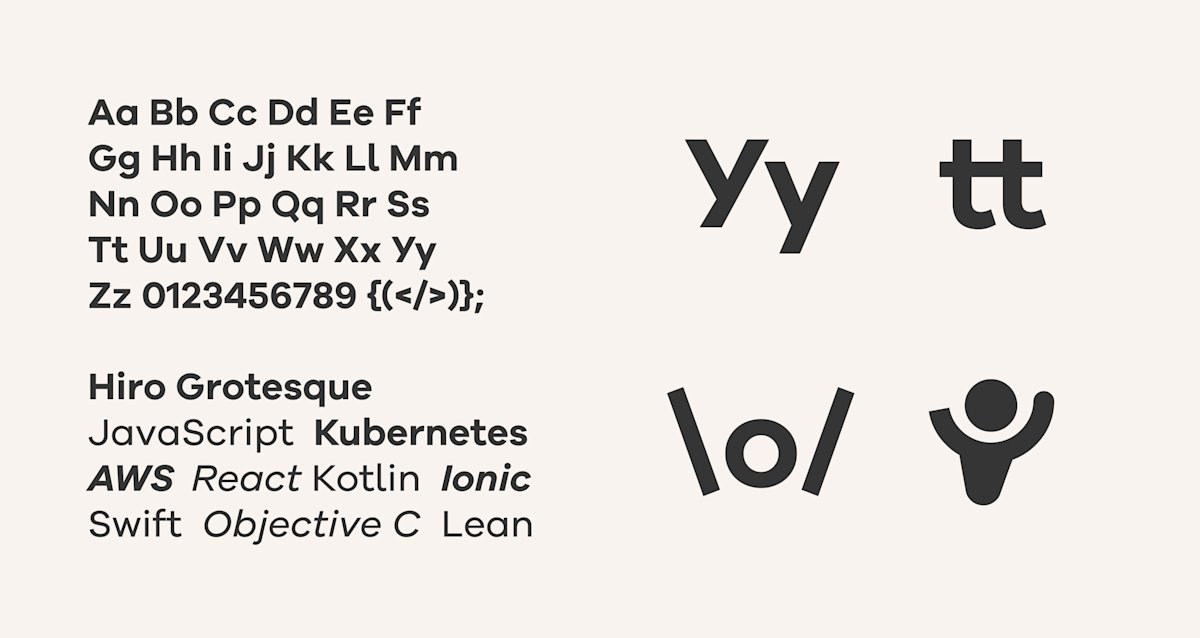
Our custom fonts include some changes and additions that help our text represent who we are even better. For example, in Hiro Grotesque we changed the Y to look the way most people write it, added custom ligatures and more. And «Hiro Mono» is optimized for reading and writing code.
## Relaunching Yatta
When you add all these things together—our logo, visual language and typography—assembled by and with a design studio and a lot of effort from the team, you get what you see here: a design system and visual feel that truly represent who we are and where we’re going.
Feel free to explore our [website](https://www.yatta.de)—and if you like what you see...we’re hiring! \\o/
Development never stops; we’re always on the lookout for creative thinkers, great developers and bright individuals. Make sure to check out [our open positions](https://yatta.de/careers).
## What's next
This brand relaunch is just the beginning. We plan to expand our offering on this new and exciting foundation—it’s going to be awesome.
---
---
title: "Art meets software: Works by artist Frank Kambor decorate our Frankfurt office"
date: "2017-05-04T15:45:00.000+02:00"
author: Yatta
collections: [Company blog]
tags: [Art, Photography, AI]
source_url: "https://yatta.de/thoughts/art-meets-software"
---
# Art meets software: Works by artist Frank Kambor decorate our Frankfurt office
Like everyone else, software developers derive inspiration from the perspectives and thought-provoking ideas that a work of art is able to offer. The front-end experts among us even deal with aesthetic questions on a daily basis. This is why we at Yatta were looking forward to last night so much when Frankfurt artist Frank Kambor brought two of his artworks to the Yatta offices on Mainzer Landstraße. From now on, these two works will decorate our office walls - and inspire the Yatta team.
## The blurring line between humans and machines
We are living in times in which Artificial Intelligence (AI), machine learning and virtual reality are progressing so rapidly that the boundaries between man and machine, original and replica, fiction and reality are becoming increasingly blurred. There are many areas where software imitates the real world perfectly – and even makes it more beautiful: [voices](https://www.descript.com/tools/voice-enhancer) and [faces](http://www.niessnerlab.org/projects/thies2016face.html) of real people, even [human emotions](https://www.wired.com/2016/06/pepper-emotional-robot-learns-feel-like-american/) that are based on algorithms often seem frighteningly real. In robotics, this phenomenon is known as the "Uncanny Valley". But one thing is certain: The imitation of reality through technological progress cannot be stopped.
This convergence of the real and the virtual world is addressed by the Frankfurt artist Frank Kambor in his work series "Verschwommen" ("Blurred"). He himself describes the photo compositions as follows:
> "The new technology is increasingly determining our communication and organization, and ever faster and more perfect machines are being developed, which blurs the profile between man and machine more and more."
>
> — Frank Kambor, Artist
Thus, the works of the "Verschwommen" series could not be a better reflection of contemporary trends. They perfectly illustrate today's technology world with all its contradictions, promises, and ambiguities. At the same time, they indirectly add local color to the Frankfurt Yatta office, given that Kambor himself is originally from Frankfurt (more precisely, Bornheim) and a member of the artist community "Atelier 3. Etage" in Rödelheim. In his works, the versatile artist not only addresses the big questions of humanity. He has also photographed, drawn, and painted typical motifs of his city.
Frank Kambor is an artist who is deeply rooted in Frankfurt, but who at the same time thinks big. We are delighted to exhibit a small part of his oeuvre at our offices.
---
---
title: B Braun Melsungen AG success story – Connecting devices and processes in hospitals
date: "2021-06-21T00:00:00.000+02:00"
author: Yatta
collections: [Case study]
tags: [B. Braun Melsungen AG, Java, Medical Technology, Success Story]
source_url: "https://yatta.de/thoughts/b-braun-melsungen-ag-connecting-devices-and-processes-in-hospitals"
---
# B Braun Melsungen AG success story – Connecting devices and processes in hospitals
## Digitizing medical services to improve patient care
Infusion therapy is an indispensable part of treatment for many diseases. To date, infusion pumps have been running largely separately from each other. However, infusion programs in everyday hospital work are rather complex: Each patient needs the right treatment in the right place at the right time in the right dosage and volume. In order to avoid errors and save time, all components of the process chains involved need to be optimally coordinated with each other.
In the field of infusion therapy, B. Braun Melsungen AG has been a pioneer from the very beginning: Since the 1930s, the company has worked on improving user safety and patient comfort through innovation. B. Braun Space is an infusion system for medical use. Via infusion pumps, patients receive medication and fluids that are precisely tailored to their individual clinical picture. Between March 2013 and December 2018, Yatta supported B. Braun Melsungen AG in the development of the B. Braun Space infusion systems. The goal was to create a scalable software platform that connects different medical devices, streamlines processes, minimizes sources of errors and thus optimizes patient care in clinical practice.
## A smart interplay of medical devices, powered by software
For a software-based optimization of the process chain in infusion therapy, in the future, Space infusion pumps will be interconnected in an efficient way thanks to the Space OnlineSuite and other interacting systems. This does not only make monitoring therapies easier for doctors and nursing staff, but it also provides them with a better overview of what medication is used in what dosage for typical therapies. Moreover, the Space OnlineSuite allows for a centralized configuration of all pumps. With hundreds of pumps under the responsibility of a single chief resident, a software-based, centralized configuration provides a crucial reduction of complexity, so that patients take center stage in medical care.
Consequently, the Space OnlineSuite is becoming the key software system for connecting devices at the hospital, simplifying administrative tasks for medical personnel during everyday hospital work and therefore leaving more time for individual care.
## Braun Melsungen AG
> Instrument-based infusion technology at B. Braun looks back on a long tradition, in which the invention of the first syringe pump in 1951 represents a landmark. In all subsequent developments, over more than half a century, high quality requirements, together with innovative solutions that simplify daily work, have been a top priority.B. Braun Space introduces a new generation of infusion technology. Perfusor® and Infusomat® Space offer a wide range of functionalities for all hospital and ambulatory applications. System compatibility and network solutions are just as much part of this solution as specific infusion profiles for anesthesia.
## The project
### Improved patient care as top goal
The ultimate objective in optimizing infusion therapy powered by B. Braun Space is to increase patients’ safety, to improve treatment successes, and to provide high-quality patient care.
One goal of the project is to create a performant and reliable software system ideally prepared for the digital future, the other goal is to extend the functionality of the Space OnlineSuite. This also includes making the Space OnlineSuite as a software system adaptable to changing requirements and processes from an operative and strategic point of view. Furthermore, it needs to support very large hospital installations and provide the option to connect additional devices, so that existing hospital processes may be automated and simplified.
### Contributing entrepreneurial and technical know-how to product management
In order to achieve the best result, Yatta is involved in all stages of the software development process, starting with product management – e.g., roadmap brainstorms or the concrete design of features – where Yatta participates actively. Other tasks include the specification of software design and architecture, the implementation of tool chains as well as the development and testing of the software system. Yatta also takes responsibility in taking care of the requirements analysis of future releases, coordinating its efforts with the responsible project partners from IT, Marketing, and Service departments.
### The interplay of client and service provider
In addition, Yatta handles system development and integration of additional hardware regarding new generations of pumps and is responsible for coordinating with other service contractors in close cooperation with the respective project leads.
## Technical implementation
### Building future-proof software
As a first step, the software was divided into separate modules to optimize the flexibility and maintainability of the Space OnlineSuite. This decision was based on an architectural analysis. The new, modular architecture reduces the time and effort needed for verification of different sub-applications and, in addition, permits parallelization of software development – in terms of staffing as well as staging. Continuous integration with test automation including UI tests ensure that further development of the Space OnlineSuite can continue in an efficient manner.
### Platform independence for a robust application
In order to ensure robustness in everyday hospital work and to be able to process increasing amounts of data in a reliable way, performance and stability of the entire software system were improved. Moreover, it’s necessary to provide support for different generations of infusion pumps. This is possible thanks to a now consistent data model and the data’s platform independence.
In addition, the consumption of resources per connected device was reduced. As a result, the software system underlying B. Braun Space has become more scalable. It now supports hospital installations of a much wider scope, including a higher number of beds and potentially even large-scale installations for several hospitals via a central server in cluster mode.
### Functional extensions for medical progress
The Space OnlineSuite’s range of features was also extended by the following additional applications:
The Device Manager permits simultaneous configuration of multiple pumps. This eliminates the time-consuming process of configuring each individual pump. All connected devices can be configured at the same time, regardless of the exact location of a pump in the hospital. In addition, an overview table shows all connected devices so that hospitals can see all important data at a glance and easily keep track of maintenance intervals and software updates.
The B. Braun Space innovations reduce the overall number of administrative tasks for the medical staff, so that physicians and nurses do not need to worry about devices, software, and configurations. The monitoring of pumps and therapies is straightforward and can be done at a central place. This ultimately leaves more time for personal and individual patient care.
### Quality assurance for safe patient care
Releasing software for medical technology requires the highest standards of quality management and quality assurance: from software design to implementation to deployment.
Quality requirements include the highest possible test coverage (including the implementation of UI tests and load tests) as well as complete test automation, continuous integration and thorough, systematic documentation.
Since the Space Infusion System is a medical device, it has been developed in accordance with the relevant industry standards: IEC 60601 (Medical Electrical Equipment), IEC 62304 (Medical Device Software – Software Life Cycle Processes), IEC 62366 (Medical Devices - Application of Usability Engineering to Medical Devices), and ISO 14971 (Risk Management).
Our team was commissioned with all aspects of quality assurance and quality management, in some cases also on our own responsibility. The results were examined and approved by B. Braun Melsungen AG, and the relevant supervisory and reporting authorities.
## Project Quick Facts
_Time frame_**:** March 2013 to December 2018
### Scope
10 Yatta specialists: product managers, project leads, software architects, software developers and testers.
### Technologies
- Java: Java EE 7, JSF, JavaScript, Wildfly Application Server
- C++: GNU Tools, CMake, boost Library
- Various database technologies, e.g., MS SQL Server, PostgreSQL
### Yatta’s responsibilities
- Project management
- Requirements engineering
- Specification of protocols and software architectures
- Consulting on technologies and development processes
- Software development (fixed rate)
- Test automation and verification
### Customer value
- Implementation of new applications and extension of existing ones
- Robustness in everyday hospital work: increased performance and reliability of the system as a whole
- Future-proofing: connection of new pumps/generations of hardware
- Flexibility in terms of hospital infrastructure: support of different database systems
- Modularization: reduced time and effort in developing and maintaining sub-applications
## What B. Braun Melsungen AG says about Yatta
> "Together with B. Braun, Yatta has built up so much know-how that all of our teams benefit from it and the overall performance has increased significantly. What is particularly impressive is that Yatta is able to develop a perfect understanding of our requirements. This is why the Yatta employees enjoy our full confidence and they are 100% involved in all B. Braun activities. We discuss any questions with them as openly as if they were our own employees."
>
> — Dr. Bernd Stich, Project Manager B.Braun Melsungen AG
---
---
title: Why to be a Techno-Optimist
date: "2024-02-23T00:00:00.000+01:00"
author: Chris Stewart
collections: [Knowledge, Technology]
tags: [Digital Transformation, Technology, Innovation, AI]
source_url: "https://yatta.de/thoughts/why-to-be-a-techno-optimist"
---
# Why to be a Techno-Optimist
Progress has improved our lives and can still shape a better future. In his Techno-Optimist Manifesto VC GOAT Marc Andreessen lays out a vision of a future where technology solves humanity’s problems and creates a world of infinite abundance. He thus takes a stand against the growing skepticism in the Western world towards technology and its blessings. As a tech company, we share much of Andreessen’s view on technology—and would like to add our more European perspective.
## Why Marc Andreessen is right to be a techno-optimist
When your loved ones drink water, how often do you worry they will die of cholera?
Probably never, right?
In 1990, around 1 in 4 people lacked access to an improved drinking-water source. So, they feared the next drink of water could kill their child. And hygiene is only the tip of the iceberg: Without access to clean drinking water, sick children cannot make it to school. In many of the affected cultures, it’s women and girls who carry water home from the wells, not men. Something that has hindered them from going to work or getting an education.
Today only about 1 in 11, some 703 million people, lack even a basic water service. Over the course of 30 years, technological development has helped more people to get access to drinking water—and in 30 more, such problems will hopefully be a thing of the past.
## The power of technology
Likewise, the number of people living in extreme poverty [has dropped significantly in the past 30 years](https://ourworldindata.org/grapher/total-population-living-in-extreme-poverty-by-world-region). In the 1990s there were 2 billion people living under the International Poverty Line (i.e., with a budget of less than $2.15 per day). Extreme poverty has fallen by roughly two-thirds to about 700 million people.
That shows rapid progress is attainable, as [the United Nations Development Programme (UNDP)](https://www.undp.org/press-releases/25-countries-halved-multidimensional-poverty-within-15-years-11-billion-remain-poor) states. India, says UNDP, saw a remarkable reduction in poverty: Within a span of 15 years, 415 million people were lifted out of poverty. The same applies for countries like China and Indonesia. Meanwhile the global literacy rate among 15-year-olds and the overall life expectancy around the world has increased wherever there is access to technology and wealth.
[Hans Rosling: 200 years in 4 minutes - BBC News](https://www.youtube.com/embed/Z8t4k0Q8e8Y)
*Update*: In this video, the late Hans Rosling, renowned Swedish physician and academic, demonstrates (in his inimitable style) the remarkable progress achieved since the Industrial Revolution.
This shows us that technology _does_ create prosperity for mostly everyone—and not just for Silicon Valley billionaires. Based on [World Bank statistics](https://data.worldbank.org/indicator/NY.GDP.MKTP.CD), the worldwide Gross Domestic Product (GDP) has grown roughly ninefold since 1980 in nominal terms (current US Dollar). This was also made possible through technological advances; the Internet gave us the ability to communicate, connect and create faster than ever before.
Countries and regions, even entire continents, have benefited tremendously from this development, driven by technological progress: On the African continent, healthy life expectancy in the WHO African Region rose by nearly 10 years between 2000 and 2019, from 46 to 56 years. China is one of the two largest countries in the world; it also used to be one of the poorest. In 2021 China declared that it has eradicated extreme poverty, at least according to the national poverty threshold. Since 1978, it lifted 770 million people out of poverty. In July 2021, President Xi Jinping declared that China had built a ‘moderately prosperous society in all respects’. Outstanding regional developments in Chinese megacities such as Shanghai (pictured below) or Chongqing, Beijing and Guangzhou were only made possible by information infrastructure and technology, both accumulated in industrial and societal development.

## Marc Andreessen’s success stories
Acknowledging these global developments and facts, it makes perfect sense that Marc Andreessen writes in his [Techno-Optimist Manifesto:](https://a16z.com/the-techno-optimist-manifesto/)
> "Technology is the glory of human ambition and achievement, the spearhead of progress, and the realization of our potential."
>
> — Techno-Optimist Manifesto
Before founding venture capital monolith Andreessen Horowitz, startup investor and entrepreneur Marc Andreessen helped build the internet as we know it: He co-created Mosaic, the browser that popularized the web by displaying images inline alongside text, and co-founded Netscape. His impact after his achievements as founder and entrepreneur might have changed the world even more: Since he founded the VC goliath [Andreessen Horowitz (a16z),](https://a16z.com/) he has successfully financed various unicorn startups such as Airbnb, GitHub, Slack, and OpenAI—to name a handful.
Technology is a lever on the world; a way to make more with less. We believe that technology begets more technology at a constantly accelerating pace.

*Update*:
This graph shows just a small selection of the significant technological advancements that have changed the world for the better including metrics such as the World's Gross Domestic Product (GDP), Global Life Expectancy, the Global Innovation Index and Child Labor.
This shows that technology is the key to achieving a better future for humankind.
By embracing advances instead of treating them with fear or skepticism, we can live in a world where Artificial Intelligence (AI) augments human intelligence, where clean water, reliable energy and acceptable healthcare are available to everyone and where freedom, security, and education are a given. Likely, there’s no other way to a sustainable and prosperous circular economy, no other cure for poverty, hunger, disease, and misery, than through technology. For example to help tackle air pollution, [the United Nations Environment Programme (UNEP)](https://www.unep.org/news-and-stories/story/how-digital-technology-and-innovation-can-help-protect-planet) aims to research desirable technologies and solutions. According to UNEP, experts say, in the years to come, a digital ecosystem of data platforms will be crucial to helping the world understand and combat a host of environmental hazards. Without doubt, major structural transformations are inevitable to reach environmental sustainability, face climate change, and prevent pollution.
> "We believe in nature, but we also believe in overcoming nature. We are not primitives, cowering in fear of the lightning bolt. We are the apex predator; the lightning works for us."
>
> — Techno-Optimist Manifesto
For Marc Andreessen, any problem facing humankind now or in the future, can and will be solved by technology. All achieved by driving technological progress forward with the optimism that things will work out in the end.
## Fear of the unknown
However, new technologies often receive a mixed welcome.
For example, the potential applications of Clustered Regularly Interspaced Short Palindromic Repeats (CRISPR) are astounding, especially in a world where climate change means we will need more resilient crops. But in a world where organic produce is prized, many are against genetically modified (GM) crops, which are seen as ‘unnatural’. Science has found that GM crops pose no greater risk to humans than other foods, but the European public remains unconvinced. “Many different types of modifications in various crops have been tested, and the studies have found no evidence that GMOs cause organ toxicity or other adverse health effects”, summarizes Megan L. Norris, cancer and developmental biologist, in a blog post for [Harvard Kenneth C. Griffin graduate school of arts and sciences](https://sites.harvard.edu/sitn/).
And this raises the question: If we could feed more people with GM crops, reduce the spread of illness by modifying mosquitoes and eliminate genetic diseases, why shouldn’t we?

## Ethics & technology
Andreessen states that by inhibiting or limiting technological development, we stifle innovation and—ultimately—harm humankind. If a technology could improve people’s lives and we refuse to use it or obstruct its use, then we are inflicting unnecessary suffering upon the world.
When dealing with new technologies, ethically, it might make sense to exercise caution if there may be unforeseen consequences. But should we not make decisions based on our current level of knowledge, and reevaluate when new information comes to light? After all, thanks to Copernicus most of us now agree that the earth revolves around the sun!
Is it right, then, to ban the use of CRISPR on crops, knowing people—including children—are starving today? Beyond crops, let’s consider the potential impact on wellbeing. If CRISPR can help with or prevent genetic disorders such as sickle cell disease, cystic fibrosis and HIV/AIDS, we should feel responsible to do whatever we reasonably can in terms of research so we can help affected families.
So, are ethical considerations holding us back, or is it fear? The latter often seems to masquerade as the former.
Likewise, developments in other fields such as autonomous vehicles, stem cell research and AI are slowed down by fearmongering and too much regulation too soon. Instead, we need as much regulation as necessary, and as little as possible. In all of these points, we agree with Marc Andreessen.
## Let's take a closer look at AI...
As companies and foundations race to develop Large Language Models (LLMs) and generative AI—with the hope (and fear) of attaining Artificial General Intelligence (AGI)—ever more [warnings](https://www.safe.ai/statement-on-ai-risk) have entered public discourse with the aim of slowing or regulating AI development.
The [EU AI Act, an entire regulation on (any) artificial intelligence](https://www.europarl.europa.eu/news/en/headlines/society/20230601STO93804/eu-ai-act-first-regulation-on-artificial-intelligence)—reaching from LLMs to potential applications—entered into force on 1 August 2024:
> "Parliament’s priority is to make sure that AI systems used in the EU are safe, transparent, traceable, non-discriminatory and environmentally friendly. AI systems should be overseen by people, rather than by automation, to prevent harmful outcomes."
>
> — European Parliament on the AI Act
With the AI Act, the honorable goal of the European Parliament might be “to prevent harmful outcomes”, and yet it also caters to and deals with common fears and anxieties that often go along with revolutionary technologies. We don’t doubt the need to avoid ‘unacceptable risks’ such as cognitive behavioral manipulation or even an AI coup à la Skynet. Fair enough.
But in any reasonable society, it should be already in the best interests of the developers, researchers and scientists, as the AI inventors to mitigate those risks—and strive for mutually beneficial outcomes. The AI Act though, implements governmental supervision and tries to assess _all_ AI systems they deem 'high risk'; any AI, model or application, that _might_ pose high or “unacceptable” risks must go through a thorough evaluation. The length and rigor of such required assessments though, could have serious implications for the EU and its technological advancement in and through AI as a whole. AI creators may simply avoid developing and releasing their products and services in the EU, while EU-based AI developers may leave for greener pastures (as they often already do).
The risk is not just slowing Europe’s AI development but putting us out of the race entirely.
The question is therefore, how do we balance valid ethical standards with the required, responsible technical advancement?
## Are market economics a regulator?
In his Techno-Optimist Manifesto, Andreessen argues for a liberal approach, prioritizing tech above all else because the market naturally disciplines and regulates itself—and the market players. According to this idea, no state supervision, authority, or government, however well-intentioned, produces better long-term results than the market itself.
> "We believe the market economy is a discovery machine, a form of intelligence – an exploratory, evolutionary, adaptive system."
>
> — Techno-Optimist Manifesto
Since its publication, Andreessen's Techno-Optimist Manifesto has received much praise, but also a lot of criticism. In our point of view, to accuse Marc Andreessen and the advocates of techno-optimism of a lack of ethics or even unethical behavior per se is insincere. The mere fact that Marc Andreessen is very successful and has benefited from technological progress (which he has also helped to drive forward), even making him a billionaire, is no reason not to take a serious look at his point of view. It curtails the debate and does not do justice to his person. Moreover, it is certainly worth finding out the secret of his success, especially when he shares them so openly.
We therefore do not understand Andreessen's Techno-Optimist Manifesto to be a simplistic, “every man for himself.” Rather, we understand Andreessen in the well-meaning spirit of utilitarianism—or of Adam Smith himself, who drew our attention to the fact that every entrepreneur can only achieve long-term success if he serves the market, i.e., his customers and users—and thus, his fellow human beings. Nowhere is this more obvious than in Andreessen's famous venture capital firm: a16z surely invests its funds mostly in the startups and founders that focus on their customers’ and users’ interests and needs. Offering technology-based solutions for this (and them) is just the cherry on top.
Still, and even though we are very much in favor of this view, Andreessen leaves several aspects unaddressed. These include:
1. How do we deal with the accumulation of power, i.e., monopolies and oligopolies?
2. How do we deal with those affected the most by unavoidable market upheavals?
3. How do we deal with potential worst-case scenarios (if at all)?
Let’s take a closer look at this:
### No more Manchester liberalism
History shows that a libertarian, hands-off approach to free market economics results in monopolies that stifle innovation and hold society back. Driven through the economy of scale, successful businesses tend to grow bigger and bigger, accumulate increasingly more power over time up to a point where they keep away competitors not through lower prices and better innovations, but through power (e.g., through mergers & acquisitions). That’s why all modern, free societies have developed strong anti-trust authorities and laws. Having those regulatory frameworks in place has been incredibly beneficial in preventing monopolies that hinder free market economics more than benefiting them. Recent examples include Adobe’s attempted takeover of Figma, which was abandoned under regulatory pressure driven by EU and UK regulators because of concerns the merger would leave creatives with less (and thus in the long-run worse) choice than otherwise.
We assume that Andreessen is counting on the premise that even the strongest monopolies (including dictatorships) cannot remain stable in the long term—and we very much hope he is right. In fact, we ourselves tend to believe that no system can last forever if it goes against the interests of the people. But even assuming the premise is correct, the question arises: What happens to those who are affected by such monopolies (and dictatorships) for years and decades, sometimes even for generations?
Are we really supposed to stand still, bear it, and hope for better times?
That also leads us to our second point…
### The life-changing consequences of market disruptions
Without doubt, technological developments can result in far-reaching changes in society and the economy, and for the time being at least, not only positive ones. Market changes are often accompanied not only by uncertainties and volatilities, but also by hard consequences for those who get the short end of the stick. The history of capitalism is full of lessons in which thousands were affected by unemployment and poverty because market forces did not favor them. In the US automobile industry, increasing globalization and automation cost former workers—from Detroit to the Midwest—their livelihoods. Many lost their jobs, and some of them even lost their homes. They and their children were directly affected and felt the economic setbacks for decades. It was of little comfort to them to be told their industry will see better times again in the future. We cannot ignore that not only entrepreneurs and founders were affected by this, but also ordinary workers and citizens from educationally disadvantaged backgrounds. To impose the full brutality of market consequences on them, even if they themselves cannot fully comprehend them, is at the very least hard to bear.
The same applies to those less blessed by nature and society, who suffer from heart failure and, even with all the will in the world, will never be able to afford the cost of a new heart on a free market for organ trading. This also is hard to stomach.
In economics, this is referred to as possible market failure and market disruption.
### Dealing with doomsday
Regarding market failure, we must also talk about potential Armageddon—or at least the fear of it.
Considering the latest breakthroughs in AI through tools like ChatGPT, based on LLMs, questions arise if this could ultimately lead to an AGI—and if so, how that would or could affect humanity. In early 2023, Elon Musk, Steve Wozniak and other thought leaders in the tech industry [signed an open letter](https://futureoflife.org/open-letter/pause-giant-ai-experiments/) urging AI labs to pause training their systems for 6 months to allow space for better planning and management because AI could “represent a profound change in the history of life on Earth”. _The_ _Terminator_ depicts a vivid imagining of this scenario.
In a [video from the annual DealBook Summit held by The New York Times, Elon Musk](https://youtu.be/2BfMuHDfGJI?si=WbvKvEiJ0N4ByD9x&t=3474) says he was losing sleep over the threat of AI danger, but a fatalistic resignation allowed him to sleep again. Because even if annihilation through AI was certain, he “probably would choose to be alive at that time because it’s the most interesting”. Even if there was nothing he could do about it.

AI is not the first potentially existential threat for humankind, and it won’t be the last. What would have happened if humanity had nuked its way out of the Cold War after the discovery of nuclear fission and the development of the atomic bomb?
It may be ethically honourable to believe in the goodness of humankind and to trust that everything will be fine at some point. But in view of potentially catastrophic risks, would it still be responsible to rely on faith alone?
It goes without saying that politicians, including governments, must address these market risks and the associated upheavals, as well as those affected by them. And we share the view that this should always be done according to the motto: As much intervention as necessary, as little as possible. That does not free us from the responsibility of being empathetic—and being mensch.
*Update*:
In the middle of the 19th century with the forces of the Industrial Revolution in full effect for close to a century, certain industrialists undertook initiatives seeking to benefit their entire workforces and their families.
In 1861, the company Friedrich Krupp (now Thyssen Krupp AG), started the “Sozialwerk”, a social services program for its workforce. And in 1906, when the company was one of the largest employers in the German Empire, Margarethe Krupp discovered there was a lack of available housing for workers, the late CEO Friedrich Alfred Krupp's widow had his firm build them somewhere to live. The so-called
[Margarethenhöhe](https://margarethe-krupp-stiftung.de/die-geschichte-der-margarethenhoehe/?lang=en) still stands today in Essen, the second largest city in the “Ruhrgebiet”. Krupp’s program was further developed to include free employee medical services, for example. Later also technical and manual training schools were provided. And the firm contributed to and supported the accident, life, and sickness insurance societies that formed. As well as being Germany's premier weapons manufacturer during both world wars, after the Nazis seized power in Germany, [Krupp supported the NS-dictatorship](https://www.krupp-stiftung.de/en/alfried-krupp/) and was one of the many German businesses that profited from forced labor of foreign civilian workers, concentration camp prisoners and prisoners of war. Today, Thyssen Krupp AG faces headwinds from a challenging business environment and is undergoing a lengthy [transformation](https://www.thyssenkrupp.com/en/company/strategie).
Another industrial-age example comes from the UK. In 1888, the Lever Brothers (founders of Unilever) started building the village [“Port Sunlight”](https://archives-unilever.com/visit/port-sunlight-building-facilities) exclusively to house their workers in the metropolitan area of Liverpool. They also introduced welfare schemes and provided for the education and entertainment of their workforce, encouraging recreation and organizations that promoted art, literature, science, or music.
Similarly, in 1893 George Cadbury (of chocolate fame in the UK, who together with his brother Richard made Cadbury's chocolate into a household name around the world, and is now part of Mondelēz International) purchased 120 acres (or 0.5 square kilometers) of land close to their factory and built the village, [Bournville](https://en.wikipedia.org/wiki/Bournville). With it, they intended to "alleviate the evils of modern, more cramped living conditions" for their workers. Unlike many industrialists of the time, they had a deep-seated concern about the way so many had to work and live in overcrowded, dirty and dangerous places. Alongside housing, extensive space and facilities were provided for enjoyment by Cadbury employees.
Having the conviction to ensure the workforce has secure accommodation and providing them with a range of facilities and services for their health and enjoyment was revolutionary in the late 19th century. It’s fair to say that this was and still is a visionary approach to how to operate a business and be a mensch—at least at the given time or in the given circumstances.
## The way forward
We believe, and it might be a European perspective, technological advancement and free markets need checks and balances—otherwise they could lead to a dystopia. As Yuval Noah Harari writes in his book [_Sapiens_](https://www.harpercollins.com/products/sapiens-yuval-noah-harari?variant=32207215656994):
> “We have advanced from canoes to galleys to steamships to space shuttles – but nobody knows where we’re going. We are more powerful than ever before, but have very little idea what to do with all that power. Worse still, humans seem to be more irresponsible than ever. Self-made gods with only the laws of physics to keep us company, we are accountable to no one.”
>
> — Yuval Noah Harari, Sapiens
While Harari has a more cautious or pessimistic view of technology than us, we agree it’s not enough to strive for more and faster material, technological developments alone. Instead, to ensure technological progress moves in the right direction, we must also continue to develop as individuals and societies. In short: we have got to evolve, too.
Maybe, there is no one size fits all. Maybe, this is also about the market of regulative ideas. So, instead of a global ruleset, each new technology can be considered by each jurisdiction on its own merits—based on the local optimum, which can be defined as a point in a problem space that is better than its immediate neighboring points. Maybe looking beyond those jurisdictions will then lead us to other, newer, and better ideas. And maybe there is no “best” solution. Maybe progress is also required through regulative developments. As much as regulations are opposed by libertarians, we may have to take the time to go through the process of trial & error to work and evolve in those developments. In the end, we believe that the technological advancements of the 17th to 19th century required not only technology, but also the Renaissance. We also share Andreessen’s fear of facing a time of anti-enlightenment, one in which not only technological but also social progress is met with reluctance and skepticism—or even open hostility.
Unlike Harari, we do not fear AI leading to a ‘useless class’ in society with no economic, military or political power. Instead, technology and AI will broaden the horizons of what is possible for human beings. Or as Marc Andreessen puts it:
> "We believe technological change, far from reducing the need for human work, increases it, by broadening the scope of what humans can productively do."
>
> — Techno-Optimist Manifesto
And where we agree, even if we believe that regulation is needed: The sweet spot seems to be, as much morality as necessary, but as little as possible.
We agree with Andreessen that the goal is not to create a utopia, but to get as close as possible. We explicitly encourage anything to help us do the best we can with what we have—to lift humankind up so we can each become the best version of ourselves.
In that sense, we are also Techno-Optimists.
## What moves us
That’s why we’d like to take the opportunity to share our very own [Yatta Manifesto](https://www.yatta.de/manifesto) with you: To show you what moves us and why we are here.
---
---
title: NVV launches new digital ticketing system based on Yatta Platform
description: "Not long ago, it took three clicks to buy a public transport ticket in the NVV mobile app—and at least another 10 and numerous entries to register an account. This could easily take up to 5 minutes... That’s a lot of time when you're waiting at Königsplatz in Kassel and the tram is pulling in."
date: "2025-01-24T00:00:00.000+01:00"
author: Chris Stewart
collections: [Product news]
tags: [Public Transport, "Platform ", Digitization]
source_url: "https://yatta.de/thoughts/nvv-launches-new-digital-ticketing-system-based-on-yatta-platform"
---
# NVV launches new digital ticketing system based on Yatta Platform
_How digital ticketing boosts public transport in North Hesse—and beyond_
Now it takes a single click to make a purchase, and an account can be set up in less than 10 seconds with just 3 clicks and two entries. That’s because, on 6 January 2025, the _Nordhessischer VerkehrsVerbund_ (NVV) replaced their digital ticketing system for public transportation in North Hesse—and switched to Yatta Platform.
“We want to make it as convenient as possible for people to get on public buses and trains. We need to remove all obstacles or barriers—and make public transportation as accessible as possible,” says NVV Managing Director Marian Volmer. “The use of state-of-the-art technology is key to offering our passengers the service they ought to expect in 2025. This includes an up-to-date user interface design and a brilliantly simple technology to process online purchases and sales. We are now implementing this in North Hesse together with Yatta.”
## The relevance of mobility for urban and rural areas
It’s common sense that local public transport needs to be strengthened to meet the mobility needs of hundreds of thousands of people in urban and rural regions today. There’s just not enough space left for cars and roads in city centers. What motorist hasn’t experienced their own endless search for an affordable parking spot?
24 million public transport passengers every day. That’s how many people the Association of German Transport Companies (in German: _Verband Deutscher Verkehrsunternehmen_, VDV) and its 600 member organizations (of which the NVV is one) serve. In 2023, the German Federal Statistics Office (in German: _Statistisches Bundesamt_, Destatis) recorded nearly 10.9 billion passenger journeys, covering more than 100 billion passenger-kilometers, on Germany's scheduled bus and rail network. In the first nine months of 2024, passenger numbers rose by around 6.5% and the total distance traveled by around 11% compared with the same period in the previous year.
North Hesse is located in the middle of Europe and is the geographical center of Germany in terms of transport infrastructure. The network operated by the NVV in North Hesse spans 7,000 km², which is more than a million times the size of Kassel’s Auestadion football pitch. And the region’s 7,113 km network of public transport routes equates to more than 48 times the distance between Kassel and Frankfurt. Every year, passengers in North Hesse travel more than 480 million km by public transport—that’s more than three times the distance between the Earth and the Sun.
## Technology in public transportation
Currently, digital tickets in the NVV network are sold via the NVV-App and the _NVV-Abocenter der KVG_, while physical tickets are available at NVV customer centers and ticket offices, as well as via ticket machines at stops and in certain vehicles around the network. A KPMG report ‘[The Future of Public Transport](https://assets.kpmg.com/content/dam/kpmg/xx/pdf/2022/11/future-of-public-transport-report.pdf)’ states that “today’s travelers are demanding modern services that are digital, personalized, flexible and universally accessible” a trend that will likely lead to less reliance on physical tickets and passes and the infrastructure that accompanies them.
### The ease of booking a ticket in Delhi
Looking outside of Germany and at other parts of the world, digitization of public transportation is already further along—especially in metropolitan areas and urban centers. For example, in Delhi, India, with a population of 21 million, the Delhi Metro Rail Corporation (DMRC) [introduced new ticketing media, new channels to purchase tickets, and new ways to pay](https://www.uitp.org/case-studies/delhi-metro-rail-corporation-digital-transformation-of-ticketing/) in 2024—all based on passenger needs and with the vision of making the commuter experience in Delhi Metro a delight. They even won an award for their ‘ease of booking’ program. And there’s more: Since November 2024, a[ Delhi Metro collaboration](https://timesofindia.indiatimes.com/travel/travel-news/you-can-now-book-monument-tickets-for-sightseeing-through-delhi-metros-new-app/articleshow/115529330.cms) allows visitors to book tickets for historical monuments of India directly through DMRC's app.
### New York’s MTA merges three apps in one
On the other side of the globe, in New York, USA, the Metropolitan Transportation Authority (MTA) [merged three apps into one](https://new.mta.info/press-release/mta-launches-new-one-stop-rail-app-combining-lirr-and-metro-north-trip-planning-and). In August 2022, they launched a one-stop journey planning, ticket purchasing and real-time train location app. This made travel much more convenient for passengers, who previously had to juggle multiple tickets in multiple apps for one journey. Within the first 15 hours of its launch, nearly 50,000 users downloaded the app, the [MTA](https://www.mta.info/press-release/mta-launches-new-one-stop-rail-app-combining-lirr-and-metro-north-trip-planning-and) reported.
### Passengers in Eindhoven hop on and off
Here in Europe, in 2022, Eindhoven in the Netherlands [adopted a “be in, be out” approach](https://www.uitp.org/case-studies/be-in-be-out-seamless-customer-experience/) for their new Mobyyou app. On the passenger’s phone, the app detects when they get on and off public transport without needing any action or input. And it lets them pay for their journeys via a Bluetooth connection. The app’s developers pledge: “This means no more standing in line. No need for multiple accounts. Or having to pay with a physical card.”
## What convenience means in public transport
These examples show that convenience and usability are an essential part of the passenger experience in public transportation. This is also stated in the [OECD Roundtable Report of International Transport Forum (ITF)](https://www.oecd.org/content/dam/oecd/en/publications/reports/2014/12/valuing-convenience-in-public-transport_g1g4525d/9789282107683-en.pdf). While there’s no general consensus on what convenience represents in a public transport context, and the term is used in the report without explicit definition, it states that ease of use and fewer hurdles for passengers are at least part of the equation.
> “Convenience is related to ‘absence of effort’ in utilizing transport services that are ‘fit for purpose’ in the way they are operated.”
>
> — Valuing Convenience in Public Transport, ITF Round Tables, No. 156, OECD
The International Association of Public Transport (UITP) points to digitization as a driver of passenger convenience and usability. In an [article on making the most of digitization in public transport](https://www.uitp.org/news/making-the-most-of-digitalisation-in-public-transport/), the UITP writes that digitizing processes and products such as ticketing can greatly improve the passenger experience and deliver efficiencies within the product lifecycle. A paper on ‘[Capturing digital value within public transport](https://www.uitp.org/publications/capturing-digital-value-within-public-transport/)’ published by the UITP in May 2024 states, “technology and data lie at the heart of transport services and operations” and concludes that digitization is “an imperative […] to deliver safe and reliable public transport.”
## The updated NVV-App—with Yatta Checkout
To help make public transport more accessible in North Hesse (our home region), the NVV wants to offer greater convenience and usability for all passengers by improving their digital ticketing. The relaunched NVV-App aims to improve the user experience by offering a secure, seamless and user-friendly solution to purchase and manage digital tickets. Moreover, we have also significantly reduced the costs for the NVV as a result.
_This video shows the ticket purchasing flow in the updated NVV-App with Yatta Checkout: _Using technology to make travel more convenient, the NVV and Yatta want to increase overall mobility in the region—and ultimately contribute to a more efficient and passenger-centric public transport system.
## The most important new features
### Streamlined user accounts
Passengers can log in with their email address or via social logins using their Google, Apple, Microsoft or similar user accounts. Information required for ticket purchases, all invoices, and any ticket subscriptions (coming soon) are stored and can be processed there.
### Expanded payment options
Apple Pay, Google Pay, and credit card payments via Visa, Mastercard, American Express or SEPA direct debit are available as payment methods. We plan to continuously expand and extend the range of available payment services.
### Purchase with one click
Once passengers are registered and have made their first purchase, they can use the payment and billing information securely stored in the NVV-App to purchase tickets with a “one-click” purchase.
### Invoices direct to your inbox
Passengers receive their invoices conveniently by email or can download them from their user account at any time.
### Available tickets and fares
From 6 January 2025, the new system will initially offer short-distance and one-way tickets, as well as SparTickets and MultiTickets. Other ticket types and season tickets will be gradually added in the following months.
### Data protection and security
Data protection (privacy) and data security are also guaranteed and future-proof with the new system. We also minimize the collection of personal data. For example, we do not set dozens of cookies and we only share personal data with partners who are essential for the provision of services.
### International & multilingual
The new functions are available in German and English; other languages may be added in the future according to demand.
*Note*: We've deployed an update and user accounts are now available in both German and English. However, our website is currently English language only. We apologize for this! We are working hard to offer all relevant content in German as soon as possible. We ask for your patience while we ensure the required quality is met.
### Human-centric design
Yatta Checkout is designed to fit seamlessly into its environment (e.g., into the NVV-App)—and to always put user needs first. We hope you like it, and welcome all feedback, whether it's praise or criticism.
Further functions, extensions and improvements will be added in the future. Our goal for our partnership with the NVV is to provide brilliantly simple access to public transportation—for everyone.
> “Yatta Checkout ensures a smooth digital purchasing process and makes the NVV-App more convenient. We are delighted to have found an innovative, committed and strong partner from the region – also in the startup scene and the local economy. This also shows the potential that lies dormant in North Hesse.”
>
> — Marian Volmer, Managing Director Nordhessischer VerkehrsVerbund (NVV)
---
---
title: "Our highlights from the Slush 2023 conference: The tech, the trends, the takeaways"
date: "2023-12-08T00:00:00.000+01:00"
author: Yatta
collections: [Events]
tags: [Startups, AI, Events]
source_url: "https://yatta.de/thoughts/highlights-from-the-slush-2023-conference"
---
# Our highlights from the Slush 2023 conference: The tech, the trends, the takeaways
5,000 founders and 3,000 investors gathered at Europe's largest startup and venture capital conference. In the midst of it were some of our teammates. We've put together our Slush highlights—from promising start-ups to those competing with the tech giants.
## The pursuit of speed through attention to detail

How to build a product that sparks people's interest and inspires them was what David was most excited about. As our Creative Director he attended various talks about product management and design including: "Scaling New Heights – Trade Republic's Journey to Become Europe's Leading Savings Platform". In this talk Christian Hecker, founder & CEO of [Trade Republic](https://traderepublic.com/de-de), and Johan Brenner, General Partner of [Creandum](https://creandum.com/), shared their experiences on products that become a topic of conversation at the lunch table. The goal for founders must therefore be to make people proud of their products and their use, so that they say: "Oh yeah, I heard about it, and I also use it."
David was also inspired by the talk given by the German-Finnish start-up investor and former professional racing driver Nico Rosberg. Together with Robert Lacher, founding partner of the [Visionaries Club](https://visionaries.vc/), the former Formula 1 world champion shared with the audience his view on the pursuit of speed. Rosberg's meticulous approach to racing unfolded in a series of small but impactful decisions: By cutting off his socks and holes into his seat, he reduced weight and gained an advantage of a few milliseconds on the racetrack. Rosberg's constant striving to improve his craft—even in the details—peaked in his success as Formula 1 world champion in 2016.
This story shows the power of attention to detail. Rosberg used this power not only in Formula 1, but also in the startup world: it ultimately makes him faster in the end.
## From Slush to the Silicon Valley

Artur, our Head of Brand & Design, especially enjoyed the atmosphere and drive of the Slush conference. "It was good to see people with ideas, going beyond the next email-marketing application and solving larger scale problems." What stood out to him the most was the combination of two worlds: early-stage startups with 3-to-6 people teams building their very first products—and founders as well as CEOs of grown tech companies like Discord, Slack, Tinder, Stripe, and Tesla talking about their growth and the challenges their leaders face.
One of Artur's highlights was [Ben Evans' yearly presentation](https://www.ben-evans.com/presentations). "I really looked forward to this talk because Ben is so good at cutting through the noise and providing a calm yet entertaining analysis of what's going on beyond any hype—especially in AI." Regarding the latest developments, Ben agreed that we are currently in a period of major technological and product change, but pointed out that nobody really knows how big this will be and in what time frame this will happen. So the phrase "We don't know" became his most frequently used expression in his talk.
What we know for sure though, Ben said, is that the new tools _will_ change the nature of work (again), just as technology and other tools have done many times in human history.
## The ambition to compete with Google

"Got into competition with Google." That’s how Jaroslaw Kutylowski got introduced at the Slush conference. The founder & CEO of [DeepL ](https://www.deepl.com/translator)launched their AI-based translation service in 2017 as an alternative to Google Translate. Since then, DeepL has managed to gain significant market share in the translation market. In his fireside chat with Eric Liaw, General Partner at [IVP](https://www.ivp.com/), Jaroslaw discussed how to disrupt the big players in the AI market—and if and how this can also be done from Germany and Europe.
Obviously, "there are more AI and tech companies in the US than in Europe", Jaroslaw said. Still, he pointed out: "That doesn't mean that you cannot build a great tech company in Europe." Our own CEO & co-founder, Johannes, couldn't agree more. In the case of DeepL, however, one would have to add: "Even if that means having to compete with Google."
## Positive change and impact at Slush
Beyond what we have reported on here, much of Slush was about positive change and impact. If you want to take the deep dive, have a closer look at[ Slush 2023 on YouTube](https://www.youtube.com/c/slush).
In particular, we recommend following the startup competition Slush 100: Various early-stage start-ups pitched against each other to win a €1,000,000 equity investment from the five top-tier VCs [Accel](https://www.accel.com/), [General Catalyst](https://www.generalcatalyst.com/), [Lightspeed Venture Partners](https://lsvp.com/), [NEA](https://www.nea.com/), and [Northzone](https://northzone.com/). These funds have backed iconic companies like Meta, Stripe, Airbnb, Snap, Uber, Spotify, Salesforce, and Klarna. This year's award went to the Berlin-based start-up [faircado](https://faircado.com/), which we also congratulate wholeheartedly! With their venture, faircando founders Evoléna D'Estmael and Ali Nezamolmaleki aspire to reduce waste of natural resources by creating a second-hand marketplace for retail goods such as electronics, books and fashion. We wish them all the best for this endeavor.
_That's it from us at Slush 2023. For us, this marks the end of an inspiring conference year. We'll be back in 2024 with more reports from the tech & start-up world._ Stay tuned for more!
---
---
title: "Our highlights from Collision 2024: The latest conference news from North America about AI, startups"
date: "2024-06-26T00:00:00.000+02:00"
author: Chris Stewart
collections: [Events]
tags: [Startups, AI, Events]
source_url: "https://yatta.de/thoughts/our-highlights-from-collision-2024"
---
# Our highlights from Collision 2024: The latest conference news from North America about AI, startups
The Collision conference has come a long way since it started in 2014. Back then, it was a smaller affair, with 1,500 attendees traveling to Las Vegas. It grew consistently over the years, moving to New Orleans for a stint before leaving the US and setting up shop in Toronto, Canada in 2019—when over 25,000 gathered for the event. Now, five years and a pandemic later, the conference is in its final year in Toronto and brought more than 40,000 people to the city from around the world.
This year, with over 800 sessions on offer, the speaker list was appropriately brimming with expertise and interesting topics. Some of our teammates were also in attendance—here’s a few things that stood out to them: startups such as deep-tech [Multiverse Computing](https://multiversecomputing.com), autonomous flight-focused [Cloudline ](https://www.flycloudline.com)and AI-powered real-time translation tool creators [Vosyn](https://vosyn.ai). They also attended talks of journalists, such as Financial Times’ tech reporter Hannah Murphy interviewing VC Annie Lamont. And they collected insights from Tech Crunch’s Editor-in-Chief Connie Loizos, and other investors from the world’s biggest funds, including Vinod Khosla of [Khosla Ventures](https://www.khoslaventures.com).
## Tough times, smart money
Annie Lamont, First Lady of Connecticut and health-tech VC, discussed the challenges of the venture capital market with Financial Times’ tech reporter Hannah Murphy. Annie spoke in detail about when a company is ready for VC. After a digestion period of tech, which is how she referred to the post-2021 market phase, there finally are margins and business models that make sense. Now could be a good exit market—and Annie still sees plenty of money out there.
By all accounts: the amount of VC investment flowing in the market today is significantly lower than in 2021. The Organisation for Economic Co-operation and Development (OECD) reports venture capital investments in the US reached $260 billion in 2021. VC investments dropped in 2022 to $188 billion, and then again in 2023 down to $129 billion—just half of what they were in 2021.
According to PitchBook reports, AI is the outlier here. Many VC investors are looking to invest in AI, and the field has some big names. In May 2024, Elon Musk's xAI raised $6 billion in Series B funding, while Mistral AI raised $640 million in June. And yet, even AI and machine learning investments have declined, albeit at a lesser rate. 2023 saw $90 billion raised, as opposed to the $102 billion invested in 2022.
## How to control AI
In counterpoint to the optimistic view of artificial intelligence, Geoffrey Hinton—one of the inventors of the neural network technology that drives machine learning and AI—examined potential dangers in his talk at Collision.
The so-called toxic cloud of anxiety around such topics as cybercrime and autonomous weaponry stood in the forefront of Geoffrey's talk—reminding attendees that AI laws and regulations often include loopholes for military applications of this technology. He emphasized surveillance as the most urgent concern, because AI will be very good at it.
Misinformation and deepfakes were other points that Geoffrey outlined to the Collision audience. The so-called ‘Godfather of AI’ proposed helping society build up resilience to such content by producing and distributing it now with disclaimers at the end.

_Geoffrey Hinton on Centre Stage during day two of Collision 2024 at the Enercare Centre in Toronto, Canada. Photo by Vaughn Ridley/Collision via Sportsfile_
Geoffrey (pictured left) finally discussed the existential threat AI could pose—one he underlined not as science fiction, but very real. His suggestion here is that “governments should be involved in forcing the big AI companies to do lots of safety experiments.” Because government is the only thing powerful enough to make big companies invest properly in AI safety.
## Dangers of over-regulation
However, it's possible to go too far in the other direction. Sun Microsystems co-founder, early backer of OpenAI and self-proclaimed techno optimist Vinod Khosla has spoken before about LLMs like OpenAI's needing to be safeguarded.
At Collision, [Vinod talked at length ](https://techcrunch.com/2024/06/23/what-vinod-khosla-says-hes-worried-about-the-most/?guccounter=1&guce_referrer=aHR0cHM6Ly93d3cuZ29vZ2xlLmNvbS8&guce_referrer_sig=AQAAAJKyfNZY9vZikvym4BpliQncwYEkCry_XeDsnv3bnwtWBZnaNRXOGnh5qF2eR4EpboTHc6XA0ToR8RKMP2WhShWPxwQV1_lnsraywJkYKztbFRTvkPN00BxXEZMFQBHp-eyHqQkO5bnYjywgvtA67JignDgSB1x_1zcmH40fXk_m)about the importance of regulation and the dangers of overdoing it, explaining that antitrust is a good thing to have in any country and economic system, but over-enforcing or over-executing is bad economic policy. And the US has a more rational business evironment compared to that of Europe, which, he added, is why the Europeans have regulated themselves out of leading in any technology area. "They basically have regulated themselves out of AI, out of all social media, out of all internet startups," said Vinod.
Meanwhile, Vinod sees China as the largest AI risk because of their mindset that is at odds with the liberal values of the United States. A successful China would, according to the investor, be able to "export both the economic power that comes with AI and their political philosophy."
Vinod predicts AI will double GDP growth in the US from 2% to 4%, 5%, or even 6%, which he thinks will bring huge abundance to economies in the next 50 years. GDP growth in Europe right now is less than 1%.
## Thanks Toronto, see you in Vancouver
Since 2019, Toronto has been the home of Collision. In that time, 97,651 people have attended the event. “Collision has been an incredible success story for Canada’s tech ecosystem,” said the Honourable Harjit S. Sajjan, Minister of Emergency Preparedness and Minister responsible for the Pacific Economic Development Agency of Canada (PacifiCan). Both Collision and the Toronto tech scene have grown together over the past five years, with the city now boasting some 24,000 companies, and 289,000 technology workers. The number of people working in tech-specific occupations has grown 25+ per cent since 2019, with the creation of 31,405 more tech talent jobs than graduates.
However, the Collision conference will be rebranded and move to Canada’s West Coast. In May 2025, the first ever [Web Summit Vancouver](https://vancouver.websummit.com/) will launch.
_Photo credits: Piaras Ó Mídheach/_[_Collision via Sportsfile_](https://www.flickr.com/photos/collisionconf/53801129835/in/album-72177720318011138/)_; Vaughn Ridley/_[_Collision via Sportsfile_](https://www.flickr.com/photos/collisionconf/53802875891/in/album-72177720318021920/)
---
---
title: "HiDPI in Eclipse: A deep intervention with lasting impact"
date: "2026-04-08T00:00:00.000+02:00"
author: Andreas Koch
collections: [Case study, Technology]
tags: [Success Story, Vector Informatik, Open Source, HiDPI, Eclipse, SWT]
source_url: "https://yatta.de/thoughts/hidpi-in-eclipse-a-deep-intervention-with-lasting-impact"
---
# HiDPI in Eclipse: A deep intervention with lasting impact
Why modern multi-monitor setups require new UI concepts in the [Eclipse](http://www.eclipseide.org/) architecture – and how a practical solution emerged for Vector Informatik that, via the Eclipse platform, benefits many software providers and thousands of products. A look behind the scenes shows how Vector and Yatta further developed the Eclipse platform for greater stability, backwards compatibility, and usability.
### **Vector and PREEvision: A focus on complex E/E systems**
Vector Informatik is an international provider of software tools and components for the development of embedded electronic systems, with a strong focus on the automotive industry. Around 4,500 employees support customers worldwide in the development, networking, and validation of electrical/electronic systems.
PREEvision is Vector's product for system design within their tool ecosystem. The software is based on the Eclipse Rich Client Platform (RCP) and enables end-to-end modeling of software-defined, cyber-physical systems—from requirements through system architecture down to the wiring harnesses. PREEvision is currently developed exclusively for Windows and is used by both customers and internally within Vector’s own product development.
### **Background: UI scaling reached its technical limits**
With the proliferation of high-resolution monitors and heterogeneous multi-monitor setups, the demands on PREEvision’s user interface grew. Different pixel densities and monitor-specific zoom settings under Windows meant that UI scaling was correctly set for the primary monitor at application startup but became blurry when windows were moved to other monitors.
The Eclipse Platform did not offer a satisfactory solution for the products using it, such as PREEvision. The existing software architecture for UI scaling proved to be highly limiting—both for users and for the further development of the Eclipse IDE itself.
### **Challenge: Platform stability meets the need for innovation**
The core technical challenge was to enable monitor-specific UI scaling within the Eclipse platform without affecting existing products. Eclipse serves as a framework for thousands of applications, so neither regressions nor API breaks could be tolerated.
The new functionality was therefore deliberately implemented as an optional feature that could be integrated incrementally. The goal was to ensure continuous stability and compatibility without disruption. At the same time, the effort required to adapt existing products was to be kept to a minimum. Adding to the complexity, fundamental design decisions of the platform – such as the underlying coordinate system – were only partially compatible with monitor-specific scaling and had to be either fundamentally reconsidered or pragmatically worked around.
The project also posed organizational challenges. Development took place in an open-source context and required close collaboration with Vector and other committers within the Eclipse project. The developers worked as a team and maintained close technical contact with other stakeholders to make key technical decisions transparently and efficiently.
### **Solution: Monitor-specific scaling as an open-source feature—and new browser technology for the Eclipse platform**
Together, Vector and Yatta developed monitor-specific UI scaling for Windows directly within the Eclipse Platform Project. This scaling ensures a sharp, zoom-compliant display on all connected displays, particularly after switching monitors. The solution is implemented as the default mode but can be disabled if needed.
_With the HiDPI improvement (right), the display is significantly sharper than without it (left). (Image: Yatta for heise developer)_
At the same time, the integration of Edge/WebView2 into Eclipse-based products was also extended, replacing the previously used Internet Explorer as the embedded browser. Until that point, Internet Explorer was still the default on Windows, and it did not handle monitor-specific scaling well. In addition, the GEF Classic diagram framework was adapted to support pixel-precise rendering in line with the new scaling logic.
The implementation was carried out entirely through corresponding open-source releases; the parties deliberately refrained from using proprietary, unpublished patches. This also significantly improved the foundation for further Eclipse-based—and therefore open-source—software products.
### **Result: A stable standard for Eclipse and PREEvision**
The new scaling functionality is available in the February 2026 release of PREEvision 26.0 and has already been successfully used in an internal PREEvision derivative since September 2025. Following Eclipse release 2025-06, it is now established as the default setting and has proven stable across multiple releases.

_Screenshot of PREEvision showing the various types of controls and editors. (© Vector Informatik)_
Beyond the functionality itself, the intensive development work has led to a noticeable revitalization of the Eclipse Widget Toolkit (SWT). For Vector, this means not only more satisfied users, but also a modernized technical foundation and deeper expertise for the long-term maintenance of the Eclipse platform as the basis of PREEvision.
> “Working with Yatta has enabled us to permanently resolve a long-standing technical deficit in the Eclipse platform. The consistent open-source approach was particularly valuable in this regard: the new monitor-specific UI scaling is stable, backwards-compatible, and can now be used as standard—not just for PREEvision, but for the entire Eclipse community.” —_Heiko Klare, Senior Manager Software Development, Vector Informatik GmbH_
### **A look behind the scenes of development**
Accompanying the project, the editorial team at heise.de published a technical article in March 2025 that sheds light on the development of monitor-specific UI scaling from a technical perspective. In the article, Yatta Software Engineer Amartya “Marty” Parijat describes the technical and architectural limitations of the existing Eclipse implementation, discusses rejected solutions, and explains why certain design decisions were necessary to ensure stability, backwards compatibility, and optionality.
Using concrete examples, the article illustrates how the new mechanisms affect SWT and related components, and what lessons can be drawn for the further development of large open-source platforms.
Read the entire technical article: [https://www.heise.de/en/background/Eclipse-IDE-Sharp-on-all-monitors-with-HiDPI-display-10326913.html](https://www.heise.de/en/background/Eclipse-IDE-Sharp-on-all-monitors-with-HiDPI-display-10326913.html)
---
---
title: "Our highlights from TechCrunch Disrupt 2023: Tech trends from the Bay Area"
date: "2023-10-04T17:00:00.000+02:00"
author: Chris Stewart
collections: [Events]
tags: [TechCrunch Disrupt, Startups, AI, Autonomous Vehicles, Events]
source_url: "https://yatta.de/thoughts/highlights-from-the-techcrunch-disrupt-2023-conference"
---
# Our highlights from TechCrunch Disrupt 2023: Tech trends from the Bay Area
For a few days in September, the San Francisco Bay Area was bursting with even more founders, investors, and tech industry leaders than usual. We were there as well and have put together some of the most exciting, interesting, and inspiring things we saw.
## Startup Battlefield
More than 12,000 people attended TechCrunch Disrupt 2023 in San Francisco. Among the exhibitors were 200 startups competing in the Startup Battlefield, chosen from over 3,200 applicants to be at the conference. 20 of these exhibitors got to pitch to a panel of judges for the opportunity to win $100,000.
But the prize money—giant check included—is just the icing on the cake. Even making it to the finals of Startup Battlefield can open doors. One of last year’s finalists, [AppMap](https://appmap.io/), has since raised almost $10M in funding according to company founder Elizabeth Lawler. She emphasized, that “the positive impact of Battlefield for startups is undeniable”.
### Winners
The main judging criteria on the Startup Battlefield is potential for impact—either social or financial. And, indeed, this year’s winner, [BioticsAI](https://www.biotics.ai/), aims to improve the quality, accuracy and completeness of second-trimester ultrasound screenings using its AI technology.
[Biotics AI pitch from TechCrunch Disrupt 2023](https://www.youtube.com/embed/lVNXSSepRXo?si=8afJSTH7B-k6qZKC)
The platform supports healthcare staff as they perform ultrasound scans, analyzing uploaded images for indications of malformations or other pre-natal issues that may be missed by a tired, stressed, or inattentive human at the controls. The company has started with pre-natal care, but has designs on adjacent fields like gynecology, urology and more: Aiming to become _the_ AI diagnostics platform for reproductive health.
**Congratulations to BioticsAI! We look forward to hearing great things!**
### Runners up
Another startup of note (among many others) on the Startup Battlefield was [Electrified Thermal Solutions](https://electrifiedthermal.com/), which aims to electrify heavy industry using bricks. But not just any bricks: Co-founders Daniel Stack and Joey Kabel have developed an electric brick that can be turned into a thermal battery so hot, it removes the need for combustion altogether.
Switching to green electricity gets expensive when you need to maintain temperatures above 1,000 degrees Celsius, but the Joule Hives provided by Electrified Thermal Solutions can match those temperatures (easily maintaining temperatures as high as 1,800 degrees) without the costs of hydrogen-generated electricity or the unreliability of wind or solar. A Joule Hive can hold heat for hours or days, with up to 95% of the energy put in being recovered as heat.
[Electrified Thermal Solutions TechCrunch Disrupt 2023 pitch](https://www.youtube.com/embed/8fzs7clo66U?si=9KyffVgrCVrgvbG9)
For now, the startup is shooting for cement and concrete, waste incineration and basic chemicals, but they want to see their technology implemented across ever more industrial sectors—wherever constant, high temperatures are required.
### Paper batteries
Meanwhile in Singapore, a startup named [Flint](https://www.linkedin.com/company/madebyflint/?originalSubdomain=sg) has created a paper battery that forgoes the rarer, expensive and environmentally unfriendly lithium, cobalt and nickel in favor of zinc, manganese and cellulose—making batteries much more sustainable in the long term. These paper batteries are even compostable.
Flint co-founder Carlo Charles claims that although the chemical makeup of the battery is different, the same manufacturing process can be used for their paper batteries. So, manufacturers of lithium batteries would be able to simply swap materials to begin making them, instead of requiring expensive new machinery and processes.
[Flint pitch TechCrunch Disrupt 2023](https://www.youtube.com/embed/P5HpOrjWrQs?si=R4klC3RmMZ16W48P)
The technology is still in its early days; Flint has a working prototype and is looking to explore the possibilities for wearable tech, electric vehicles—and even electric aircraft. Nevertheless, we will be keeping an eye on this one!
## Artificial intelligence
A key part of the Startup Battlefield 2023 winner was its AI platform, and artificial intelligence was definitely (and unsurprisingly) _the_ biggest topic at the TechCrunch Disrupt 2023 conference.
As the link between AI and software engineering becomes increasingly significant, it raises important questions about the role of developers in this evolving landscape. Thomas Dohmke, CEO of GitHub, articulated this connection during a fireside chat at the conference. Dohmke emphasized, “AI and software development are now inextricably linked for the rest of our lives”. He proceeded: “The demand for software developers will continue to outweigh the supply.” The amount of software in 10 years is going to exponentially grow with an ever-increasing number of lines of code to manage, and an ever-growing number of ideas for new software or features, Dohmke predicts and adds:
> “Quite frankly, every company is now a software company.”
>
> — Thomas Dohmke, CEO of GitHub
### Gold rush
There were also several talks and roundtable sessions on subjects such as the ethics of AI, how to use it for social good, how to navigate the ‘gold rush,’ its merits for different use cases, and—on the show floor—debates whether “AI” is coming to mean a data-driven product with a nice-looking frontend slapped on.
Sports legend and venture capital investor Shaquille O’Neal appeared with the founder of [Edsoma](https://www.edsoma.com/). They discussed using AI to help underprivileged children across the US improve their reading skills. In principle, the more users the educational platform has, the more data they can accumulate, analyze, and use to improve the experience for other users.
### Robotaxis and fleet learning
In another fireside chat with [Cruise](https://getcruise.com/)’s president Kyle Vogt, we learned that his company has now crossed 5 million driverless miles. The founder believes autonomous vehicles (AV) are here to stay, even if there’s some resistance to them at the moment. He said the first million AV miles in a new city sees a 75% reduction in the number of accidents that cause injury, so “if we’re serious about safety in our cities, we should roll out the red carpet for AVs”.
[Cruise Kyle Vogt on the robotaxi revolution](https://www.youtube.com/embed/LiYTtYC5iB8?si=eDLH85SPcTUg9pMk)
Vogt emphasized the power of fleet learning—every car in the company’s fleet is collecting data that makes every other car more efficient. And as they develop hardware suited to different climates and add more vehicles to the fleet, the data set grows exponentially.
Even so, according to Vogt, we shouldn’t expect perfection from AVs (for now at least) because the system is flawed. But short of perfection, if AVs reduce the likelihood of accidents by 100x, Vogt said we have to take a good look at why we’re still allowing human-driven vehicles on the road.
Finally, he discussed getting robotaxis into the hands of more people, mentioning new ownership models such as owner/sharer or group ownership (a topic we discuss in our article, ["How Apple could disrupt the automotive industry within a decade"](https://www.yatta.de/thoughts/how-apple-could-disrupt-the-automotive-industry-within-a-decade)). More people lead to lower cost, which decreases friction for AVs and their widespread adoption. In the end, Vogt assured that “robotaxi ownership models are inevitable”.
**Stay tuned for more conference action—and read our highlights from **[Slush 2023 in Helsinki, Finland](https://www.yatta.de/thoughts/highlights-from-the-slush-2023-conference)**! **
---
---
title: "Bitkom’s Software Steering Committee: Yatta co-founder Leif Geiger was re-elected as co-chairman"
date: "2022-12-08T16:00:00.000+01:00"
author: Yatta
collections: [Company blog]
tags: [Bitkom, Collaboration, Software Steering Committee, Software Development, Leadership]
source_url: "https://yatta.de/thoughts/bitkoms-software-steering-committee-yatta-co-founder-leif-geiger-re-elected"
---
# Bitkom’s Software Steering Committee: Yatta co-founder Leif Geiger was re-elected as co-chairman
[Bitkom](https://www.bitkom.org/), Germany's association for the digital economy, re-elected the members of the steering committee for its [software](https://www.bitkom.org/Bitkom/Organisation/Gremien/Software.html) committee. [Dr. Kim Laurenroth](https://www.linkedin.com/in/kim-lauenroth/), digital design lecturer at the Faculty of Computer Science at the [FH Dortmund](https://www.fh-dortmund.de/) was re-elected as chairman. Alongside [Holger Koch](https://www.linkedin.com/in/holger-koch-8450766/), product owner at [DB Systel GmbH](https://www.dbsystel.de/dbsystel-en), Yatta co-founder [Dr. Leif Geiger](https://www.linkedin.com/in/leif-geiger-50b7891/) was re-elected co-chairman.
“I feel honored and look forward to continuing to serve as co-chairman of the Bitkom Software Steering Committee for another year,” said Leif.
> “Together with my fellow chairs, we want to help those who actually drive progress and transform business models by building and running software: professional software developers and engineers, solution providers, UI/UX designers, tech startups and entrepreneurs. There is a lot of untapped potential for better and more software innovation. Therefore it’s worth investing in exchange and collaboration!”
>
> — Dr. Leif Geiger, Yatta co-founder & Product Manager Platform Team
The Bitkom software committee includes working groups on Digital Design, Open Data & Open API, [Open Source](https://www.bitkom.org/Themen/Technologien-Software/Software/Open-Source), Software Engineering & Software Architecture, Project Management, as well as Usability & User Experience (UUX).
Bitkom is the association for the German information and telecommunication industry whose goal is to improve framework conditions for thriving digital industry in Germany. Its Software Steering Committee advocates for software to improve people’s daily lives, at work and at home.
[Leif Geiger](https://www.linkedin.com/in/leif-geiger-50b7891/) is a co-founder, product manager & software engineer at Yatta. As a scientific idealist, he is also a true tech evangelist. Besides his commitments at Bitkom, he is also an active committer to various open-source projects including as project lead of the Eclipse Marketplace Client. In his private life, Leif is a father, husband and mountain biker.
---
---
title: "A sneak peek behind the curtain: Thoughts on software, technology and the future"
date: "2022-07-21T11:00:00.000+02:00"
author: Artur Lang
collections: [Company blog, Knowledge, Technology]
tags: [Culture, Technology, Future, Motivation, Purpose, Manifesto, Digital Transformation]
source_url: "https://yatta.de/thoughts/a-sneak-peek-behind-the-curtain"
---
# A sneak peek behind the curtain: Thoughts on software, technology and the future
It has been almost 11 years since Marc Andreessen published his essay, “Why Software Is Eating The World.” Marc concluded that software companies would disrupt (more or less) all traditional industries, and we have seen that transformation going on ever since. While his prediction became common sense over time, the questions and challenges we face might have changed.
We asked our teammates what they see as the key challenges of digital transformation – and how we can (and should) contribute to tackle them.
Take a glimpse at some of the answers.
[A sneak peek behind the curtain](https://www.youtube-nocookie.com/embed/BPk1kftwvPw)
---
---
title: "Superhuman skills become reality: Our key highlights and selected projections from OMR 2023"
date: "2023-05-24T00:00:00.000+02:00"
author: Yatta
collections: [Events, Knowledge]
tags: [Digital Transformation, Knowledge, Software Development, Developer Productivity, Events]
source_url: "https://yatta.de/thoughts/superhuman-skills-become-reality"
---
# Superhuman skills become reality: Our key highlights and selected projections from OMR 2023
As we experience digital transformation and the emergence of artificial intelligence, our lived reality is evolving rapidly. At OMR 2023, Europe's biggest digital and marketing festival, several experts shared their forecasts. They explained, how we can improve efficiency and propel humanity forward.
The transformative impact of AI is often compared to that of the Industrial Revolution. AI has proven to be a revolutionary force, overhauling industries, and enhancing human capabilities. Its ability to process enormous volumes of data, make informed decisions, and perform tasks with unmatched efficiency has led to new levels of productivity.
In the technology sector, the notion of superhuman skills has evolved from science fiction to tangible reality. While this may be intimidating for some, it presents an incredible opportunity for innovation and progress. To advance in this direction, Germany needs to accelerate its AI development. Digital expert Sascha Lobo championed this call to action at OMR 2023 in Hamburg, and he was not alone.
“An AI jerk must go through Germany”, Lobo insisted on the [conference stage of the festival](https://www.youtube.com/watch?v=xLLqO_oJG3Q). Numerous other conference speakers advocated for a swift digital transition.
For instance, Jonas Andrulis, founder of [Aleph Alpha](https://www.aleph-alpha.com/), and Richard Socher, founder of [You.com](http://www.you.com/), emphasized on [OMR.com](https://omr.com/de/) the importance of AI, particularly generative AI, following the excitement around ChatGPT. Andrulis added as part of the OMR50-Ranking 2023, "I believe we need an independent AI company that's on par with those in the US and China."
> “Have US digital companies peaked?”
>
> — Philipp Westermeyer, OMR-founder
The advent of superhuman skills will usher us into the age of efficiency, explained tech investor and advisor Philipp "Pip" Klöckner on the red stage of the OMR festival.
Large tech companies need to become more efficient, as their workforce growth over the last six years nearly matched their sales growth. Although salaries at Google and Meta continue to increase, employees are not generating more gross profit. Startups too must become increasingly efficient, as rising capital costs and less venture capital lead to austerity constraints.
## Future of the platform
“AI is triggering a much-needed wave and could help solve the problems of a shortage of workers and the challenging pension situation in Germany”, stated Sven Schmidt, CMO of Machineseeker Group, on the conference stage of OMR. In his lecture about “the future of the platform Germany”, Schmidt stressed that, AI can increase people's productivity, but will trigger a structural change in the course of which salary structures will change massively.
Unlike two years ago, investors are now focused on profitability and the development of sustainable businesses rather than growth at any price, it was said unanimously on OMR-sidekick conference [FinanceFWD](https://financefwd.com/de/finance-forward-konferenz/). "Since 2022 there has been a completely different mindset," reported Jonas Tebbe, co-founder of Recap, a fintech from the credit sector. "No one talks about expansion and new products anymore."
## Become ultimately profitable
Fast growth is still essential, noted Paul Morgenthaler, Managing Partner at CommerzVentures, but now it has to be cost-effective—a significant shift for both founders and investors. For example Christian Hecker, founder and CEO of Trade Republic, who shared his experiences in ensuring that every product and customer transaction is ultimately profitable.
Companies in the end customer business are particularly challenged, leading investors to be more cautious. Julia André, an investment professional at Index Ventures, still views fintechs as an attractive investment opportunity but anticipates more activity in the B2B sector in the near future.
Despite financial pressures and urgency, we still don't know exactly how the AI transformation will unfold. New markets, business models, and untapped potentials will emerge, but what will this highly efficient world look like?
## Enhancing Efficiency in Industries
In the business world, AI has become an invaluable asset, augmenting human abilities and streamlining operations. In sectors such as healthcare, AI-powered diagnostic tools can analyze medical images, detect patterns, and assist doctors in making accurate diagnoses, exponentially improving efficiency and saving lives. Similarly, in manufacturing, AI-driven automation optimizes production lines, minimizing errors, and maximizing output, far surpassing human capabilities.
## Empowering Individuals
Superhuman skills bestowed by AI are not limited to industries and technology. Individuals, too, benefit from the efficiency enhancements offered by AI. Language translation apps equipped with AI algorithms allow us to communicate with people from different cultures and backgrounds, bridging language barriers with remarkable accuracy. AI-powered productivity tools assist us in managing complex tasks, organizing information, and boosting creativity, enabling us to achieve more in less time.
AI has also permeated our daily lives, enhancing our efficiency and transforming the way we interact with technology. Virtual personal assistants like Siri and Google Assistant have become our digital companions, effortlessly managing our schedules, providing information, and anticipating our needs. AI-powered recommendation systems personalize our online experiences, suggesting movies, music, and products tailored to our preferences, saving us valuable time and effort.
## Fueling Innovation and Growth
Investments serve as the catalysts for economic transformation. By allocating resources to research and development, infrastructure, and emerging industries, we foster innovation and drive economic growth. Encouraging public and private investments in areas such as renewable energy, digital infrastructure, and sustainable technologies helps to create a solid foundation for a transformed economy. Investments provide opportunities for entrepreneurs, attract new businesses, and create jobs, thereby boosting productivity and competitiveness.
## Embracing Change and Overcoming Challenges
Transforming our economy requires courage—the willingness to challenge the status quo, embrace change, and overcome obstacles. It demands the ability to adapt to disruptive technologies, reimagine business models, and navigate uncertain terrain. Encouraging a mindset of innovation, risk-taking, and entrepreneurial spirit enables individuals, businesses, and policymakers to proactively embrace and drive transformation. Courageous leadership and a supportive ecosystem that celebrates creativity, diversity, and resilience are essential to overcome resistance and build a sustainable future.
## Collaboration for Success
To achieve a successful transformation, collaboration is vital. Governments, businesses, educational institutions, and communities must work hand in hand to align their efforts and resources. Public-private partnerships can foster innovation, leverage expertise, and accelerate the implementation of transformative initiatives. Engaging stakeholders from various sectors and ensuring inclusivity in decision-making processes enhance the chances of a comprehensive and successful transformation.
By directing investments towards innovative and sustainable sectors, prioritizing education to empower the workforce, fostering courage to embrace change, and promoting collaboration, we can lay the foundation for a resilient, inclusive, and prosperous economy. Embracing these elements ensures that our economy adapts and thrives amidst the challenges and opportunities of the rapidly changing world.
## Winners and Losers of the German Internet
In conclusion, OMR-founder Philipp Westermeyer and Roland Eisenbrand, Editor in Chief of OMR, listed the winners and losers of [the german internet](https://www.youtube.com/watch?v=SGLs2ha7O_Q): On the winning side are sport streaming, climate tech, prompt engineers, EU regulation and the audience of Youtube. On the losing side are life at tech companies, the Metaverse, company logos and social media.
## Recommendations for deep dives
- "[State of the German Internet 2023](https://www.youtube.com/watch?v=1pNDTri61IY&ab_channel=OMR)", Phillip Westermeyer
- "[Durch Deutschland muss ein KI-Ruck gehen](https://www.youtube.com/watch?v=xLLqO_oJG3Q&ab_channel=OMR )", Sascha Lobo
- "[Das Zeitalter der Effizienz](https://www.youtube.com/watch?v=PcPuu6WPlnM)", Pip Klöckner
---
---
title: "Developer tool landscape, part 1 – The leverage of software development tools"
date: "2022-11-15T18:00:00.000+01:00"
author: Yatta
collections: [Technology, Knowledge]
tags: [Developer Tools, Software Development, Software Tools, Developer Productivity]
source_url: "https://yatta.de/thoughts/developer-tool-landscape-part-1"
---
# Developer tool landscape, part 1 – The leverage of software development tools
_In this series of articles, we will examine the developer tool landscape, the (mostly untapped) potential of developer tools to create more and better software, and the best way forward to realize this potential. The series will consist of multiple parts, starting with this article on why proper tooling has the most leverage to help us meet the growing global demand for software._
Some decades ago, software was a niche domain of programmers and mathematicians. Today, we live immersed in software; we carry it with us in our pockets, we wear it, we use it to work, stay in touch with each other, and even control the lights at home.
Exploding demand over the last years has led to more and more software being created faster than ever before. In 2016, software revenues amounted to around 420 billion USD worldwide. By 2026, this figure is projected to almost double to 824 billion USD.
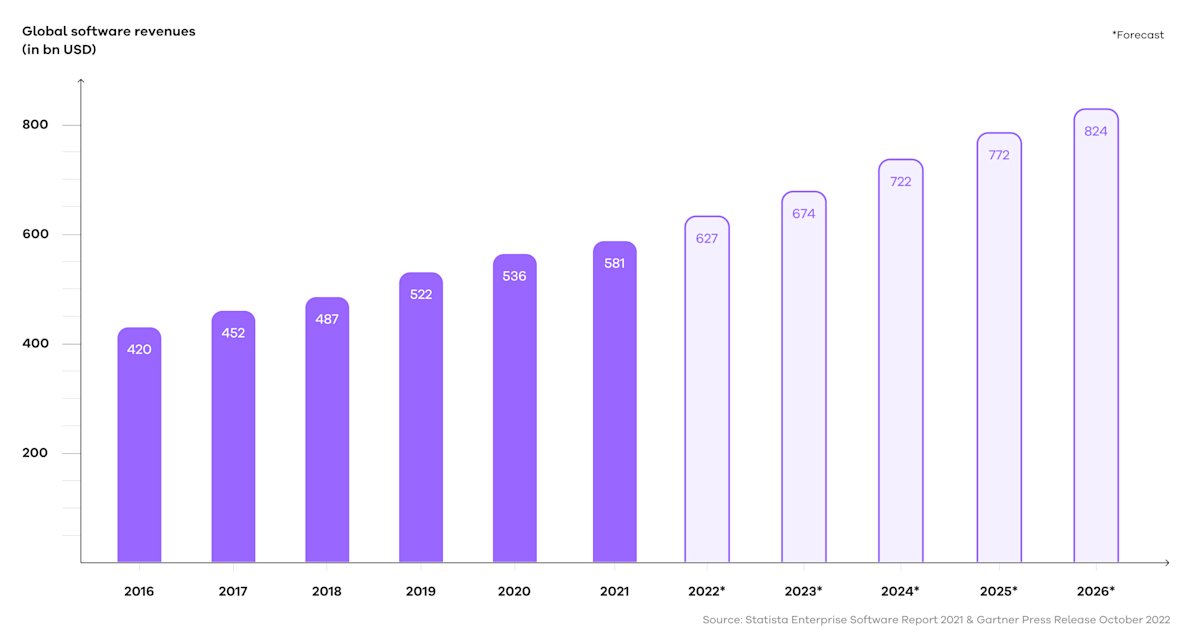
The software we work—and code—with also is becoming ever more complex as we strive to solve bigger problems of increasing complexity at a faster pace. MS-DOS v1.25 (1983) had 13,587 lines of code, whereas Windows 11 (2021) has more than 50 million. And if you own a smart fridge, you have more computing power in your kitchen than we needed to put a man on the moon.
The growth in demand for more and better software is unbroken. And that is a good thing. Software is the key driver to progress and essential for enabling us to together tackle the various challenges facing humankind.
But to do so, one crucial question remains: How do we serve the tremendous demand for software?
## A lever to improve software development
Building software requires several things; the main are hardware (to code on), tools (to code with) and software engineers (to write the code).
Looking at these key ingredients for software, the most obvious solution for producing more seems to be to increase the number of software engineers.
Depending on which source you trust, there are currently [between 24 and 27 million software engineers](https://www.developernation.net/developer-reports/dn21) in the world—and [the number is increasing](https://www.statista.com/statistics/627312/worldwide-developer-population). But with established tech companies hiring more engineers, enterprises boosting their development budgets, and more venture capital flowing into startups that need software, demand for developers far exceeds the available talent. In other words, even if every school and bootcamp outperforms expectations, [there still won’t be enough graduates](https://hired.com/2022-state-of-software-engineers/)—not even close—to keep up with demand in the coming years.
What about providing existing software engineers with (even) more and better training or improving the processes they work with? Obviously, our methods and methodologies have continuously improved, increasing developer teams’ productivity—and they are still being optimized. The latest significant breakthrough, however, was the agile landslide based on the Agile Manifesto written in 2001. And Scrum dates even back to the early 1990s. There might be more leverage in teaching and continuing to develop these methods, but progressing beyond agile, Scrum and other methods is definitely not a low hanging fruit anymore.
If we can’t satisfy the growing demand by training more and better engineers faster, would improving the hardware they work with make a difference?
We don’t think so.
In the last ten years, hardware (such as laptops, workstations, monitors, etc.) has become largely commoditized—and affordable for businesses. Much of it has even been replaced by software running in the cloud and accessed via APIs. Whether engineers work on a PC or Mac does not matter much anymore: Prices might differ, but in terms of improving software development, the hardware selection of developers—if not done completely wrong—has little leverage on their output.
Since neither increasing the number of software engineers nor a further optimization of hardware or development methods can satisfy future software demand, it’s worth considering our remaining lever: the tools developers code with.
## Developer tools in the spotlight
For each stage in the software development process—planning, building, testing, deployment, running and monitoring—software engineers have a range of development tools at their disposal to support them in their work. Beyond that, there is an increasing number of low code and no code platforms and tools available. But while at first glance it seems like developers have everything they need, a closer look reveals much room for improvement.
As software becomes more complex, the tools to build it must evolve in parallel. In the days of assembly, engineers needed to write every single statement executed by the CPU. Then came C, abstracting away so much that engineers could solve much more complex problems. Object-oriented programming, garbage collection and virtualization; innovations like these multiplied the amount and complexity of real-life problems a software can handle within its domain.
To keep up with the demand and improve developer productivity, investing in state-of-the-art software development tooling is essential—imagine if we had never progressed beyond binary code! Without the most innovative and up-to-date tools for the job, developers must make do with what they have, increasing development time, costs and risks—and decreasing the quantity and quality of their output.
So, if the benefits of adequate tooling seem so self-evident, how much is the world spending on software development tools? Approximately $24 billion in 2022.
This sounds impressive, but it’s a drop in the ocean when compared with the overall IT market: In 2022, we are projected to spend [over 4.4 trillion USD on IT](https://www.gartner.com/en/newsroom/press-releases/2022-10-19-gartner-forecasts-worldwide-it-spending-to-grow-5-percent-in-2023).
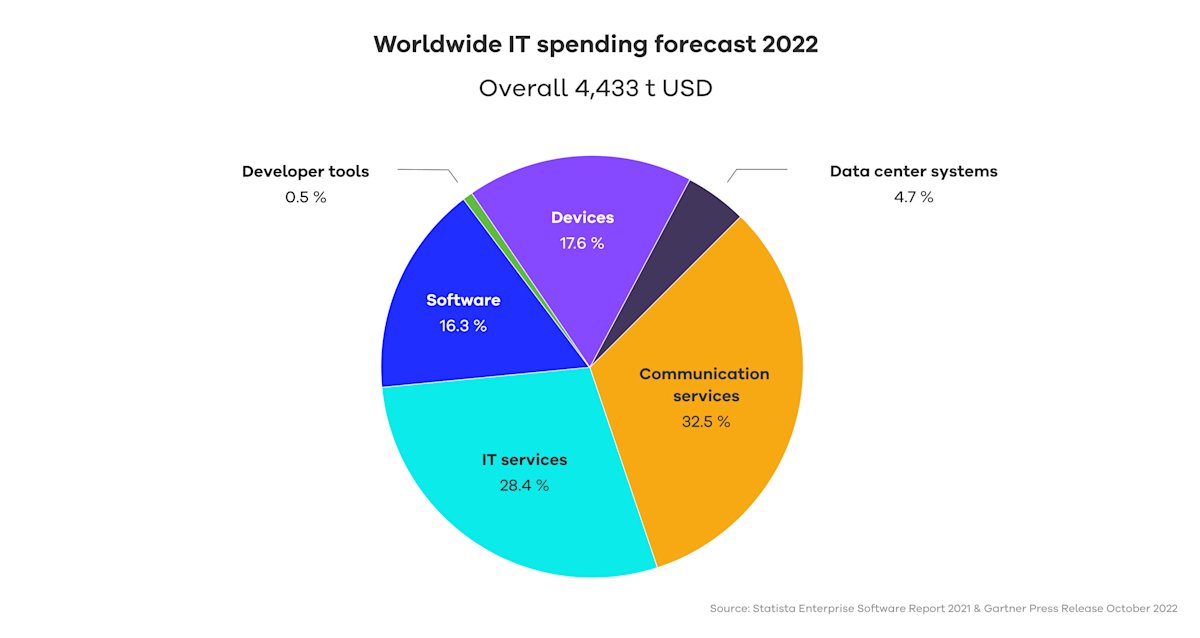
So, while companies spent almost a third of their budgets—in total 1,280 billion USD(!)—on third-party providers, they spent only 24 billion USD on ensuring that their developers have the tools they need. In total, only 0.5% of all IT costs account for investments into proper developer tooling.
This stunningly low figure has a strong limiting impact—in the form of wasted potential—on our global software output.
Instead of a niche market, developer tools must become key drivers for the future growth of the software industry. It is therefore our goal to multiply the money spent on proper developer tooling by at least 10x.
_In part 2 of our series, we will show you how—stay tuned!_
---
---
title: "WeAreDevelopers World Congress 2024 highlights: News and trends from Berlin's biggest developer conference"
date: "2024-07-29T00:00:00.000+02:00"
author: Christian Kemper
collections: [Events]
tags: [WeAreDevelopers, Technology, AI, Events]
source_url: "https://yatta.de/thoughts/wearedevelopers-world-congress-2024-highlights"
---
# WeAreDevelopers World Congress 2024 highlights: News and trends from Berlin's biggest developer conference
Started as a side project with friends, WeAreDevelopers (WAD) was initially more of a hobby for CEO & co-founder Sead Ahmetovic. Today’s WAD World Congress aims to close the gap between developers and decision-makers. It promotes a broad community that can network and exchange ideas regardless of the tech stack, programming language, or developer tools used.
## A framework for tech
David Simas (pictured above) kicked things off in the opening keynote. The Managing Director of Research & Impact at Emerson Collective, former White House Political Director and then CEO of the Obama Foundation, spoke about "civic coding" and a "framework for democratic tech". He underlined that developers influence companies, societies, countries, and the whole world like never before. Awareness of one's rights and responsibilities is crucial: “Remember who you are and who you represent,” he urged the audience. “Technology has triggered epic changes,” David went on to explain, such as:
- The disruption of economies and destruction of affluence, especially that of the middle class.
- The transformation of culture and demographics, increasing differences between people.
- The accumulation of knowledge and the need to determine truth from fiction.
In his proposed framework for tech, David identified three aspects of leadership for developers to embrace:
1. Leadership of self—awareness of ego, vanity, and pride, and personal biases and triggers.
2. Leadership of others—endorsing diversity and the perspectives of others, managing disagreements, and fostering openness in thought.
3. Leadership to serve—achieving and striving for your goals while noting interdependencies and serving citizenship and solidarity.
To give our European readers a little more context: As in the EU, the pros and cons, as well as the how much, of Big Tech regulation are heatedly debated in the US. While 60% of Democrats say major tech companies should be regulated more, a slim majority of 55% of Republicans are against more regulation, even though the difference between the two parties (in this regard) is narrowing (Source: [PEW Research Center, ](https://www.pewresearch.org/internet/2024/04/29/americans-views-of-technology-companies-2/)"Americans' Views of Technology Companies" survey, February 2024). Unlike in the EU, regulation is discussed here less with a consumer protection perspective and more in context of the conflict between the (regulatory) freedom of speech versus the protection of personal rights (including personal identity). In other words, how much does a free society, but also every individual, have to tolerate and endure from other (co-)users on omnipresent social media platforms? And to what extent should the lawmakers be allowed to step in and regulate social media platforms in order to protect users from each other? Given this background, of course, the question arises as to what "democratic tech" in the sense of David Simas is actually supposed to mean.
We think that democracies and their governments are generally well advised to exercise restraint when it comes to state coercion. Free private platform providers, on the other hand, are in our view (more) free to apply stricter standards to their user community than mere compliance with the criminal liability threshold. This applies at least as long as they do not violate any laws themselves, do not discriminate against anyone—and as long as they do not have a monopoly (and therefore sovereign-like) position. In general, we prefer not to let politicians, lawmakers or governments decide which technology, which (free and legal) opinion or which company should prevail, but to simply let the power of the market (and the better argument) take effect.
## Developers' usage of AI
Rajeev Rajan, CTO at Atlassian, also took the WAD main stage. His thesis? Generative AI is already increasing developer joy. “When developer joy suffers, so does innovation,” Rajeev stated. “But developer joy isn’t just something to be measured in qualitative terms, like a 10x increase in experimentation and a measure of productivity. It’s more than that; it’s the flow of creativity.”
Rajeev believes that AI will make developers more productive by functioning as an assistant with humans in control. He addressed what he sees as the three major obstacles to developer joy and where AI can have a huge impact:
- Tech debt—imagine giving an entire source code report to AI to scan. Why not ask it to find a common set of problems and automatically fix them at the push of a button?
- Insufficient documentation—Gen AI’s search functionality is improving at pace. Why shouldn’t it allow developers to quickly search across all apps and formats for documentation?
- A lack of time for deep work—incidents or noise pull developers away from the work they’re doing. What if AI could group similar alerts, detect patterns, and find the root cause automatically?
Rajeev finished his talk by asking the audience to think about how to drive change and mitigate the effects. “It’s up to us to change the future,” he declared. “AI has the potential to supercharge developers, supercharge humans, and enable us.”
In fact, since the days of early computing in the 1940s, software and technology have created value by serving us ever more and even better. Increased developer productivity is the more, and the results of our creativity is the better. Of course, the two elements here in parts depend on and influence each other. Thus, every better tooling, every programming language, every IDE, and every framework that has helped us as developers to develop more & better software has ultimately improved our ability to create more value for others through our ideas, creativity, and craftsmanship. We expect nothing less (but also nothing more) from AI.
## Future of the Internet
Prashanth Chandrasekar, CEO of Stack Overflow, in his talk, compared what he called the “new super cycle” of AI with previous watershed moments such as personal computing in the 1980s, the Internet in the 1990s, mobile computing in the 2000s and cloud computing in the 2010s. Meanwhile, he thinks the 2020s will be remembered as the decade of AI.
The year 2023 was, according to Prashanth, especially notable: a year of change catalyzed by the arrival of ChatGPT and other LLMs. He then went on to outline how Stack Overflow’s partnerships with providers such as Google Cloud and OpenAI are intended to keep improving OverflowAI, a natural language search tool for questions on coding and software engineering. The company’s long-term vision for software engineers is that they will never have to leave their IDE while coding—because ultimately, he says, that’s where this is all going: To keep you in your flow.
> “The future of the AI ecosystem remains grounded in quality data.”
>
> — Prashanth Chandrasekar, CEO of Stack Overflow
Prashanth also gave a preview of the [Stack Overflow 2024 Developer Survey](https://survey.stackoverflow.co/2024/). Every year, the survey delivers insights into the global developer community. As in the previous year, much of the focus was on AI. Before concerns are raised against the alleged hype, we would like to point to this year's key findings: Because 63.2% of all professional developers said that they are already using AI in their software development processes—another 13.5% plan to do so soon. 81% of all respondents stated that AI increases their productivity and identified this as the greatest benefit of AI tools for developers.
We therefore think: AI is by no means just a hype, rather the "hype" has long since found its way into professional software development—and the day-to-day work of developers. Certainly there is more to come in the not-too-distant future. We are looking forward to it!
### Share your thoughts with us
These are our takeaways from the WAD World Congress 2024 in Berlin. Discover what we’re up to next or share your WAD conference takeaways with us on [LinkedIn](https://www.linkedin.com/company/yatta-solutions-gmbh/).
Also, check out WAD’s YouTube channel to catch more conference content:
[WeAreDevelopers Conference Recap Day One](https://www.youtube.com/embed/BlBiNUCmfuM)
---
---
title: "TechCrunch Disrupt 2024 highlights: The latest trends from San Francisco’s annual tech conference"
date: "2024-11-12T00:00:00.000+01:00"
author: Rupert Burnham
collections: [Events]
tags: [TechCrunch, Disrupt, Technology, AI, Events]
source_url: "https://yatta.de/thoughts/techcrunch-disrupt-2024-highlights"
---
# TechCrunch Disrupt 2024 highlights: The latest trends from San Francisco’s annual tech conference
At TechCrunch Disrupt, [Dropbox unveiled its cloud storage service](https://www.youtube.com/watch?v=frsVoYyKpTk) for the first time to the public. That was in 2008. Today, in 2024, the company is valued at $8.5 billion. Numerous other startups (including Trello and Yammer) have since made the pilgrimage to downtown San Francisco to take part in the Disrupt "Startup Battlefield". This year was no exception.
Here's our take on the dominant themes and more interesting conference conversations.
#### AI, AI, AI—and AI regulation…
The most discussed topic at the conference was - _of course_ - yet again AI. This time, however, many of the talks were no longer about the technology itself, but about its regulation. As one of the first speakers, Vinod Khosla, co-founder of Sun Microsystems and renowned venture capitalist, took to the main stage to discuss AI risks and opportunities.
[Vinod Khosla looks into the past to see the future of AI | TechCrunch Disrupt 2024](https://www.youtube.com/embed/B41F8Ub0_9Q)
##### What benefits AI may bring us all
A straight-talking, prescient voice, Vinod advocates for technology to be used with care and compassion and considers himself as a technology possibilist—you might even call him a [Techno-Optimist](https://yatta.de/thoughts/technology-can-lead-to-dystopia-or-be-our-savior). He states that the dystopian narrative around AI “takes away so much from all the people who stand to benefit.” By contrast, he suggests that a utopian narrative _must_ be advanced to explain what AI could afford us. Phrasing it in terms of how AI will be able to augment human expertise, Vinod concluded: “It doesn't matter whether you're talking about primary care physicians, mental health therapists, oncologists, structural engineers, or accountants—all of it (their services) can be near free”.
)](https://images.ctfassets.net/9jm3t1lrj5m2/3PTUUug3sYPOqiesKcTf7E/3767082bf8024699b3ac4738b132a2d2/54099913277_fd68d8a611_o.jpg?w=1200&fm=jpg&q=85)
_(Photo: Kimberly White/Getty Images for TechCrunch; [license notice](https://creativecommons.org/licenses/by/2.0/))_
Overall, Vinod (pictured above, being interviewed by TechCrunch editor-in-chief Connie Loizos) predicts that AI could increase global GDP growth from 2% to well over 5%, though he gave no timeframe for his prediction. This potential increase would create more than enough abundance to take care of anyone negatively impacted.
Reiterating his views from his recent essay “[AI: Dystopia or Utopia?](https://www.khoslaventures.com/ai-dystopia-or-utopia/)”, he believes AI would let us fundamentally redefine what it means to be human. No longer would people’s existence be defined by the work that they do and must do. He further comments:
> “The AI cycle will be faster than previous technological shifts, making adjustment harder.”
>
> — Vinod Khosla, founder of Khosla Ventures in: “AI: Dystopia or Utopia?”
Acknowledging the fears of people who might be negatively impacted by AI, Vinod firmly believes that these fears can be countered by the societal choices we make. Agreeing that AI safety should be addressed as there is a risk associated with it, he posited that this ought to be put into perspective as one of many existential risks facing humanity.
##### Regulating transformative technologies
When new technologies emerge that challenge existing paradigms, such as the internet or, more recently, AI, we tend to immediately think about regulating them, whether out of fear of the new or concern about change. That’s what Martin Casado, general partner at Andreessen Horowitz (also known as [a16z](https://a16z.com/)), discussed on the Builder’s Stage.
Technology and regulation coexist uneasily, but from Martin’s perspective, the discussion around regulating AI hasn’t paid attention to past examples and is too focused on conjuring up entirely new regulation—as he believed was the case with the State of California’s [Safe and Secure Innovation for Frontier Artificial Intelligence Models Act (SB1047)](https://leginfo.legislature.ca.gov/faces/billNavClient.xhtml?bill_id=202320240SB1047).
The crucial point to consider here is that, first, in order to regulate, you need to know exactly what it is that you want to control. An interesting observation that Martin shared was that California's historic AI safety bill SB1047, flawed though the legislation was, did force the issue of regulation, creating substantial academic dialogue on the topic, something that had previously been lacking. He then cited a proposal titled [”A Path for Science and Evidence-based AI Policy”](https://understanding-ai-safety.org/) by Dr. Li Fei-Fei and Dawn Song, Professor in the Department of Electrical Engineering and Computer Science at University of California, Berkeley, and others, looking at marginal risk for AI. If we are to regulate, then the authors argue that it should be evidence-based regulation with a solid understanding of marginal risk at its center.
In his panel, Martin of a16z stressed the importance of academic experts being part of the dialogue and listening to those voices. If they’re saying that something is going to be bad for the industry, then it’s imperative to understand what that is and use their expertise to help shape policy correctly.
> “The incompleteness of the AI Act fails to provide legal certainty to AI developers and deployers. Moreover, it generates high compliance costs, especially for SMEs and start-ups that might find the EU regulatory environment too costly and risky.”
>
> — Bertin Martens, senior fellow at Bruegel, in: [“The European Union AI Act: premature or precocious regulation?”](https://www.bruegel.org/analysis/european-union-ai-act-premature-or-precocious-regulation)
Being [Techno-Optimists](https://yatta.de/thoughts/technology-can-lead-to-dystopia-or-be-our-savior) like Martin, we agree with his stance. The absence of evidence-based regulation leads to legislation like the 144 page-strong European Union’s [AI Act](https://eur-lex.europa.eu/legal-content/EN/TXT/?uri=CELEX%3A32024R1689&qid=1731073825866) that risks slowing down, restraining and even hindering progress and innovation, something we strongly oppose. As much as necessary and as little as possible – that is our regulatory stance to allow innovation to flourish. Phrasing such as "in advance", "as comprehensively as possible", or "just in case ..." is, in our view, not indicative of either an adequate or a commensurate regulatory approach.
)](https://images.ctfassets.net/9jm3t1lrj5m2/2mUBKA3EtjX5ObI272g04I/903829c737c548e6f467917a7a868730/54103689349_5cb3e32c4f_o.jpg?w=1200&fm=jpg&q=85)
_(Photo: Kimberly White/Getty Images for TechCrunch; [license notice](https://creativecommons.org/licenses/by/2.0/))_
#### Top startup traits that capture VC interest
Besides AI, conversations at TechCrunch also addressed the venture capital landscape. They highlighted the critical importance of several key factors for VCs and startups alike.
###### **Customer-centric approach and market awareness**
First of all, success hinges on working closely with customers to solve an actual problem and possessing a deep understanding of the relevant market dynamics and the investor ecosystem that can support the solution.
###### **Evidence-backed founder confidence**
Secondly, as emphasized in the discussion with VC Sound Ventures, Ashton Kutcher (pictured above), Guy Oseary, and Effie Epstein, founders can leave a lasting impression by presenting an idea with confidence as long as it is bolstered by solid numbers and facts. Never mind the deck; the main thing is whether the story is compelling and feels like a no brainer once the problem and solution have been presented.
###### **Hard work and unwavering commitment**
Thirdly, in order to successfully build the business, it is essential to foster a culture that focusses on and rewards dedicated hard work and initiative. People need to work in dedicated teams, and teams need to be empowered to do great work. This empowerment not only enhances innovation but also strengthens the potential for success in a competitive market.
This last point of success in a competitive market was strongly reiterated by Nest founder, Tony Fadell in his talk ‘[Building the Next Generation of Deep Tech Startups](https://www.youtube.com/watch?v=I-8NdMx-g60)’. When discussing what’s required to get something to market, he said it’s important to “give people enough rope, but not enough to hang themselves”.
Tony vehemently decried the culture of large tech corporations, arguing that their culture and immense resources promote entitlement, make it easier to hide, and breed complacency. As he sees it, a crystal-clear focus on the problem being solved, defined outputs, constrained resources and close collaboration _on site_ are the elements that are of critical importance to a company’s success – especially those that truly want to disrupt for the good.
[Building the next generation of deep tech startups with Tony Fadell](https://www.youtube.com/embed/I-8NdMx-g60?si=1dA8aGaGVHxtHm__)
More of Tony Fadell’s anecdotes, backstories as well as his straight-talking advice can be found in his book [“Build: an unorthodox guide to making things worth making”](https://www.buildc.com/the-book).
#### What’s essential for tech development
The conversation between Rivian CSO Wassym Bensaid and TechCrunch editor Kirsten Korosec on the last day of Disrupt covered “How to build tech that wins over customers”. They talked about building from scratch using first principles, paring back the complexity of technology, and how the customer experience is the essential component of the entire Rivian process. Naturally the discussion also [touched on AI](https://techcrunch.com/2024/10/30/rivians-chief-software-officer-says-in-car-buttons-are-an-anomaly/) and how future automotive developments could be impacted.
##### An uncertain partnership
More interesting though (at least from our perspective) the conversation ended with a discussion of Rivian’s software partnership with the Volkswagen Group which was announced in June–a venture that’s potentially worth up to $5 billion. From Wassym’s perspective, it’s a partnership that could transform the automotive industry, if successful, and he hopes it could position Rivian as the leading supplier of EV operating systems for the automotive industry. Alongside monetization opportunities for Rivian, he argued it would accelerate the global transition to sustainable transportation. These are bold claims to make given the [persistent supplier problems of Rivian](https://techcrunch.com/2024/11/07/rivian-takes-revenue-hit-as-supplier-problem-persists/), the recent [Q3 results of Volkswagen Group](https://www.volkswagen-group.com/en/press-releases/volkswagen-groups-nine-month-results-impacted-by-higher-fixed-costs-and-restructuring-provisions-18768), and the challenging economic outlook for Europe’s largest carmaker brought about by [flatlining sales in Europe and a collapse in its core Chinese market](https://www.politico.eu/article/brutal-financial-results-volkswagen-group-germany/). It is worth noting that all [European carmakers are currently struggling](https://www.euronews.com/business/2024/09/11/why-are-european-automakers-struggling-in-the-electric-vehicle-market) in the EV sector except for BMW, as reported by Euronews based on Bank of America analysis.
##### Raising the stakes
Nonetheless, after TechCrunch Disrupt 2024 ended, VW and Rivian announced they would further extend the partnership, and [intend to form a joint venture](https://rivian.com/de-DE/newsroom/article/rivian-and-volkswagen-group-announce-plans-for-joint-venture): “Rivian and Volkswagen Group Technologies”. It will create next-generation software-defined vehicle (SDV) platforms for use in both companies’ future electric vehicles. This would [see VW’s investment with Rivian increase](https://techcrunch.com/2024/11/12/the-rivian-volkswagen-joint-venture-deal-is-now-up-to-5-8b/) by some 16% to $5.8 billion and include a 50% stake in the joint venture. It’s something of quid pro quo for both companies, Rivian gets a much needed capital injection, while VW should better be able to compete in the competitive EV market with next-generation electrical architecture and software. At the very least the joint venture allays some fears that Rivian will run out of money before they become profitable.
#### Share your thoughts with us
These are our takeaways from TechCrunch Disrupt 2024 in San Francisco. Check out [TC’s YouTube channel](https://www.youtube.com/@TechCrunch/featured) for more conference content! And discover what we’re up to next or share your Disrupt takeaways with us on [LinkedIn](https://www.linkedin.com/company/yatta-solutions-gmbh/).
---
---
title: Making waves and moving forward – Introducing new roles and welcoming new teammates
description: "Imagine the scene: A rider suits up, straps on their water skis, and gazes out across uncharted waters. Suddenly they’re off, pulled forward at exhilarating speed as they carve their own path across the glassy water. No looking back, no looking down—the focus is on what lies ahead. It’s extremely hard work, and at the same time a balancing act that demands strength from and to the core. Planning and caution only go so far. What matters most is holding on and riding the momentum at best, much like a startup, after takeoff."
date: "2025-10-07T00:00:00.000+02:00"
author: Rupert Burnham
collections: [Company blog]
tags: [Careers, Leadership]
source_url: "https://yatta.de/thoughts/making-waves-and-moving-forward"
---
# Making waves and moving forward – Introducing new roles and welcoming new teammates
These thoughts also came to mind at our Summer Party a few weeks ago. Sunshine on the lake, a tree-lined shore, and a sandy beach were the perfect backdrop for teammates and their families to spend time together. “You should call it Family Day,” someone said. With waterskiing, wakeboarding, paddleboarding, canoeing, and an Aqua Park (with slides and trampolines), there were plenty of activities on offer, but also time and space to connect and share the most recent updates across the team.
##### A snapshot in numbers
On one of the last days of summer, 152 people (including 30 kids), comprising nearly 90 teammates, their families, and friends, gathered. They filled seven coaches, were invited to take part in six water-based activities and over 10 land-based games, attempted seven water ski jumps, had more than 300 sausages and toasted around 2.5 kilograms of marshmallows—that’s 358 marshmallows, give or take. Not healthy, but reasonable.
Just like the party, the company has grown in scale: Almost 90 teammates today, our team has grown by more than 27% since April 2024—with more to come. Furthermore, we’ve had over 46% year-on-year revenue growth since 2021. And so far in 2025, we’ve seen 37,000 new users and 150,000 new purchase transactions.
## The roles shaping what's next
This year, we’ve welcomed not only 12 new Software Engineers, but also our first Sales Directors and Product Managers, alongside new additions to our platform, and delivery teams. Here’s a closer look at them…
## Sales & business development
With Emanuel and Robby on board, we’re building the partnerships that make scaling possible.

### Emanuel Darlea, Sales Director
Emanuel relocated from Montreal to Frankfurt, bringing more than 15 years of sales experience. He’s managed portfolios worth up to $20 million, led global teams of 60 people, and worked with various Fortune 1,000 companies, including [Maersk](https://www.maersk.com/), and has sales and project management expertise in tech across industries.
At Yatta, he’s now focused on expanding partnerships and growing our presence internationally, especially in the tech industry. Born in Romania, raised in Germany, and later moving to Canada, he’s fluent in English, French, and Romanian, and speaks German and Spanish at an intermediate level. Outside work, Emanuel is a keen cook, avid traveler, and natural problem solver who thrives on connecting with people to tackle and master challenges.

### Robert Scharf (Robby), Sales Director
Robby joined us from [LPA](http://www.l-p-a.com) with nearly 20 years of sales and networking experience. He began his career selling diamonds—a masterclass in people and persuasion. At Yatta, he’s focused on growing our vendor base, particularly in public transportation and the public sector.
In his former life, Robby was a talented and highly disciplined athlete: a footballer, a competitive swimmer, and a professional skier. Today, he is a true Madridista, has an impressive golf handicap of scratch and a _love_ of competitive sports. He met his wife 10 years ago through a shared love of diving, and they now have two young boys of five and three.
## Product management
Lisa brings instincts and hands-on experience that help turn vision into features.

### Lisa VanRielly, Product Manager
Lisa moved with her family from Denver, USA, to Frankfurt, Germany, bringing eight years of experience shaping complex B2B and B2B2C products in fintech, healthcare, and telecom. Most recently, at [Flywire](https://www.flywire.com/), she developed payment solutions designed for those who can afford the least.
At Yatta, she combines a sharp instinct for product growth with a passion for the human side of technology, building tools that empower rather than overwhelm (obviously, we couldn’t have found a better fit 😉).
Away from work, when she’s not adventuring with her partner and their two young kids, Lisa is a self-professed foodie on a mission: To eat her way through Germany in search of the perfect loaf of bread.
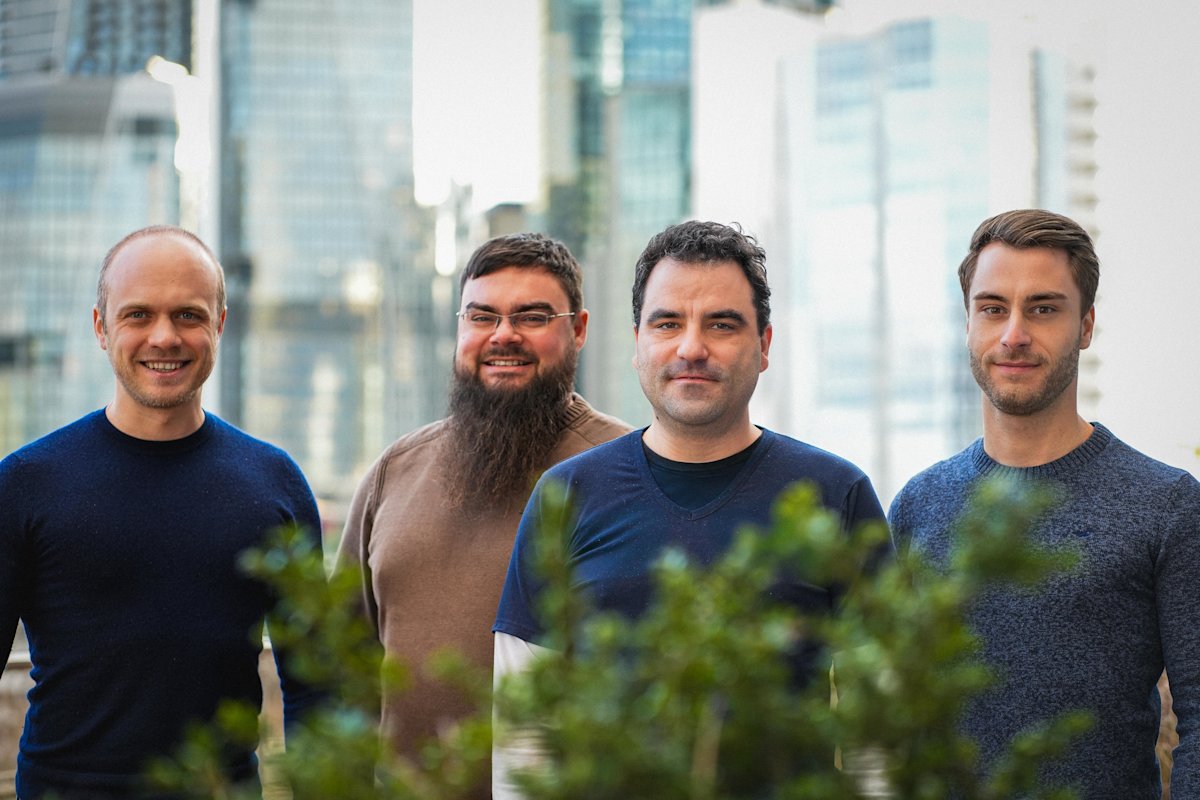
### Florian Schneider, Venture Team Lead
Florian (left) studied Computer Science in Wiesbaden and swiftly moved into software project management. He previously worked in the space industry, and most recently was Director of Consulting Services at [CGI](https://www.cgi.com/en).
As a Venture Team Lead, Florian brings together people, technology and strategy to turn ambitious ideas into running software and plans into outcomes. An astronomer in his spare time, he also loves cycling, table tennis and hitting the gym.
### Christopher Thonfeld-Guckes, Project Lead
Christopher (middle left) joined us, having previously worked for Zurich-based [triarc laboratories](https://www.triarc-labs.com/). In addition to his hands-on engineering mindset and creative energy, outside of work, he’s a drummer, accordion player, DIY home renovator and proud dad of three.
### Boris Malenšek, Head of Platform Services & Infrastructure
Bolstering our Platform Engineering team further, Boris (middle right) joined us from [Aiven](https://aiven.io/). Moving from Berlin to Frankfurt, he also worked for TomTom and Zalando. At Zalando, he scaled their Merchant Operations engineering organization from 20 to over 110 engineers.
A keen athlete, he previously played badminton in the Slovenian National League.
### Tim Schmidt, Venture Team Lead
Working alongside Florian as a Venture Team Lead is Tim (right). With a B.Sc. in computer science from DHBW Mannheim, he spent part of his studies at IBM, then led multinational development and platform ops teams at [Deloitte ](https://www.deloitte.com/global/en.html)with a focus on data engineering, cloud platforms, and AI.
As our other Venture Team Lead, Tim combines deep technical know-how with hands-on leadership to help teams and clients in Public Transport and beyond perform with digital products and systems. When he's not in the office, you can find him exploring the Taunus trails on his gravel bike.
## Software Engineering
This year, more software engineers have joined to push us further: New teammates include Ali Aminian, a seasoned backend and DevOps engineer with 16 years’ experience in banking and SWIFT finance; Arun Jose, who recently earned his master’s in Digital Engineering from the [University of Magdeburg](https://www.ovgu.de/) and brings hands-on experience from [Intel](https://www.intel.de/); Peter Leicht, a [TU Darmstadt](https://www.tu-darmstadt.de/) graduate and former IT consultant who also co-founded his own e-commerce startup; Ricardo “Rico” Reyna, who joins Team Nemo with an IT background from his time in the [U.S. Army in Wiesbaden](https://home.army.mil/wiesbaden/about/deutsch)—and a growing passion for writing code, learning Japanese, and playing guitar (with a drum set possibly next on the list); Roland Fuchs, who teaches computer science at [Hochschule Darmstadt](https://h-da.de/), joins us with deep C++ and architecture expertise, and still carries a hint of his metalhead roots; Sebastian Ochs, an active problem-solver and board-game enthusiast who’s also been known to code his own mini-games; and Shehryar “Shery” Bokhari, a Frankfurt native with dual degrees in mathematics and physics and five years as a lead developer. Also joining in Frankfurt is Noah Mühl as a working student.
And a further four engineers joined us in September: Laurenz Seipel, who worked in IT consulting as a Full-Stack Developer on web and iOS solutions; Amar Ademi, who completed his Computer Science degree at TU Darmstadt with a focus on cryptography; Jan-Philipp Fahlbusch, whose background spans mechanical engineering, machine learning, and the gaming industry; and Marvin Christian who joins Team Nemo having recently completed his Bachelor’s and Master’s degrees.
Collectively, they bring experience from institutions such as TU Darmstadt, the University of Magdeburg, Fulda University of Applied Sciences, and TU München, as well as from employers including Intel, the US Army Europe, and Ubisoft Mainz.
##### On the horizon
From Denver, Montreal, and Berlin to Frankfurt: Our new teammates bring expertise and fresh perspectives from all over the world. And in the upcoming event season, you’ll find us at [SaaStock](https://saastock-europe.com/), [TechCrunch Disrupt](https://techcrunch.com/events/tc-disrupt-2025/) in San Francisco and [Web Summit](https://websummit.com/) in Lisbon—come and say hi if you see us.
Or better yet, [check out our open roles](https://yatta.de/careers) and help us chart our course. 🏄♂️
---
---
title: "German Brand Award 2023: child and Yatta recognized for logo rebranding, with a special mention for corporate brand"
date: "2023-06-16T09:00:00.000+02:00"
author: Yatta
collections: [Company blog, Events]
tags: [Branding, Typography, Logo, Design, Press Release]
source_url: "https://yatta.de/thoughts/german-brand-institute-awards-our-branding"
---
# German Brand Award 2023: child and Yatta recognized for logo rebranding, with a special mention for corporate brand
In collaboration with [child – Studio for applied strategy](https://child.team/), Yatta has been honored with the [German Brand Award 2023](https://www.german-brand-award.com/) in the category “excellence in brand strategy and creation – brand design”. The jury awarded our efforts twice in [Brand Design Logo](https://www.german-brand-award.com/en/the-winners/gallery/detail/45869-yatta-rebranding-logo.html) and [Corporate Brand Identity](https://www.german-brand-award.com/en/the-winners/gallery/detail/45870-yatta-rebranding.html) with the German Brand Award 2023 Winner and Special Mention. The award ceremony took place in Berlin on Thursday, June 15, 2023.
## Branding is a success factor
The German Brand Award is an annual competition organized by the German Brand Institute. Since its establishment in 2016 by the German Design Council and GMK Markenberatung, the award aims to emphasize the significance of brand management as a crucial success factor in a competitive environment. With over 1,200 submissions each year, the award has gained recognition among companies, agencies, and service providers. It is considered as one of the marketing prizes with the widest reach in the German-speaking area.
The jury's decision considers aspects of the degree of innovation, sustainability, future viability, as well as design quality, homogeneity, and economic success. The jury consists of independent, interdisciplinary experts from companies, science, consulting, services, and agencies.
## **Connecting technology and human nature**
Our Yatta branding aims to continue the heritage of our company and emphasizes the human aspect of technology. For the Yatta logo and the corporate font, type designer [René Bieder](https://www.renebieder.com/) created a customized version of the Galano Grotesque to meet functional requirements and give it a more independent character. The new font was named Hiro Grotesque, inspired by the main character of the TV-series “Heroes”. As a software company, Yatta also had the technical Pondon designed, the Hiro Mono. As a non-proportional typeface based on Hiro Grotesque, this monospace font is specially developed for the use of code.
### **Do you want to know more about our (re-)branding? **
[Click here to take the deep dive! ](https://www.yatta.de/thoughts/brand-new-going-beyond-our-logo-and-website)
---
---
title: "You are the rising agent of our economic growth" – Attending the Start-up Lounge with Christian Lindner
date: "2016-06-20T15:00:00.000+02:00"
author: Yatta
collections: [Company blog, Events]
tags: [Start-Up Lounge, Press Release, Politics, Leadership, Events]
source_url: "https://yatta.de/thoughts/attending-the-start-up-lounge-with-christian-lindner"
---
# "You are the rising agent of our economic growth" – Attending the Start-up Lounge with Christian Lindner
Christian Lindner, national leader of the FDP, Germany's liberal democratic party, visited the Science Park in Kassel to meet entrepreneurs and participate in a panel discussion on startup-related topics.
Over 350 visitors attended the Start-Up Lounge in Kassel on 15 February 2016. The event had "Founders create futures" as its motto. Founders met with Christian Lindner, leader of Germany’s Liberal Democrats (Freie Demokratische Partei, FDP for short), who used to be a company founder himself. They first talked informally at the Science Park Kassel and then during a panel discussion on the premises of Walter Fenster + Türen.
At the Science Park, the epicenter of the Kassel start-up scene, Christian Lindner visited the start-up Yatta, which helps digitization processes to gather speed through software engineering. Afterwards, an informal get-together provided ample opportunity for the other founders to talk to Christian Lindner (and on an informal, first-name basis, too).
Lindner opened the panel with an ad-hoc presentation on the significance of start-ups for the German economy. Since they are courageous economic experiments or "the rising agent of national economies", start-ups have the opportunity to implement new, flexible, and innovative solutions. Even more traditional companies may ultimately benefit from these solutions. He also mentioned a „culture of failure “, just as he had done in his famous „tirade“ on the floor of the state parliament of North Rhine-Westphalia.
[Christian Lindner's 'tirade' in the NRW state parliament](https://www.youtube.com/embed/GrA8wwy5pLI)
The following discussion was suffused with the "start-up spirit" – and not just because business ties were no longer in evidence. On the stage, Lindner was joined by two successful start-up entrepreneurs from the Kassel Science Park, Johannes Jacop (CEO of Yatta Solutions GmbH) and Dr. Christoph Pohl (CEO of eta-opt GmbH), as well as by Erik Heinelt (CEO of askCharlie GmbH and director of the federal association of start-ups (_Bundesverband Deutsche Startups_)).
They primarily discussed various difficulties faced by new founders in their day-to-day doings, such as various bureaucratic stumbling block like new laws restricting working hours or how to document the working hours of interns. Another topic was problems with getting financial support as getting investors on board is currently discouraged by the broader structural requirements placed on new businesses.
Despite these difficulties, the panel concluded on a positive note: to encourage innovation requires many areas of public life and business culture to become more flexible and to take account of individual variation and freedoms. But change is already underway, Lindner emphasized.
---
---
title: Meeting Chancellor Merkel at the IT Summit 2011
date: "2011-01-06T00:00:00.000+01:00"
author: Yatta
collections: [Company blog]
tags: ["IT Summit 2011 ", Politics, Press Release, Leadership]
source_url: "https://yatta.de/thoughts/meeting-chancellor-merkel"
---
# Meeting Chancellor Merkel at the IT Summit 2011
Munich, December 6, 2011 – As German "ICT Start-up of the Year 2011" we were invited to the "IT-Gipfel 2011" (National IT Summit) where Germany's leading politicians, CEOs and CIOs debated the future of information technology.
At the Young-IT Lounge we met many interesting people, including German Chancellor Angela Merkel, Federal Minister of Economics and Technology Philipp Rösler, Bavarian Prime Minister Horst Seehofer, Bavarian Minister of State Manfred Zeil, and BITKOM President Dieter Kempf.
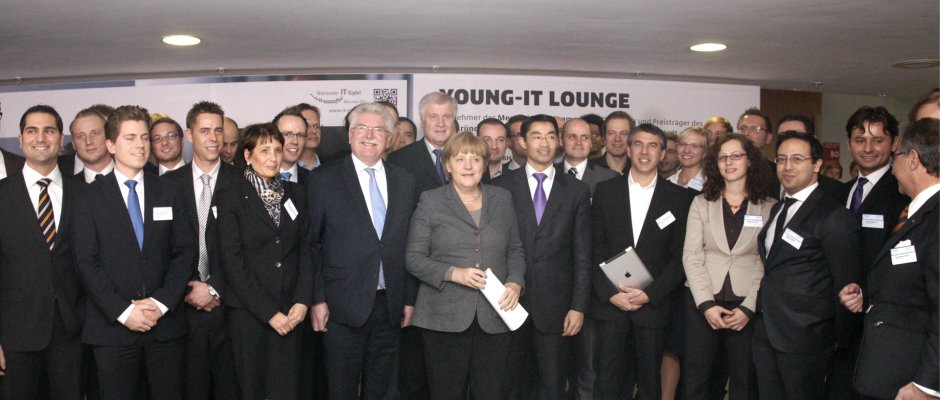
_(Picture by BMWi/Schmalz - all rights reserved)_
---
---
title: "Yatta at OMR23: Meet us on Europe's biggest digital and marketing festival "
date: "2023-05-04T00:00:00.000+02:00"
author: Yatta
collections: [Events, Company blog]
tags: [Software Development, Platform, Sales, Events]
source_url: "https://yatta.de/thoughts/yatta-at-omr23-meet-us-on-europes-biggest-digital-and-marketing-festival"
---
# Yatta at OMR23: Meet us on Europe's biggest digital and marketing festival
From Amazon, Google and Meta to Salesforce, Shopify and Twitch—more than 1,000 exhibitors are expected this year. And 70,000 visitors will be at the trade fair, attending masterclasses featuring well-known personalities and informative side events, go on guided tours, enjoy entertaining exhibition spaces and experience live concerts. We're there presenting Yatta Checkout—built to help monetize & sell digital products.
## Connecting techies
A lot is going on in Hamburg’s Messehallen during the OMR festival. The trade fair will connect digital entrepreneurs and tech companies from all over the world. Including the attendance of many innovative companies, who will be presenting themselves and their products. Yatta will be right there with them and can be found in hall A4, booth C10.
Get ready for inspiring insights from artists, scientists and industry leaders. And look forward to meeting Yatta at OMR 2023!
Do you want to know more about Yatta and our [Checkout](https://www.yatta.de/checkout)? It’s built to help digital creators and innovators sell their products. So make sure to drop a line to Frederic!
---
---
title: "Sunsetting Profiles Hub – Hosting service for Profiles to be discontinued "
date: "2022-09-28T12:00:00.000+02:00"
author: Yatta
collections: [Product news]
tags: [Eclipse, Profiles]
source_url: "https://yatta.de/thoughts/sunsetting-profiles-hub"
---
# Sunsetting Profiles Hub – Hosting service for Profiles to be discontinued
The world keeps changing — and Yatta Profiles is changing with it. Based on user and customer feedback, we will discontinue the hosting service for Yatta Profiles from 13 October 2022.
## Why are we sunsetting the Profiles Hub?
Our vision for Yatta Profiles was to allow developers to install and deploy their development stack quickly and easily. Based on the [Oomph](https://projects.eclipse.org/projects/tools.oomph) open-source framework, we developed an installer and a plugin with a hosting service for the [Eclipse IDE](https://www.eclipse.org/downloads/packages/).
Our vision has not changed.
But we have realized that our focus on the Eclipse IDE was too narrow: Wherever possible, developers should be able to define and deploy their tech stack independently of their chosen IDE. In this regard, containerization and other technologies are much more favorable than those used by Profiles back in 2015.
In order to pursue our original vision in the most effective way, we have decided to do a major revamp of our Profiles tooling. (In fact, we are planning a complete reimplementation. 😉) As part of this process, and to focus our limited resources, we will be discontinuing the Profiles Hub on 13 October 2022. Enterprise hosting will continue as agreed with our customers until further notice.
## You can continue using Profiles
Although you will no longer be able to search for and use Profiles on the Hub, we have ensured you can continue to download, install and use Profiles.
### Download the Launcher
You can get the Profiles Launcher from the following links:
- [For Windows](https://cdn.yatta.de/update/profiles/yatta-eclipse-launcher-windows-64.exe)
- [For Mac](https://cdn.yatta.de/update/profiles/yatta-eclipse-launcher-macosx-64.dmg)
- [For Linux](https://cdn.yatta.de/update/profiles/yatta-eclipse-launcher-linux-64.jar)
### Download the Eclipse plugin
You can find an up-to-date version of the Eclipse plugin at the following update site: [https://marketplace.yatta.de/update/profiles/client](https://marketplace.yatta.de/update/profiles/client)
### Share Profiles with teammates
Share Profiles using the Export and Import function. Exporting creates an Oomph file you can send to teammates. When they import your Oomph file, your Profile will be available for them to use.
Once you have logged in, you can export all your existing Profiles at any time using the Launcher.
The export and import functions are available in both the Launcher and the Eclipse plugin.
## What’s next?
To find out more about the next stage of our Profiles tooling, you can keep an eye out for updates [here](https://yatta.de/thoughts).
If you have any feedback, thoughts or questions we love to hear from our users — contact us at [info@yatta.de](mailto:info@yatta.de).
---
---
title: "Yatta releases IDE Intruders, an open-source mini game for the Eclipse community"
date: "2023-04-17T11:15:00.000+02:00"
author: Yatta
collections: [Product news]
tags: [Eclipse, Open Source, Eclipse Marketplace]
source_url: "https://yatta.de/thoughts/yatta-releases-ide-intruders-an-open-source-mini-game-for-the-eclipse"
---
# Yatta releases IDE Intruders, an open-source mini game for the Eclipse community
Software engineering company and Eclipse Contributing Member Yatta has released IDE Intruders, an entertaining open-source mini game that runs in the Eclipse IDE.
The Yatta development team has had a lot of fun putting this game together. You can [download IDE Intruders from the Eclipse Marketplace](https://marketplace.eclipse.org/content/ide-intruders-game-checkout-eclipse-demo) and try it for yourself. The game is also open-source — [the code is available on GitHub](https://github.com/YattaSolutions/de.yatta.ide-intruders-game) and you're invited to contribute!
The game is not only a fun way to engage with the Eclipse community, but also serves as an interactive demonstration of our [Checkout for Eclipse ecommerce solution](https://yatta.de/checkout-for-eclipse).
The Checkout for Eclipse helps tool builders and vendors sell software products— right from within the Eclipse IDE. The demo is designed to showcase the seamless purchase experience with Yatta Checkout, all while remaining inside the Eclipse IDE. If you like the experience and want to use the Checkout to monetize and sell your software products, Frederic from Yatta is happy to help.
With the Checkout for Eclipse, companies and members involved in the Eclipse community are taking a big step forward in positioning Eclipse as an open ecosystem. By enabling software vendors to efficiently monetize and sell Eclipse-based products, we hope to help the Eclipse community continuing to thrive and prosper.
## About Yatta
The German tech and software engineering company has been contributing to the Eclipse Foundation since 2011. Keen supporters of Eclipse, Yatta want to sustain an open ecosystem; they are a member of the Eclipse IDE working group, project lead of the Eclipse Marketplace Client, and Package Maintainer of the Eclipse IDE for Java Developers. Yatta also contributes to various open-source projects, including Eclipse Oomph.
## Contact
Frederic Ebelshäuser
_Eclipse Committer & Co-Head of Yatta Checkout_
[checkout@yatta.de](mailto:checkout@yatta.de)
+49 69 2475666-0
[www.yatta.de](https://www.yatta.de)
_This article originally appeared on the Eclipse Community News blog: _[_https://newsroom.eclipse.org/news/community-news/yatta-releases-ide-intruders-open-source-mini-game-eclipse-community_](https://newsroom.eclipse.org/news/community-news/yatta-releases-ide-intruders-open-source-mini-game-eclipse-community)
---
---
title: Software Engineering working group elects Leif Geiger as new chairman
date: "2016-09-22T12:00:00.000+02:00"
author: Yatta
collections: [Company blog]
tags: ["Eclipse Foundation ", Open Source, Team, Press Release]
source_url: "https://yatta.de/thoughts/software-engineering-working-group-elects-leif-geiger-as-new-chairman"
---
# Software Engineering working group elects Leif Geiger as new chairman
We congratulate Dr. Leif Geiger on his election as new chairman of the Bitkom working group Software Engineering.
As a team, we work on promoting excellent software made in Germany every day. This has been an important part of our commitment since we became an active Bitkom member in 2011. Leif's chairmanship emphasizes this commitment yet again. With Dr. Christian Schneider the working group already had another chairman employed by Yatta.
[Bitkom](https://www.bitkom.org/) is the industry association of the German information and telecommunication industry and pursues the goal to create the best possible conditions for companies in the industry. The working group software engineering advocates to further excellent software engineering.
## **About Leif Geiger**
Dr. Leif Geiger is co-founder and shareholder of Yatta. He holds a PhD in Software Engineering and is responsible for customer projects. As a technical expert, Leif brings more than 11 years of experience as a software architect and engineer to the position. Leif is married and a passionate mountain biker. Sometimes he even takes his son along in his bike trailer.
# Collections
---
---
title: Company blog
description: Articles in the "Company blog" collection on yatta.de.
source_url: "https://yatta.de/thoughts/collection/company%20blog"
section: Collections
---
# Company blog
Articles in the "Company blog" collection on yatta.de.
- [Startups in Hesse and our base at Science Park Kassel: "More than just an office"](https://yatta.de/thoughts/more-than-just-an-office) — Read this feature story of tagesschau.de and Hessischer Rundfunk about what's going on right now in the startup scene in Hesse—and check out what Johannes said about our base at Science Park Kassel and its impact on our growth.
- [HNA interview: “Man muss das halt auch geil machen”](https://yatta.de/thoughts/hna-interview-with-johannes-and-manuel-you-also-have-to-make-it-badass) — In this interview, you'll learn more about what drives us, how to build and grow a business, and why hard work pays off.
- [IHK Kassel-Marburg interview with Johannes](https://yatta.de/thoughts/ihk-kassel-marburg-interview-with-johannes) — Explore this magazine questionnaire about developing ideas, decision making, nerve-wracking as well as empowering experiences — and what to pass on to future generations.
- [Making waves and moving forward – Introducing new roles and welcoming new teammates](https://yatta.de/thoughts/making-waves-and-moving-forward) — Imagine the scene: A rider suits up, straps on their water skis, and gazes out across uncharted waters. Suddenly they’re off, pulled forward at exhilarating speed as they carve their own path across the glassy water. No looking back, no looking down—the focus is on what lies ahead. It’s extremely hard work, and at the same time a balancing act that demands strength from and to the core. Planning and caution only go so far. What matters most is holding on and riding the momentum at best, much like a startup, after takeoff.
- [German Brand Award 2023: child and Yatta recognized for logo rebranding, with a special mention for corporate brand](https://yatta.de/thoughts/german-brand-institute-awards-our-branding)
- [Yatta at OMR23: Meet us on Europe's biggest digital and marketing festival ](https://yatta.de/thoughts/yatta-at-omr23-meet-us-on-europes-biggest-digital-and-marketing-festival)
- [Bitkom’s Software Steering Committee: Yatta co-founder Leif Geiger was re-elected as co-chairman](https://yatta.de/thoughts/bitkoms-software-steering-committee-yatta-co-founder-leif-geiger-re-elected)
- [Brand new – Going beyond our logo and website](https://yatta.de/thoughts/brand-new-going-beyond-our-logo-and-website) — Relaunching the Yatta brand
- [Brand new – (Re-)shaping our company brand](https://yatta.de/thoughts/brand-new)
- [A sneak peek behind the curtain: Thoughts on software, technology and the future](https://yatta.de/thoughts/a-sneak-peek-behind-the-curtain)
- [Leif Geiger elected Package Maintainer of Eclipse IDE for Java Developers by the Eclipse Packaging Project](https://yatta.de/thoughts/leif-geiger-elected-package-maintainer-of-eclipse-ide-for-java-developers)
- [Leif Geiger re-elected to lead Bitkom Working Group Software Engineering](https://yatta.de/thoughts/leif-geiger-re-elected-to-lead-wg-software-engineering)
- [Girls' Day 2017: Teens explore the world of software development](https://yatta.de/thoughts/girls-day-2017)
- [Art meets software: Works by artist Frank Kambor decorate our Frankfurt office](https://yatta.de/thoughts/art-meets-software)
- [15 talks you shouldn't miss at Devoxx US 2017](https://yatta.de/thoughts/15-talks-you-shouldnt-miss-at-devoxx-us-2017)
- [Yatta At OOP 2017: The latest trends in software technology](https://yatta.de/thoughts/yatta-at-oop-2017)
- [Software Engineering working group elects Leif Geiger as new chairman](https://yatta.de/thoughts/software-engineering-working-group-elects-leif-geiger-as-new-chairman)
- [Welcome, Freddy! – Frederic Ebelshäuser is now a new Yatta shareholder](https://yatta.de/thoughts/welcome-frederic)
- ["You are the rising agent of our economic growth" – Attending the Start-up Lounge with Christian Lindner](https://yatta.de/thoughts/attending-the-start-up-lounge-with-christian-lindner)
- [Venturing into a new era: Yatta opens a new office in Frankfurt am Main](https://yatta.de/thoughts/venturing-into-a-new-era)
- [Yatta receives “ICT Start-Up of the Year” award](https://yatta.de/thoughts/yatta-receives-ict-start-up-of-the-year-award)
- [Meeting Chancellor Merkel at the IT Summit 2011](https://yatta.de/thoughts/meeting-chancellor-merkel)
- [Yatta is now a member of the Eclipse community](https://yatta.de/thoughts/yatta-is-now-a-member-of-the-eclipse-community)
---
---
title: Product news
description: Articles in the "Product news" collection on yatta.de.
source_url: "https://yatta.de/thoughts/collection/product%20news"
section: Collections
---
# Product news
Articles in the "Product news" collection on yatta.de.
- [Digital tickets integrated in Google Wallet and Apple Wallet](https://yatta.de/thoughts/digital-tickets-integrated-in-google-wallet-and-apple-wallet) — Find out in this press release about additional features in the NVV app to store Deutschlandtickets as well as various other travel tickets, subscriptions, and surcharges.
- [NVV and Yatta expand digital ticket options in the NVV app](https://yatta.de/thoughts/nvv-and-yatta-expand-digital-options-in-the-NVV-app) — Read our joint press release about new features of the NVV app: more ticket types, plus the option to buy tickets now to travel later.
- [One click to the digital Deutschlandticket](https://yatta.de/thoughts/one-click-to-the-digital-deutschland-ticket) — This joint press release with the NVV announces the digital Deutschlandticket — and plenty of other fares — now available straight from the NVV app.
- [NVV launches new digital ticketing system based on Yatta Platform](https://yatta.de/thoughts/nvv-launches-new-digital-ticketing-system-based-on-yatta-platform) — Not long ago, it took three clicks to buy a public transport ticket in the NVV mobile app—and at least another 10 and numerous entries to register an account. This could easily take up to 5 minutes... That’s a lot of time when you're waiting at Königsplatz in Kassel and the tram is pulling in.
- [Yatta & NVV: How a company from Kassel helps make ticket purchasing smarter](https://yatta.de/thoughts/yatta-and-nvv-how-a-company-from-kassel-helps-make-ticket-purchasing-smarter) — A newspaper article looks at us, our Checkout, and our partnership with the Nordhessischer VerkehrsVerbund (NVV).
- [NVV has redesigned digital ticket sales in their mobile app—and switched to Yatta Checkout](https://yatta.de/thoughts/nvv-and-yatta-redefine-digital-ticketing-for-public-transport) — Buying digital tickets through the NVV app, the NVV website, or partner websites will become faster and more convenient. Find out how it's done in our joint press release.
- [Yatta releases IDE Intruders, an open-source mini game for the Eclipse community](https://yatta.de/thoughts/yatta-releases-ide-intruders-an-open-source-mini-game-for-the-eclipse)
- [Hello Checkout – A tool to sell any digital product B2B](https://yatta.de/thoughts/hello-checkout)
- [Case study: How Yatta Checkout helped us increase product revenues by 10.6x](https://yatta.de/thoughts/yatta-checkout-case-study)
- [Sunsetting Profiles Hub – Hosting service for Profiles to be discontinued ](https://yatta.de/thoughts/sunsetting-profiles-hub)
- [Yatta is now a member of the Eclipse community](https://yatta.de/thoughts/yatta-is-now-a-member-of-the-eclipse-community)
---
---
title: Technology
description: Articles in the "Technology" collection on yatta.de.
source_url: "https://yatta.de/thoughts/collection/technology"
section: Collections
---
# Technology
Articles in the "Technology" collection on yatta.de.
- [HiDPI in Eclipse: A deep intervention with lasting impact](https://yatta.de/thoughts/hidpi-in-eclipse-a-deep-intervention-with-lasting-impact)
- [Behind the scenes of development: Monitor-specific UI scaling for Eclipse under Windows](https://yatta.de/thoughts/look-behind-the-scenes-of-development-monitor-specific-ui-scaling-for-eclipse-under-windows) — Monitor-specific UI scaling for Eclipse under Windows is a problem, but solvable. We'll show you how on Heise Developer.
- [Why to be a Techno-Optimist](https://yatta.de/thoughts/why-to-be-a-techno-optimist)
- [Improving the balance between software quality and development efficiency with AI](https://yatta.de/thoughts/improving-the-balance-between-software-quality-and-development-efficiency)
- [Software testing with ChatGPT as an assistant](https://yatta.de/thoughts/software-testing-with-chatgpt-as-an-assistant) — In collaboration with Heise Developer, we explain how to use LLMs to write accurate unit tests for cross-platform projects.
- [How Apple could disrupt the automotive industry within a decade](https://yatta.de/thoughts/how-apple-could-disrupt-the-automotive-industry-within-a-decade)
- [Prompt Engineering: How to get more out of ChatGPT and other AI tools](https://yatta.de/thoughts/prompt-engineering-how-to-get-more-out-of-chatgpt-and-other-ai-tools) — With tools like ChatGPT, AI easy to use. The challenge is crafting prompts that give useful answers to the right questions.
- [Thoughts on transformation, part 2 – Struggles of the transformers](https://yatta.de/thoughts/thoughts-on-transformation-part-2)
- [Developer tool landscape, part 1 – The leverage of software development tools](https://yatta.de/thoughts/developer-tool-landscape-part-1)
- [Thoughts on transformation, part 1 – Software companies on the rise](https://yatta.de/thoughts/thoughts-on-transformation-part-1)
- [A sneak peek behind the curtain: Thoughts on software, technology and the future](https://yatta.de/thoughts/a-sneak-peek-behind-the-curtain)
- [CeBIT IoT conference guide – Internet of Things program highlights](https://yatta.de/thoughts/cebit-iot-conference-guide)
- [Digitization as the age of useless gadgets? Why inventions are not the same as innovation](https://yatta.de/thoughts/digitization-as-the-age-of-useless-gadgets)
- [Yatta At OOP 2017: The latest trends in software technology](https://yatta.de/thoughts/yatta-at-oop-2017)
- [Rise of the "d!conomy" – A portmanteau of the words "digital" and "economy"](https://yatta.de/thoughts/rise-of-the-d-conomy)
---
---
title: Knowledge
description: Articles in the "Knowledge" collection on yatta.de.
source_url: "https://yatta.de/thoughts/collection/knowledge"
section: Collections
---
# Knowledge
Articles in the "Knowledge" collection on yatta.de.
- [Minister Mansoori visits companies in North Hesse](https://yatta.de/thoughts/minister-mansoori-visits-companies-in-north-hesse) — What are the main economic challenges in the region? A HNA reporter on the road with Hesse’s Minister of Economic Affairs and the Wirtschaftsjunioren visiting our Kassel office.
- [From digital tickets to a connected region: How user-friendly mobility benefits people and the economy](https://yatta.de/thoughts/from-digital-tickets-to-a-connected-region) — Fewer clicks, getting around faster: a research paper on user-friendly mobility in North Hesse.
- [The economy in North Hesse and what makes it a great place to grow](https://yatta.de/thoughts/the-economy-in-north-hesse-and-what-makes-it-a-great-place-to-grow) — In this TV coverage, the Hessischer Rundfunk reports from Kassel on the state of businesses driving the region.
- [FORA | brand eins podcast: NEIN TO FIVE—the office and beyond ](https://yatta.de/thoughts/fora-or-brandeins-podcast-nein-to-five-the-office-and-beyond) — Listen to this brand eins podcast in collaboration with FORA about New Work and the future of the office, hosted by Frank Dahlmann.
- [How companies can close the personnel gap and attract IT specialists](https://yatta.de/thoughts/how-companies-can-close-the-personnel-gap-and-attract-it-specialists) — Germany’s labor market faces a dilemma: ambitious growth targets collide with a shortage of skilled workers. This journal article explains how companies can attract new IT talent.
- [Why to be a Techno-Optimist](https://yatta.de/thoughts/why-to-be-a-techno-optimist)
- [How Apple could disrupt the automotive industry within a decade](https://yatta.de/thoughts/how-apple-could-disrupt-the-automotive-industry-within-a-decade)
- [Superhuman skills become reality: Our key highlights and selected projections from OMR 2023](https://yatta.de/thoughts/superhuman-skills-become-reality)
- [Prompt Engineering: How to get more out of ChatGPT and other AI tools](https://yatta.de/thoughts/prompt-engineering-how-to-get-more-out-of-chatgpt-and-other-ai-tools) — With tools like ChatGPT, AI easy to use. The challenge is crafting prompts that give useful answers to the right questions.
- [Finance 4 Startups event with Horváth Partners: How startups manage costs and finances](https://yatta.de/thoughts/how-we-manage-our-costs-and-finances)
- [Thoughts on transformation, part 2 – Struggles of the transformers](https://yatta.de/thoughts/thoughts-on-transformation-part-2)
- [Developer tool landscape, part 1 – The leverage of software development tools](https://yatta.de/thoughts/developer-tool-landscape-part-1)
- [Brand new – Going beyond our logo and website](https://yatta.de/thoughts/brand-new-going-beyond-our-logo-and-website) — Relaunching the Yatta brand
- [Thoughts on transformation, part 1 – Software companies on the rise](https://yatta.de/thoughts/thoughts-on-transformation-part-1)
- [A sneak peek behind the curtain: Thoughts on software, technology and the future](https://yatta.de/thoughts/a-sneak-peek-behind-the-curtain)
---
---
title: Events
description: Articles in the "Events" collection on yatta.de.
source_url: "https://yatta.de/thoughts/collection/events"
section: Collections
---
# Events
Articles in the "Events" collection on yatta.de.
- [TechCrunch Disrupt 2024 highlights: The latest trends from San Francisco’s annual tech conference](https://yatta.de/thoughts/techcrunch-disrupt-2024-highlights)
- [WeAreDevelopers World Congress 2024 highlights: News and trends from Berlin's biggest developer conference](https://yatta.de/thoughts/wearedevelopers-world-congress-2024-highlights)
- [Our highlights from Collision 2024: The latest conference news from North America about AI, startups](https://yatta.de/thoughts/our-highlights-from-collision-2024)
- [Our highlights from the Slush 2023 conference: The tech, the trends, the takeaways](https://yatta.de/thoughts/highlights-from-the-slush-2023-conference)
- [Our highlights from TechCrunch Disrupt 2023: Tech trends from the Bay Area](https://yatta.de/thoughts/highlights-from-the-techcrunch-disrupt-2023-conference)
- [German Brand Award 2023: child and Yatta recognized for logo rebranding, with a special mention for corporate brand](https://yatta.de/thoughts/german-brand-institute-awards-our-branding)
- [Superhuman skills become reality: Our key highlights and selected projections from OMR 2023](https://yatta.de/thoughts/superhuman-skills-become-reality)
- [Yatta at OMR23: Meet us on Europe's biggest digital and marketing festival ](https://yatta.de/thoughts/yatta-at-omr23-meet-us-on-europes-biggest-digital-and-marketing-festival)
- [Finance 4 Startups event with Horváth Partners: How startups manage costs and finances](https://yatta.de/thoughts/how-we-manage-our-costs-and-finances)
- [Hackathon Darmstadt – Hacking for a better city](https://yatta.de/thoughts/hackathon-darmstadt)
- [Girls' Day 2017: Teens explore the world of software development](https://yatta.de/thoughts/girls-day-2017)
- [Digitization as the age of useless gadgets? Why inventions are not the same as innovation](https://yatta.de/thoughts/digitization-as-the-age-of-useless-gadgets)
- [15 talks you shouldn't miss at Devoxx US 2017](https://yatta.de/thoughts/15-talks-you-shouldnt-miss-at-devoxx-us-2017)
- [Yatta At OOP 2017: The latest trends in software technology](https://yatta.de/thoughts/yatta-at-oop-2017)
- ["You are the rising agent of our economic growth" – Attending the Start-up Lounge with Christian Lindner](https://yatta.de/thoughts/attending-the-start-up-lounge-with-christian-lindner)
---
---
title: Case study
description: Articles in the "Case study" collection on yatta.de.
source_url: "https://yatta.de/thoughts/collection/case%20study"
section: Collections
---
# Case study
Articles in the "Case study" collection on yatta.de.
- [HiDPI in Eclipse: A deep intervention with lasting impact](https://yatta.de/thoughts/hidpi-in-eclipse-a-deep-intervention-with-lasting-impact)
- [Case study: How Yatta Checkout helped us increase product revenues by 10.6x](https://yatta.de/thoughts/yatta-checkout-case-study)
- [B Braun Melsungen AG success story – Connecting devices and processes in hospitals](https://yatta.de/thoughts/b-braun-melsungen-ag-connecting-devices-and-processes-in-hospitals)
- [enercast GmbH success story – Performing online forecasts for renewable energies](https://yatta.de/thoughts/enercast-online-forecasts-for-renewable-energies)
- [1&1 Internet SE success story: Customer-oriented implementation through agile software development](https://yatta.de/thoughts/1-and-1-internet-se-customer-oriented-implementation-through-agile-software)
- [Hewlett Packard success story – Implementing Cloud Service Automation (CSA) with UML Lab](https://yatta.de/thoughts/hewlett-packard-implements-cloud-service-automation-csa-with-uml-lab)
# Careers
---
---
title: Careers - Software Engineer
description: "Is software engineering more than a job to you? Do you love problems because you can’t wait to dig in and find a solution? Do you believe in teamwork and collaboration to become your very best self? And do you want to build software that benefits and delights users in real life? Join us and become part of our team of researchers, developers, engineers, designers, and entrepreneurs."
location: [Frankfurt, Kassel]
employment_type: Full time
date: "2022-12-05T00:00:00.000+01:00"
source_url: "https://yatta.de/careers/software-engineer"
---
# Careers - Software Engineer
Is software engineering more than a job to you? Do you love problems because you can’t wait to dig in and find a solution? Do you believe in teamwork and collaboration to become your very best self? And do you want to build software that benefits and delights users in real life? Join us and become part of our team of researchers, developers, engineers, designers, and entrepreneurs.
_Location: Frankfurt, Kassel · Employment type: Full time · Posted: 2022-12-05T00:00:00.000+01:00_
#### Job description
Is software engineering more than a job to you? Do you love problems because you can’t wait to dig in and find a solution? Do you believe in teamwork and collaboration to become your very best self? And do you want to build software that benefits and delights users in real life?
Join us and become part of our team of researchers, developers, engineers, designers and entrepreneurs.
Help us turn challenging projects into success stories by building brilliantly simple digital products and services.
#### Key responsibilities & tasks
We develop software projects on behalf of customers and do research and development for our own software products and services, both open source and commercial.
- In-house software development in small, agile teams—for customers or for our own products and services (esp. software tools)
- Design and implementation of software components, products and services, from analysis and development to deployment and rollout
- Evaluation and analysis of new and existing technologies, frameworks and tooling for productive use in software development
- Continuous improvement of quality through relentless root-cause analysis, detailed code reviews, thorough documentation, testing, learning and debugging
- Active sharing of experiences and skills within and across development teams to improve software and code quality
- Contribute to and make good decisions to resolve complex problems and provide sustainable solutions for real life
#### Required qualifications
- Degree in computer science with above-average grades (preferably M.Sc., diploma or PhD) or similar qualification
- Several years of practical experience in designing and developing software, preferably as part of a development team (e.g., through work experience, open-source projects or internships)
- Technical know-how and skills that match (at least in part) our tech stack and responsibilities as developers. Everything else is a plus, as long as you are not obsessed!
-
Strong problem-solving and decision-making skills with good judgment and appreciation for feedback to develop and grow
Apply: [careers@yatta.de](mailto:careers@yatta.de)
---
---
title: Careers - Project Lead
description: "Software must fulfill its purpose as well as serve and inspire people. As Project Lead you are responsible for delivering—in terms of software—brilliantly simple results in time, scope and budget. "
location: [Frankfurt, Kassel]
employment_type: Full time
date: "2023-01-09T00:00:00.000+01:00"
source_url: "https://yatta.de/careers/project-lead"
---
# Careers - Project Lead
Software must fulfill its purpose as well as serve and inspire people. As Project Lead you are responsible for delivering—in terms of software—brilliantly simple results in time, scope and budget.
_Location: Frankfurt, Kassel · Employment type: Full time · Posted: 2023-01-09T00:00:00.000+01:00_
#### Job description
Software must fulfill its purpose as well as serve and inspire people. As Project Lead you are responsible for delivering—in terms of software—brilliantly simple results in time, scope and budget.
To master challenging software projects, you will have to enable your team of up to five software engineers through servant leadership, involve highly skilled experts (e.g., for UI/UX and QM/QA), take ownership, and work closely with end-users, customers and other stakeholders.
#### Key responsibilities & tasks
- Lead an in-house software development team of up to five teammates - Involve technical or business specialists (e.g., UI/UX design, QM/QA, strategy or technology) where useful and coordinate a cross-functional team
- Be a servant leader to your team and promote the Yatta spirit: Enable, develop and form your team in accordance with our culture code, mission, vision and values
- Maximize your project team’s output by enabling and developing your teammates and team
- Develop software products, systems and services with your team—and deliver high-quality results - Take ownership of your project team’s goals (e.g., for fulfilling all technical and business requirements) through thorough project management, planning and controlling
- Deliver in time, scope and budget—and exceed your customer’s expectations
- Be in charge of project revenues and budgets as well as the quality of results
- Become a software project wizard—and don’t rest, but evolve - Master your project management skills from team setup, organization and delivery to reports and controlling
- Become a strategic technical advisor to your stakeholders and clients, and help create value
- Serve and inspire end-users by building human-centric software, ideally at scale
- Contribute to the company-wide development of the entire Yatta team of teams - Promote and share positive results, but also knowledge and understanding
- Connect with clients and stakeholders and create long-term value
- Participate in training and development (Yatta Academy)
- Recruitment, onboarding and offboarding in your own team
- Evangelize and live our company culture
#### Required qualifications
**Education & skills**
- Degree in computer science with above average grades (preferably M.Sc., diploma or PhD) or similar qualification
- First leadership experience as part of an agile development team with two or more engineers
- Several years of experience in professional software engineering, preferably across the software lifecycle (i.e., from requirements engineering to software design, architecture, programming and implementation to deployment and operation)
- Solid understanding of software technologies and trends (e.g., tools, frameworks, libraries, programming languages and methods) including their limits and use cases, ideally for various target platforms, domains and applications (e.g., cloud, server, mobile, embedded)
**Personality and way of working**
- Strong team and leadership skills without hierarchical thinking
- Great conceptual and analytical understanding
- Fast comprehension of technical topics and empathy for human dynamics
- Ability to perform under high pressure; highly organized with a strong sense of ownership—and a pinch of idealism
- Good communication skills with high levels of German and English, both written and spoken
- Strong problem-solving and decision-making skills with good judgment and appreciation for feedback to develop and grow
- An entrepreneurial mind with a hands-on attitude to achieve long-term quality results through short-term actions, ideally with a basic understanding of lean management—and human-centric software design.
Apply: [careers@yatta.de](mailto:careers@yatta.de)
---
---
title: Careers - Venture Team Lead
description: "We are looking for Venture Team Leads who build trusting customer relationships, empower their teams and take ownership; people who understand and thrive in the software development market, and who enjoy leading projects to success"
location: [Frankfurt]
employment_type: Full time
date: "2022-12-05T00:00:00.000+01:00"
source_url: "https://yatta.de/careers/venture-team-lead"
---
# Careers - Venture Team Lead
We are looking for Venture Team Leads who build trusting customer relationships, empower their teams and take ownership; people who understand and thrive in the software development market, and who enjoy leading projects to success
_Location: Frankfurt · Employment type: Full time · Posted: 2022-12-05T00:00:00.000+01:00_
#### Job description
Do you see software projects in terms of technology as well as from a business perspective? Are you skilled at orchestrating technologies and the teams behind them?
We are looking for Venture Team Leads who build trusting customer relationships, empower their teams and take ownership; people who understand and thrive in the software development market, and who enjoy leading projects to success—from the initial business case through the entire software lifecycle.
Does this sound like you? Then we look forward to getting to know you!
#### Key responsibilities & tasks
**Key account management & customer success**
- Develop and expand our key accounts actively and systematically
- Acquire new customers and follow-up projects in close cooperation with the COO, including initiating and implementing pilot projects with analytically strong, technically skilled and creative teams
- Negotiate contracts in coordination with CEO and COO
- Manage multiple customer projects together with the respective project managers and development teams
- Take over revenue and prospective budget responsibility in the context of software projects
- Have a holistic and entrepreneurial perspective that considers the consequences of your actions and their impact on the company
- Strengthen our brand and personal networks through active involvement in marketing and networking
**Software engineering**
- Develop sophisticated software products, systems and services with and for our customers
- Lead multiple small, agile in-house teams (with four to six members each)
- Coordinate cross-functional responsibilities such as QA engineers, UI/UX design, content, legal, strategy, etc.
- Consulte independently with our customers at the intersection of business analysis and technical understanding across and beyond all phases of our products and services
- Steer project management to achieve the best possible quantitative and qualitative goals in time, scope and budget
- Orchestrate all contacts and stakeholders from different organizational levels – from developers doing the implementation to decision makers and budget managers
- Host workshops and meetings confidently with internal and external participants
**Team development**
- Leadership, empowerment, further development and building of teams
- Identification and promotion of strengths and potential
- Leadership and support of project leaders through close exchange (supported by COO)
- Optimization for the best possible joint output as a team
- Contribute to the company-wide development of the entire Yatta team
- Evangelize and live our company culture
- Participate in training and development (Yatta Academy)
- Recruitment, onboarding and offboarding in your own team
#### Required qualifications
**Education & skills**
- Degree in computer science, business informatics or similar with above-average grades (preferably M.Sc., diploma or PhD)
- At least 4 years’ experience in software development for platforms or products with responsibility for the quality of outputs and successful project implementation
- At least 2 years of leadership experience as part of a development team with 5 or more people and with cross-functional responsibilities (e.g., engineering, testing, design, content)
- Overview of proven and emerging software development technologies - Ideally with experience (as a developer and project lead) in projects with different programming languages (e.g., Java, .NET, Python) for different purposes (e.g., server, cloud, mobile, embedded)
- Basic knowledge of programming and modern software architecture to coordinate and evaluate projects
**Personality and way of working**
- Strong team and leadership skills without hierarchical thinking
- Very good conceptual and analytical understanding
- Fast comprehension and empathy for technical topics and human dynamics
- Ability to work well under pressure, highly organized, with a strong sense of ownership and a pinch of idealism
- Good communication skills with high levels of German and English, both written and spoken
- Solution and results oriented with a focus on quality over short-term pragmatism
- Hands on with an understanding of lean management, keeping the software’s end user in mind
Apply: [careers@yatta.de](mailto:careers@yatta.de)
---
---
title: Careers - UI/UX Designer
description: "Do you believe software should be more beautiful? When it comes to design, do you see yourself more as a scientist than an artist? Are you looking to join a team that will go the extra mile to deliver brilliant results?"
location: [Frankfurt]
employment_type: Full time
date: "2023-04-27T00:00:00.000+01:00"
source_url: "https://yatta.de/careers/ui-ux-designer"
---
# Careers - UI/UX Designer
Do you believe software should be more beautiful? When it comes to design, do you see yourself more as a scientist than an artist? Are you looking to join a team that will go the extra mile to deliver brilliant results?
_Location: Frankfurt · Employment type: Full time · Posted: 2023-04-27T00:00:00.000+01:00_
#### Job description
Do you believe software should be more beautiful? When it comes to design, do you see yourself more as a scientist than an artist? Are you looking to join a team that will go the extra mile to deliver brilliant results?
#### Key responsibilities & tasks
- Develop high-quality visual assets and UI components, ensuring consistency with our design guidelines and brand identity
- Create and maintain design documentation, including style guides, component libraries, and design specifications, to ensure a consistent and cohesive visual language across all our products
- Design and develop new concepts, pages and components for our company and product websites
- Co-create our Yatta product design across all media types and channels
- Designing visually appealing and intuitive UI/UX for our own products as well as customer projects
- Collaborate with co-founders, software engineers, marketeers, and writers to ensure the accurate implementation of designs
#### Required qualifications
- Graduate or postgraduate degree in graphic design, communication design, interaction design, digital media or similar
- 2+ years of relevant work experience in design (preferably in agencies, design-oriented companies, or startups)
- Proficient in common wireframing and design tools such as Figma, Adobe CC, etc.
- Basic understanding of HTML, CSS, and web frameworks (Note: You won’t need to code—that’s the developers’ job—but understanding the basics improves collaboration with the team)
- The ability to envision design as a system with implications on future outcomes and deliverables ideally backed by experience with software design systems, libraries, and components
- Strong analytical skills to transform complexity into design that works and inspires, a keen eye for aesthetics, usability, and typography with a penchant for precision and detail, to the point of perfection
- Interest in tech and development topics as well as issues and topics in and around startup culture
Apply: [careers@yatta.de](mailto:careers@yatta.de)
---
---
title: "Interactive & Motion Designer"
description: "Do you design clean, modern interfaces—and know how to make them move in ways that feel organic? Do you think in layout, typography, and hierarchy—but also timing, easing, and flow?"
location: [Frankfurt]
employment_type: Full time
date: "2023-04-27T00:00:00.000+01:00"
source_url: "https://yatta.de/careers/interactive-and-motion-designer"
---
# Interactive & Motion Designer
Do you design clean, modern interfaces—and know how to make them move in ways that feel organic? Do you think in layout, typography, and hierarchy—but also timing, easing, and flow?
_Location: Frankfurt · Employment type: Full time · Posted: 2023-04-27T00:00:00.000+01:00_
#### Job description
Do you design clean, modern interfaces—and know how to make them move in ways that feel organic? Do you think in layout, typography, and hierarchy—but also timing, easing, and flow?
We’re looking for an Interactive & Motion Designer who brings our brand & products to life through purposeful motion. Someone who translates ideas into experiences and takes ownership of motion and interaction across our entire digital ecosystem.
If you’re passionate about how things feel as much as how they look, and you thrive at the intersection of design, storytelling, and technology—let’s talk.
#### Key responsibilities & tasks
- Design intuitive, consistent user interfaces for web and mobile—and bring them to life with motion and interaction that guide and delight users
- Develop and maintain motion principles, animation systems, and interaction patterns that enhance usability and emotional connection
- Own the motion design domain: ensure conceptual, technical, and visual consistency across products and media
- Create micro-interactions, transitions, loading and state animations that enhance clarity while feeling effortless and alive
- Define component states, transitions, and motion guidelines for scalable reuse across design systems
- Prototype ideas in the relevant design and software programs and tools
- Support our marketing and communications teams with animations for product explainers, campaigns, and hero visuals.
- Continuously refine quality through thoughtful iteration, detailed feedback, and documentation
- Share knowledge and best practices through workshops, reviews, and documentation
- Collaborate closely with engineers and product teams to ensure designs are feasible, performant, and purposeful
- Contribute to a culture of design excellence, innovation, and teamwork
#### Required qualifications
###### **Education & skills**
- Degree in **digital design, interaction design, visual communication**, or a related field
- 2+ years of experience in UI or motion design (freelance or part-time work counts—as long as the projects were ambitious and meaningful)
- Strong conceptual and analytical thinking—able to translate complex ideas into clear visual and motion concepts
- Solid understanding of software technologies and trends (e.g., tools, frameworks, libraries) and how design interacts with them
- Proficient in **Figma **for interface design and prototyping, plus one or more motion tools (e.g., **After Effects, Lottie, Framer, Rive**)
- Basic understanding of HTML, CSS, JavaScript, SVG animation, including performance and feasibility considerations
- Portfolio that showcases exceptional motion design and interactive work—where motion enhances usability, clarity, and storytelling.
**Personality and way of working**
- Quick comprehension and empathy for both human and technical aspects of interaction design
- Enjoy working in interdisciplinary teams of engineers, designers, writers, and product specialists
- Passionate about learning, feedback, and continuous improvement
- Hands-on, structured, and driven by curiosity—with a love for details that make motion feel effortless
- Great communicator—able to articulate complex design and motion decisions clearly to engineers and stakeholders
Apply: [careers@yatta.de](mailto:careers@yatta.de)
---
---
title: Careers - Working Student Software Developer
description: |
Do you enjoy coding apps and programs outside your studies? And do you want to build software that benefits and delights users in real life? Here at Yatta, you’ll develop digital products and create real value, both economically and by pushing the envelope of how tech can help humanity. You’ll learn to use the latest technologies in real-world scenarios and will share knowledge with people who are among the best in their chosen field.
You will join a team of 65+ software engineers, creatives, and entrepreneurs with diverse backgrounds, who all work together on-prem in Germany. Together, we can turn challenging projects into success stories by building brilliantly simple digital products and services.
location: [Frankfurt, Kassel]
employment_type: "Part time (e.g., 16.5 hours per week)"
date: "2024-05-29T00:00:00.000+01:00"
source_url: "https://yatta.de/careers/working-student-software-developer"
---
# Careers - Working Student Software Developer
Do you enjoy coding apps and programs outside your studies? And do you want to build software that benefits and delights users in real life? Here at Yatta, you’ll develop digital products and create real value, both economically and by pushing the envelope of how tech can help humanity. You’ll learn to use the latest technologies in real-world scenarios and will share knowledge with people who are among the best in their chosen field.
You will join a team of 65+ software engineers, creatives, and entrepreneurs with diverse backgrounds, who all work together on-prem in Germany. Together, we can turn challenging projects into success stories by building brilliantly simple digital products and services.
_Location: Frankfurt, Kassel · Employment type: Part time (e.g., 16.5 hours per week) · Posted: 2024-05-29T00:00:00.000+01:00_
#### Job description
Do you enjoy coding apps and programs outside your studies? And do you want to build software that benefits and delights users in real life? Here at Yatta, you’ll develop digital products and create real value, both economically and by pushing the envelope of how tech can help humanity. You’ll learn to use the latest technologies in real-world scenarios and will share knowledge with people who are among the best in their chosen field.
You will join a team of 65+ software engineers, creatives, and entrepreneurs with diverse backgrounds, who all work together on-prem in Germany. Together, we can turn challenging projects into success stories by building brilliantly simple digital products and services.
#### Your tasks
We develop software projects for customers and do research and development for our own software products and services, both open source and commercial. Here are some of the things you will do as part of our team:
####
- In-house software development in small, agile teams
- Design and implementation of software components, products, and services, from analysis and development to deployment and rollout
- Evaluation and analysis of new and existing technologies, frameworks, and tooling for productive use in software development
- Continuous improvement of quality through relentless root-cause analysis, detailed code reviews, thorough documentation, testing, learning, and debugging
- Active sharing of experiences and skills within and across development teams to improve software and code quality
- Contributing to and making good decisions to resolve complex problems and provide sustainable solutions for real life
#### Your skillset and interests
- You’re working on your degree in computer science and have had very good results so far
- Your skills match (at least in part) our tech stack and responsibilities as developers. Everything else is a plus, as long as you are not obsessed :-)
- You have strong problem-solving and decision-making skills with good judgment and appreciation for feedback to develop and grow
- Ideally, you have already worked on—and completed—your own projects or contributed to open source
- You’re keen to participate in designing and developing software, and you want to be an integral part of a development team
- You want to be the kind of software engineer who works and thinks holistically, so you learn from the best as part of a true team
- You want to develop software that’s used in real life and has a genuine impact on our world
Apply: [careers@yatta.de](mailto:careers@yatta.de)
# Documentation
---
---
title: Documentation
description: "Yatta Checkout User Guide "
source_url: "https://yatta.de/documentation"
---
# Documentation
Yatta Checkout User Guide
## Contents
- Get started
- [Create account](https://yatta.de/documentation/create-account.md)
- [Add your product](https://yatta.de/documentation/add-your-product.md)
- [Enter company information](https://yatta.de/documentation/enter-company-information.md)
- Preview Yatta Checkout
- [Web](https://yatta.de/documentation/preview-yatta-checkout-web.md)
- [In-app](https://yatta.de/documentation/preview-yatta-checkout-in-app.md)
- Integrating Yatta Checkout
- [Web API](https://yatta.de/documentation/web-api.md)
- [In-app (Eclipse IDE)](https://yatta.de/documentation/integrating-yatta-checkout-in-app.md)
- [REST API Endpoints](https://yatta.de/documentation/rest-api.md)
- [Webhooks](https://yatta.de/documentation/webhooks.md)
- [Testing Checkout integration](https://yatta.de/documentation/testing-checkout-integration.md)
- [Yatta Authentication](https://yatta.de/documentation/starting-to-use-yatta-authentication.md)
- Going live
- [Submit KYC](https://yatta.de/documentation/submit-kyc.md)
- [Provide product information](https://yatta.de/documentation/provide-product-information.md)
- Selling and scaling globally
- [Invoicing & taxation](https://yatta.de/documentation/invoicing-and-taxation.md)
- [User emails & notifications](https://yatta.de/documentation/user-emails-and-notifications.md)
- [PCI DSS](https://yatta.de/documentation/pci-dss.md)
- [Support](https://yatta.de/documentation/support.md)
## All pages
- [Overview](https://yatta.de/documentation/overview.md) — Here you will find step-by-step guides and examples to help you use the Checkout to distribute and sell your developer tools via your channels, such as your website, and within th…
- [Integrating Yatta Checkout in-app](https://yatta.de/documentation/integrating-yatta-checkout-in-app.md)
- [User emails and notifications](https://yatta.de/documentation/user-emails-and-notifications.md)
- [Web API](https://yatta.de/documentation/web-api.md)
- [REST API](https://yatta.de/documentation/rest-api.md)
- [Webhooks](https://yatta.de/documentation/webhooks.md)
- [Preview Yatta Checkout in-app](https://yatta.de/documentation/preview-yatta-checkout-in-app.md)
- [Preview Yatta Checkout web](https://yatta.de/documentation/preview-yatta-checkout-web.md)
- [Provide final product information](https://yatta.de/documentation/provide-product-information.md)
- [Submit KYC](https://yatta.de/documentation/submit-kyc.md)
- [Testing Checkout integration](https://yatta.de/documentation/testing-checkout-integration.md)
- [Enter company information](https://yatta.de/documentation/enter-company-information.md)
- [Add your product](https://yatta.de/documentation/add-your-product.md)
- [Create account](https://yatta.de/documentation/create-account.md)
- [Starting to use Yatta Authentication](https://yatta.de/documentation/starting-to-use-yatta-authentication.md)
- [PCI DSS](https://yatta.de/documentation/pci-dss.md)
- [Invoicing & Taxation](https://yatta.de/documentation/invoicing-and-taxation.md)
- [Support](https://yatta.de/documentation/support.md)
---
---
title: Overview
description: "Here you will find step-by-step guides and examples to help you use the Checkout to distribute and sell your developer tools via your channels, such as your website, and within the Eclipse IDE."
source_url: "https://yatta.de/documentation/overview"
---
# Overview
_Here you will find step-by-step guides and examples to help you use the Checkout to distribute and sell your developer tools via your channels, such as your website, and within the Eclipse IDE._
# Learn about Yatta Checkout
Use Yatta Checkout to sell digital products via your [website](https://yatta.de/checkout) or directly [in-app in Eclipse](https://yatta.de/checkout-for-eclipse). Learn about integrating and testing your Checkout integration — as well as everything else you need to do to start selling.
The graphic below will help you find the documentation you need, whether you're getting started, integrating the Checkout or going live.
---
---
title: Integrating Yatta Checkout in-app
source_url: "https://yatta.de/documentation/integrating-yatta-checkout-in-app"
---
# Integrating Yatta Checkout in-app
# Integrating Yatta Checkout in Eclipse (In-App)
## Workspace configuration
##
### Configure the target platform
###
The target platform specifies the set of bundles used to compile and build against within the Eclipse PDE (plugin development environment).
Add the target platform to your workspace. This can be done in two different ways:
1. Configure your own target platform file
2. Use the “Eclipse Target Platform Wizard” provided by Eclipse
### Configuring your own target platform file
The target platform file will be located in your Eclipse IDE preferences or your plugin’s directory. An example target platform file might look like this:
```javascript
```
### Configuring with the Eclipse Target Platform Wizard
1. Select from menu:
```text
Window
```
>
```text
Preferences
```
>
```text
Plug-In Development
```
>
```text
Target Platform
```
2. Choose your active target platform
3. Click the
```text
Edit
```
button and choose
```text
Software Site
```
4. In the edit view, add the update site _https://cdn.yatta.de/update/marketplace/_ to your target platform
5. Wait until the data is cached on your local machine and click
```text
Finish
```
.
6.
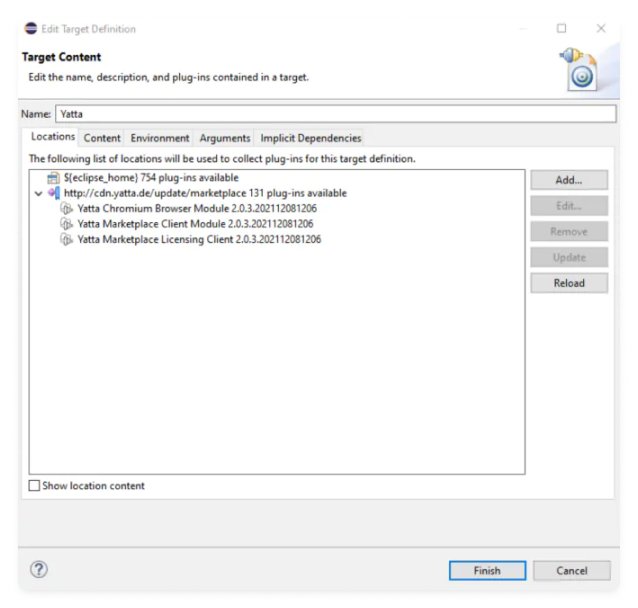
7. Confirm by clicking on
```text
Apply and Close
```
### Configure the plugin dependencies
Add the following plugins to your
```text
MANIFEST.MF
```
file in the
```text
META-INF
```
directory:
```java
de.yatta.platform.marketplace.licensing.client
com.yattasolutions.platform.marketplace.client
```
They are thus declared as dependencies for the plugin.
You can use either of the following two methods to add the plugins:
- Add the plugins in the Eclipse Editor
- Add the plugins using the Eclipse Wizard
An example
```text
MANIFEST.MF
```
file might look like this:
```java
Manifest-Version: 1.0
Bundle-ManifestVersion: 2
Bundle-Name: Licenseclient
Bundle-SymbolicName: de.yatta.example.licenseclient;singleton:=true
Bundle-Version: 1.0.0.qualifier
Require-Bundle: org.eclipse.ui,
de.yatta.platform.marketplace.licensing.client,
de.yatta.platform.marketplace.licensing.client.ui,
com.yattasolutions.platform.marketplace.client
Automatic-Module-Name: de.yatta.example.licenseclient
Bundle-RequiredExecutionEnvironment: JavaSE-11
```
### Optional: Enable the pre-configured UI elements
Yatta Checkout offers a selection of pre-configured UI elements, like a page to show the current state of a license and an academic preferences page to manage the state of an academic license.
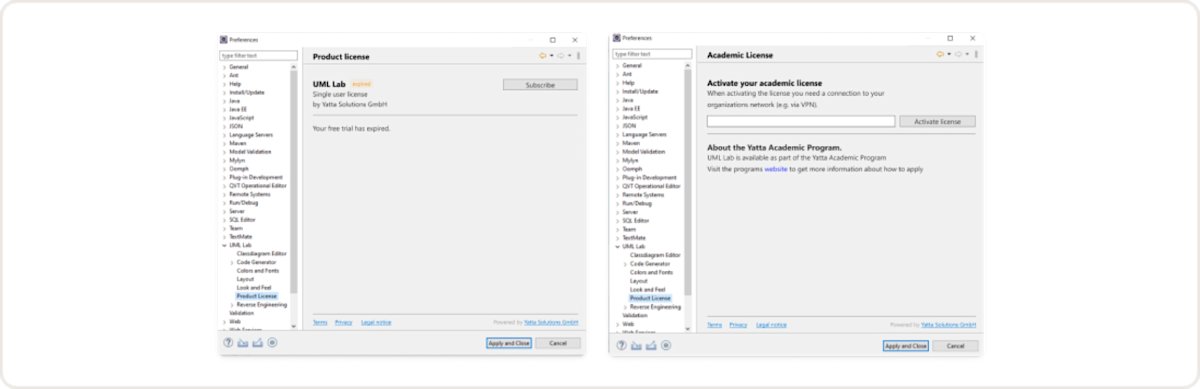
To enable the UI, add the following configuration to your
```text
MANIFEST.MF
```
file:
```java
de.yatta.platform.marketplace.licensing.client.ui
```
Add an implementation for a preference page by inheriting from
```text
LicenseDetailsPage
```
```java
package de.softwarevendor.product.client.ui.licenses;
import de.yatta.platform.marketplace.licensing.client.ui.preferences.LicenseDetailsPage;
import com.yattasolutions.platform.marketplace.client.CheckoutEnvironment;
public class MyLicenseDetailsPage extends LicenseDetailsPage {
@Override
protected String getProductId() {
return "e01a3c75-01b0-49c2-bed5-b235a304bea3";
}
@Override
protected CheckoutEnvironment getEnvironment() {
return CheckoutEnvironment.PREVIEW;
}
}
```
Then add the following code to your
```text
plugin.xml
```
:
```html
```
For subscription and one-time purchase licenses, different product IDs must be used. If your product is available with both license types, there should be two different preference pages. A second class inheriting from
```text
LicenseDetailsPage
```
should be implemented and added to
```text
plugin.xml
```
.
## Checkout implementation
Once the Eclipse IDE is configured, you can start implementing the Licensing Client and the In-App Checkout.
The two key actions are to _open the In-App Checkout as an Eclipse view_ (to guide a user towards a license purchase) and to _query a license_ (to determine the license status of your product).
### Open the in-app Checkout
The following command opens the in-app Checkout:
```java
MarketplaceClient.get().openCheckout(
MarketplaceClientPlugin.getDisplay(), PRODUCT_ID, ENVIRONMENT
);
```
__Note:__ The ‘MarketplaceClient.get().openCheckout’ method does not detect automatically if you are using a preview or live version of a product. You have to set the environment manually. If you are using a live version, pass the environment value of *live*. If you are using a preview version, pass the environment value of *preview*. If the environment has been set to *live* and no live product is available, the preview product will be selected.
If the user is not already signed in, the user is asked to sign in. If the user already has a license, a dialog is shown informing them that a valid license already exists.
### Query a license
The following commands query the license for the user (who is currently signed in):
```java
LicenseResponse licenseResponse = LicensingClient.get().queryLicense(new
LicenseRequest(PRODUCT_ID, ENVIRONMENT, version, checkoutDuration, VENDOR_KEY));
```
The following parameters can be set individually:
```java
int checkoutDuration = 1; /* Time the checkout is valid for in minutes. We recommend setting this to 1. Because this is a duration, the token is valid until the server has evaluated it.
From a security point of view, a lower number and a shorter time span is better because in case of a security breach, a longer period means that an attacker would have more time to decrypt the token. */
String version = null; /* Null is the default and means that every version of your product is valid. If you want to set a specific version, you can set a version range like [1.0.0,2.0.0). */
```
The validity of the LicenseResponse can be checked with the following command:
```java
Validity validity = licenseResponse.getValidity();
```
```text
licenseResponse.getValidity()
```
can give the following responses:
## Implementation example
Here is a basic example of an implementation using the Yatta Checkout within Eclipse.
The app shows a dialog that provides the state of the license and the sign-in. If the user is not signed in or if a valid license is missing, the in-app Checkout will open.
```java
package de.yatta.example.checkout.handlers;
import org.eclipse.core.commands.AbstractHandler;
import org.eclipse.core.commands.ExecutionEvent;
import org.eclipse.core.commands.ExecutionException;
import org.eclipse.jface.dialogs.MessageDialog;
import org.eclipse.ui.IWorkbenchWindow;
import org.eclipse.ui.handlers.HandlerUtil;
import com.yattasolutions.platform.marketplace.client.MarketplaceClient;
import com.yattasolutions.platform.marketplace.client.MarketplaceClientPlugin;
import com.yattasolutions.platform.marketplace.client.account.AccountManager;
import de.yatta.platform.marketplace.licensing.client.LicenseRequest;
import de.yatta.platform.marketplace.licensing.client.LicenseResponse;
import de.yatta.platform.marketplace.licensing.client.LicenseResponse.Validity;
import de.yatta.platform.marketplace.licensing.client.LicensingClient;
import com.yattasolutions.platform.marketplace.client.CheckoutEnvironment;
public class InAppExample extends AbstractHandler {
private static final String VENDOR_KEY = "";
private static final String PRODUCT_ID
= "e01a3c75-01b0-49c2-bed5-b235a304bea3de";
// The environment of your product
private static final CheckoutEnvironment ENVIRONMENT
= CheckoutEnvironment.PREVIEW;
// Time in minutes the checkout token is valid
private int checkoutDuration = 1;
// version string if the request is only valid for a specific version
private String version = null;
@Override
public Object execute(ExecutionEvent event) throws ExecutionException {
IWorkbenchWindow window = HandlerUtil.getActiveWorkbenchWindowChecked(event);
boolean signedIn = AccountManager.get().isSignedIn();
LicenseResponse fetchLicense = fetchLicense(PRODUCT_ID);
long timeoutInMillis = System.currentTimeMillis() + 1000; // 1-second timeout
while (fetchLicense.getValidity().equals(Validity.WAIT) &&
System.currentTimeMillis() < timeoutInMillis) {
fetchLicense = fetchLicense(PRODUCT_ID);
}
String signInSnippet = signedIn ? "Hello " + AccountManager.get().getEmail().get() +
", nice to see you \\o/." :
"You are currently not logged in!";
MessageDialog.openInformation(window.getShell(), "In-App Checkout Example",
"License Status: " + fetchLicense.getValidity() + "\n\n" + signInSnippet);
if (fetchLicense.getValidity().equals(Validity.UNLICENSED)) {
MarketplaceClient.get().openCheckout(
MarketplaceClientPlugin.getDisplay(), PRODUCT_ID, ENVIRONMENT
);
}
return null;
}
private LicenseResponse fetchLicense(String productId) {
return LicensingClient.get().queryLicense(
new LicenseRequest(productId, ENVIRONMENT, version, checkoutDuration, VENDOR_KEY));
}
}
```
For a more elaborate example, check out the source code of our Eclipse Demo Plugin:
[https://yatta.de/download/YattaCheckoutDemo-source.zip](https://yatta.de/download/YattaCheckoutDemo-source.zip)
---
---
title: User emails and notifications
source_url: "https://yatta.de/documentation/user-emails-and-notifications"
---
# User emails and notifications
# User emails and notifications
Users get notified about errors, warnings and useful information either via email, a banner in the user interface, or both.
### Emails are sent to users in the following cases:
- Account authentication and password reset
- Authentication and registration for the Academic Program
- Purchase confirmation
- Refused payments of a subscription renewal
- Changes in the payment method or billing information of a subscription
- Changes in account email address or OAuth provider.
- Payments of a pending subscription fee are declined by payment provider
- Account deactivation and reactivation
### Vendors will be CC'd in automatically sent emails in the following cases:
- Purchase confirmations (including invoices) for products sold
- Notification if a subscription has been canceled by a user
- Notification that payments on a renewed subscription have been refused
---
---
title: Web API
source_url: "https://yatta.de/documentation/web-api"
---
# Web API
# Web API
On this page you can find detailed information on how to add the drop-in API, as well as details about its methods, parameters and fields.
## Adding the JavaScript library
#
Yatta Checkout is provided as a UMD (universal module definition for JavaScript modules). You can integrate this as a plain JavaScript library into your system.
The Yatta Checkout drop-in does all the work for server-side and client-side integration. For the integration you need to make sure that the Document Object Model ([DOM](https://developer.mozilla.org/en-US/docs/Web/API/Document_Object_Model)) is already rendered. This can be done by including
```text
drop-in.min.js
```
between the
```text
```
and
```text
```
tags in your HTML and before calling any of our functions like
```text
yatta.startCheckout(...)
```
:
```xml
```
__Note:__ If you test the web integration on your local machine, you must ensure that the website is served by an HTTP server. (Otherwise, it’s not possible to test the integration properly.) To do this, you can use [Python’s http.server module](https://developer.mozilla.org/en-US/docs/Learn/Common_questions/Tools_and_setup/set_up_a_local_testing_server) or another server module with equivalent functionality.
## Start Checkout
Starts the Checkout. If the user is already subscribed to your product, the relevant subscription management is opened. Similarly, if the user already purchased your product and it can only be purchased once, the purchase information is opened. If multiple one-time purchases are allowed, a user who already purchased is able to purchase again.
This example code snippet starts the Checkout in the live environment for a user who does not yet have rights to access the product, pre-selecting a yearly subscription, passing custom metadata through the purchase, setting metadata context IDs for—and a redirect after—a successful purchase or closing the checkout.
```javascript
yatta.startCheckout(
'productId',
{
environment: 'LIVE',
locale: 'en',
manageBooking: null,
start: {
type: 'SUBSCRIPTION',
subscriptionInterval: 'YEARLY'
},
forceSignIn: false,
metadata: {
customMetadata: {
key1: 'value1',
key2: 'value2'
},
onSuccess: {
redirectUrl: 'https://product-company.com/success?token=$$SESSION_TOKEN$$'
},
onClose: {
redirectUrl: 'https://product-company.com/main?token=$$SESSION_TOKEN$$'
}
},
// Set metadataId to overrule metadata key
// metadataId: 'e634e558-7090-442a-b94c-77b2d82b7c4f'
}
)
```
This example starts the Checkout in the live environment for a user who might not yet have rights to access the product, pre-selecting a one-time purchase with quantity two and limited term of three years starting on 1 January 2024. It passes custom metadata through the purchase, setting metadata context IDs for—and a redirect after—a successful purchase or closing the checkout.
```javascript
yatta.startCheckout(
'productId',
{
environment: 'LIVE',
locale: 'en',
manageBooking: null,
start: {
type: 'ONE_TIME_PURCHASE',
quantity: 2,
term: {
runtime: 3,
unit: 'YEAR',
startOfTerm: '2024-01-01T00:00Z'
}
},
forceSignIn: false,
metadata: {
customMetadata: {
key1: 'value1',
key2: 'value2'
},
onSuccess: {
redirectUrl: 'https://product-company.com/success?token=$$SESSION_TOKEN$$'
},
onClose: {
redirectUrl: 'https://product-company.com/main?token=$$SESSION_TOKEN$$'
}
},
// Set metadataId to overrule metadata key
// metadataId: 'e634e558-7090-442a-b94c-77b2d82b7c4f'
}
)
```
### Metadata object
Contains parameters to configure the individual checkout session and additional custom data to be passed through a transaction to the purchase callback.
__Security note:__ We recommend handling metadata via the metadata backend API—setting only the metadataId key instead of the full metadata object in the yatta.startCheckout(...) params. This way, sensitive data like billing information is not passed through any frontends where it could be manipulated or inspected by a third party.
## Sign-in status change
Subscribe to changes to the current user's sign-in status.
```javascript
yatta.onSignedInChange(function (signedIn) {
if (signedIn) {
// handle signed in state
} else {
// handle signed out state
}
})
```
## Asset status change
Subscribe to changes to the asset status of the current user for a given product.
```javascript
yatta.onAssetStatusChange(
'productId',
function (value) {
if (value.assetStatus.length < 1) {
console.log('User is not signed in or does not have a license');
} else if (value.assetStatus[0].type == 'ONE_TIME_PURCHASE') {
console.log(`User's one-time license with booking ID ${value.assetStatus[0].bookingId} is ${value.assetStatus[0].bookingStatus}`);
} else if (value.assetStatus[0].type == 'SUBSCRIPTION') {
console.log(`User's subscription license with booking ID ${value.assetStatus[0].bookingId} is ${assetStatus.status[0].bookingStatus}`);
}
},
'LIVE'
)
```
### AssetStatus object
The status for all assets for a specified product provided to the callback in the
```typescript
yatta.onAssetStatusChange
```
drop-in interface if the user is signed in and has the right to access the assets.
__Note:__ The AssetStatus object contains an array with the status of all the (non-expired) assets a user has for a specified product.
```javascript
{
assetStatus: [
{
type: 'SUBSCRIPTION',
bookingId: '550e8400-e29b-11d4-a716-446655440000',
bookingStatus: 'SUBSCRIBED'
},
{
type: 'ONE_TIME_PURCHASE',
bookingId: '550e8400-e29b-11d4-a716-446655440042',
bookingStatus: 'BOOKED'
}
]
}
```
## Session change
Subscribe to changes to the session of the current user in the drop-in interface.
```javascript
yatta.onSessionChange(
vendorId: string,
callback: (checkoutSession: CheckoutSession | null) => void
): void;
```
### CheckoutSession object
The current web session object in the callback defined in the
```typescript
yatta.onSessionChange
```
drop-in interface if the user is signed in.
__Note:__ When the CheckoutSession object is null, the user is not signed in.
```javascript
{
accountId: 'c8608778-a412-43ab-9b33-9f337e523ce8',
sessionToken: 'eyJraWQiOiJ5YXR0YS1jaGVja291dC12MSIsInR5cCI6IkpXVCI…'
}
```
## Sign in
Allows the user to sign in, then closes without additional actions.
```javascript
yatta.signIn(
'vendorId',
{
forceSignIn: false,
locale: 'en',
metadata: {
customMetadata: {
key1: 'value1',
key2: 'value2'
},
onSuccess: {
redirectUrl: 'https://product-company.com/success?token=$$SESSION_TOKEN$$'
},
onClose: {
redirectUrl: 'https://product-company.com/main?token=$$SESSION_TOKEN$$'
}
},
// Set metadataId to overrule metadata key
// metadataId: 'e634e558-7090-442a-b94c-77b2d82b7c4f'
}
)
```
## Sign out
Signs the user out.
```javascript
yatta.signOut()
```
## Link account
Links a non-Yatta account to the Checkout to ensure access to licenses for products that require a link to this account. This is only necessary if you want to use your own IAM.
```javascript
// Account shall be linked (User is signed in to your IAM):
yatta.linkAccount({
accountId: 'accountId',
email: 'email@product-company.com'
})
// Account shall be unlinked (User is logged out from your IAM):
yatta.linkAccount(null)
```
__Note:__ If a product that requires a linked account is sold using the Checkout, this API must be called every time the user signs in or out, and upon page load.
## Implementation example
Here is a basic example of a Yatta Checkout website implementation showing how to initialize and open the Checkout on a website.
```html
IDE Intruders game
IDE Intruders game
Subscribe (Demo)
```
__Note:__ The JavaScript library will embed Yatta Checkout on your website in an iframe. The content of this iframe is hosted on a Yatta domain. Modern browsers do not allow JavaScript to communicate between your website and the iframe due to cross-origin resource policy (CORP), so all communication is handled via [window.postMessage](https://developer.mozilla.org/en-US/docs/Web/API/Window/postMessage) (postMessage() is a global method that safely enables cross-origin communication).
Apple Safari reports the existence of an iframe with a different domain as an error in the JavaScript console: "Blocked a frame with origin...". This has no impact on the functionality of Yatta Checkout and this message may be ignored.
---
---
title: REST API
source_url: "https://yatta.de/documentation/rest-api"
---
# REST API
# REST API Endpoints
## Check licenses
This endpoint can be used to check if a specific account has purchased a license for a given product, including its expiry date.
### Request
```text
POST https://api.yatta.de/checkout/v1/vendor/license/checkout
Content-Type: application/json
Authorization: Basic :
{
"environment": "PREVIEW",
"accountId": "ffa6706ff2127a749973072756f83c532e43ed02",
"sessionToken": "eyJraWQiOiJ5YXR0YS1jaGVja291dC12MSIsInR5cCI6IkpXVCI…",
"productId": "031082ef-420e-4a92-a5ed-34a65566fcc0",
"durationMinutes": 1440
}
```
**Headers**
**Parameters**
### Response
```text
HTTP/1.1 200
Content-Type: application/json;charset=UTF-8
{
"environment": "PREVIEW",
"validity": "LICENSED",
"accountId": "ffa6706ff2127a749973072756f83c532e43ed02",
"licenseType": "PERSONAL",
"productId": "031082ef-420e-4a92-a5ed-34a65566fcc0",
"checkedOutAt": "2023-04-03T11:17:10.255+0000",
"checkedOutUntil": "2023-04-30T00:00:00.000+0000",
"validFrom": "2023-03-31T16:23:23.693+0000",
"validUntil": "2023-04-30T00:00:00.000+0000"
}
```
**Parameters**
### Errors
- 400 —
```text
Bad Request
```
- 401 —
```text
Unauthorized
```
- 404 —
```text
Not Found
```
```text
HTTP/1.1 404
Content-Type: application/json
{
"errorType": "ACCOUNT_NOT_FOUND"
}
```
**Parameters**
## Check SaaS API key
This endpoint can be used by your SaaS API service to check whether a request is from a user with a valid API key for your product. To speed up consecutive requests, the response can be cached in your API service.
### Request
```text
POST https://api.yatta.de/checkout/v1/vendor/saas-api/validate
Content-Type: application/json
Authorization: Basic :
{
"environment": "PREVIEW",
"productId": "a6079ddc-19dd-4b4c-ac33-9b9a92957f0b",
"apiKey": "BCEV4KGfohkPzDKFV5FTAyP6GJWABh5WwkxsllgUsz"
}
```
**Headers**
**Parameters**
### Response
```text
HTTP/1.1 200
Content-Type: application/json;charset=UTF-8
{
"environment": "PREVIEW",
"productId": "a6079ddc-19dd-4b4c-ac33-9b9a92957a0b",
"accountId": "2389137e-e7b6-4ca2-8a90-412c516aceaf",
"validity": "LICENSED",
"validFrom": "2023-07-19T12:00:00.000+00:00",
"validUntil": "2023-08-19T00:00:00.000+00:00"
}
```
**Parameters**
### Errors
- 401 —
```text
Unauthorized
```
- 404 —
```text
Not Found
```
```text
HTTP/1.1 404
Content-Type: application/json
{
"errorType": "KEY_NOT_FOUND"
}
```
**Parameters**
## Price API
Prices both define and show users a range of attributes related to the costs of a single unit of a particular product. These include:
- Unit cost
- Currency
- Subscription intervals (optional)
These parameters apply to both subscriptions and one-time purchases.
### Request
The Price API request has the following general format:
```html
GET /checkout/v1/product/${env}/${productId}/
GET /checkout/v1/product/${env}/${productId}/${type}/
```
This request generates a response that shows all price options for a particular product. With a specified type, you will receive a filtered list of license types and their prices.
### URL parameters
### Response
```javascript
[
{
"productIdentifier":{
"productId":"157edcdc-3531-493f-9ea5-d349ca2cfe14",
"environment":"preview"
},
"licenseTypeId":"preview.157edcdc-3531-493f-9ea5-d349ca2cfe14.1year",
"name":"Your Product",
"kind":{
"type":"ONE_TIME_PURCHASE",
"term":{
"runtime":1,
"unit":"YEAR",
"startOfTerm":null
}
},
"prices":{
"EUR":200.00,
"USD":200.00
}
},
{
"productIdentifier":{
"productId":"157edcdc-3531-493f-9ea5-d349ca2cfe14",
"environment":"preview"
},
"licenseTypeId":"preview.157edcdc-3531-493f-9ea5-d349ca2cfe14.2year",
"name":"Your Product",
"kind":{
"type":"ONE_TIME_PURCHASE",
"term":{
"runtime":2,
"unit":"YEAR",
"startOfTerm":null
}
},
"prices":{
"EUR":360.00,
"USD":360.00
}
}
]
```
### Requesting a specific one-time purchase license type
```html
GET /checkout/v1/product/${env}/${productId}/ONE_TIME_PURCHASE/${runtime}/${unit}
```
In addition to the above, the one-time-purchase-specific license type needs the following parameters:
#### Request example
```html
GET /checkout/v1/product/PREVIEW/157edcdc-3531-493f-9ea5-d349ca2cfe14/ONE_TIME_PURCHASE/1/YEAR
```
#### Response example
```javascript
{
"productIdentifier":{
"productId":"157edcdc-3531-493f-9ea5-d349ca2cfe14",
"environment":"PREVIEW"
},
"licenseTypeId":"preview.157edcdc-3531-493f-9ea5-d349ca2cfe14.1year",
"name":"Your Product",
"kind":{
"type":"ONE_TIME_PURCHASE",
"term":{
"runtime":1,
"unit":"YEAR",
"startOfTerm":null
}
},
"prices":{
"EUR":200.00,
"USD":200.00
}
}
```
### Requesting a specific subscription license type
```javascript
GET /checkout/v1/product/${env}/${productId}/SUBSCRIPTION/${interval}
```
In addition to the above parameters, the subscription-specific license type needs the following parameter:
#### Request example
```html
GET /checkout/v1/product/PREVIEW/c5339794-fefe-4cef-bb67-1a358f66fce8/SUBSCRIPTION/MONTHLY
```
#### Response example
```javascript
{
"productIdentifier": {
"productId": "c5339794-fefe-4cef-bb67-1a358f66fce8",
"environment": "PREVIEW"
},
"licenseTypeId": "preview.c5339794-fefe-4cef-bb67-1a358f66fce8.MONTHLY",
"productName": "Productify",
"kind": {
"type": "SUBSCRIPTION",
"subscriptionInterval": "MONTHLY"
},
"prices": {
"EUR": 50
}
}
```
## Metadata
For each checkout call, you can attach custom metadata as well as information about the user to the Checkout session. The resulting
```text
metadataId
```
has to be added to the startCheckout parameters (see [startCheckout()](https://yatta.de/documentation/web-api#start-checkout)). The
```text
customMetadata
```
will also be returned to your backend service via the [purchase callback](https://yatta.de/documentation/purchase-callback).
### Post-Request
```html
POST /checkout/v1/vendor/metadata
Content-Type: application/json
Authorization: Basic :
{
"accountId": "",
"contexts": [
{
"type": "MOBILE",
"appName": "Product App"
}
],
"customMetadata": {
"key1": "value1",
"key2": "value2"
},
"mergeMetadataId": "",
"onSuccess": {
"redirectUrl": "https://product-company.com/success?token=$$SESSION_TOKEN$$"
},
"onClose": {
"redirectUrl": "https://product-company.com/main?token=$$SESSION_TOKEN$$"
}
}
```
**Headers**
**Parameters**
### Post-Response
```html
HTTP/1.1 200
Content-Type: application/json;charset=UTF-8
{
"metadataId": "eda322f7-1a8c-4c9c-8c59-1f3fffb39e9b"
}
```
### Contexts
For each
```text
metadata
```
object you can add several
```text
contexts
```
. Those are as follows:
**Purchase context**
**IAM context**
**Mobile context**
**Travel ticket context**
**Shared access context**
**Shopping cart context**
**Request**
```html
POST /checkout/v1/vendor/metadata
Content-Type: application/json
Authorization: Basic :
{
"contexts": [
{
"type": "SHOPPING_CART",
"environment": "LIVE",
"products": [
{
"productId": "dc06f4ed-7f44-43d6-a07d-6df9ea386ab6",
"quantity": 2
},
{
"productId": "ca84e79c-ccec-4ae4-a9a7-2e2ed5ec7473",
"quantity": 3
}
]
}
]
}
```
**Validity context**
### Fetching existing Metadata
####
Existing metadata can be refetched using the UUID received as a post response. This is only allowed, if the same authorization header is used or the metadata was created with a shared access context, by a different vendor and shared to the given vendor.
**Request**
```html
GET /checkout/v1/vendor/metadata/{UUID}
Authorization: Basic :
```
**Response**
```html
{
"metadataId": "",
"accountId": "",
"contexts": [
{
"type": "MOBILE",
"appName": "Product App"
}
],
"customMetadata": "",
"onSuccess": {
"redirectUrl": "https://product-company.com/success?token=$$SESSION_TOKEN$$"
},
"onClose": {
"redirectUrl": "https://product-company.com/main?token=$$SESSION_TOKEN$$"
}
}
```
### Errors
- 401 —
```text
Unauthorized
```
---
---
title: Webhooks
source_url: "https://yatta.de/documentation/webhooks"
---
# Webhooks
# Webhooks
## Setup
To enable webhooks for your product, [drop us a short email](mailto:checkout@yatta.de) containing a list of event types you want to receive and a URL for your live system. In the future, you'll be able to set these URLs directly in the portal.
If the specified endpoint cannot be reached or the request is not acknowledged with a 200 code, the request will be retried hourly for 24h and afterwards once per day. If the webhook cannot be executed for 30 days, it will be dropped.
## Verification
To verify that the message was actually sent by Yatta, every request uses the Bearer authentication scheme with a JWT token. These tokens will be signed with an RSA key, and the selected key is available on `https://api.yatta.de/checkout/v1/jwks`.
```javascript
Authorization: Bearer eyJraWQiOiJ5YXR0YS1jaGVja291dC1uZXciLCJ0eXAiOiJKV1Q
iLCJhbGciOiJSUzI1NiJ9.eyJzdWIiOiJZYXR0YUNoZWNrb3V0Q2FsbGJhY2siLCJhdWQiO
iJkZS5zb2Z0d2FyZXZlbmRvciIsImlzcyI6InlhdHRhLmRlIiwidHhJZCI6ImM1YjY4Y2Y5
LWJlYWUtNGQzNC05NmNjLWM5ZmFhNTFmOGFjYiIsImlhdCI6MTcxMTM3MjgwMiwiaGFzaC1
hbGciOiJTSEEzLTI1NiIsImhhc2giOiIzZWY4OGRmYTM5ODE5OGYxYmQ4ZmJhZmM0NTliOW
VjNzQyOTA4NzdkMjczYzliODgwNTQ2NDFlYTMxOWYyMzQ4In0.B9MJwf0ZhjwgBDaAVcS1K
25wZOeC4wGVEN7PJzg-IvOC9jxIkBW44ZgDJ0P3650WEkQGR7eJLkoDfo0fO0qhuJJd7fOG
x1m35NT_nrAGzJ1X4UlAvOzV5BUrr22vBm6Oi9LD4ikozEAFbnevH2sojs7NTVR1TZAaZOb
7dOsr1K_Kx5yPhgrCV0EOVM6qW-RmyLhvccUubx5brIOdEwi4hwU6aENzYJ1WNwI7SKD25O
INMC08XZndVbfL1qsnDdGqSdZv8Si0Ksq1_r_W9D9oBlzlN9OjqxELXYAm6qT_WiFHpXLpX
oo70IMicKfl_P2_jRZmzOcjm5cWCcs7mGjGTw
```
After decoding the JWT token into its parts—header, payload and signature—the payload will contain the following example data:
```javascript
{
"sub": "YattaCheckoutCallback",
"aud": "7a2be672-cd14-43bd-b63d-66d2ff2fd4ab",
"iss": "yatta.de",
"iat": 1711372802,
"hash-alg": "SHA3-256",
"hash": "3ef88dfa398198f1bd8fbafc459b9ec74290877d273c9b88054641ea319f2348"
}
```
Make sure to verify the token's signature (for fast and safe results, use a library of your choice) and also check that the audience field equals your known Vendor ID. Last but not least, you can verify the hash of the full body to ensure the data you received has not been tampered with.
Only acknowledge the request with a 200 return code if verification is successful.
## Structure
Each webhook event payload contains the following common fields:
### Account
### Product
### Transaction
For event types where a payment is executed or expected (e.g. `PURCHASE`, `RENEWAL` and `BOOKING_CREATED`), the event payload contains following common fields in addition to event specific fields in transaction object.
### Price
Similar to [Transaction](https://yatta.de/documentation/webhooks#transaction--) object, Price object is common in events where a payment is executed or expected.
For additional fields specific to each event type, see the [Event Types](https://yatta.de/documentation/webhooks#event-types) section below.
## Event types
## Purchase
```javascript
{
"event" : "PURCHASE",
"eventVersion" : 1,
"account": {
"email": "hiro@bluecompany.com",
"linkedAccount": {
"accountId": "c4bc89a7-aa07-4ba3-b8b1-8000bb67e42a"
}
},
"bookingId" : "SV011-03U05I2X",
"price": {
"currency": "EUR",
"grossValue": 595,
"netValue": 500,
"quantity": 1,
"total": 595,
"userCountryISO2Lookup": "DE",
"vatPercentage": 0.19,
"vatReversed": false,
"vatValue": 95
},
"product": {
"kind": {
"term": {
"runtime": 2,
"startOfTerm": "2024-05-01T00:00:00Z",
"unit": "YEAR"
},
"type": "ONE_TIME_PURCHASE"
},
"licenseTypeId": "89205781-343c-414e-b54f-5a165c80c9bb",
"productIdentifier": {
"environment": "LIVE",
"productId": "89205781-343c-414e-b54f-5a165c80c9bb"
},
"productName": "Productify"
},
"transaction": {
"customerInvoiceNo": "Y-MP-PR011-24-00037",
"purchaseDate": "2024-03-22T10:14:55.881Z",
"txId": "3c7784a9-e1fa-429f-8b26-445f4ac14161",
"customMetadata": {},
"groupContext": {
"name": "Department North",
"id": "ce3df125-89d8-48e3-bee7-cf9780f73eaa"
},
"keys": […]
}
```
The event payload contains following fields in addition to common fields:
### Transaction
### Keys
A list of keys in JWT format, size is equal to the number of licenses. In case you offer variable quantities for your product, the `keys` attribute will contain a list of keys differentiating multiple sub-keys, which are valid JWT. They can be handed out to customers to identify their unique license key and contain the timespan in which they are valid.
Keys are similar in content to the overall message, notable differences are:
- Subject of the token is the `accountId.`
- Additional sequence number (`seq`).
- Detail objects (account, transaction and product) are stringified.
```javascript
{
"iss": "yatta.de",
"iat": 1711382329,
"aud": "7a2be672-cd14-43bd-b63d-66d2ff2fd4ab",
"sub": "c4bc89a7-aa07-4ba3-b8b1-8000bb67e42a",
"validFromDate": "2023-05-01T00:00:00Z",
"validBeforeDate": "2025-05-01T00:00:00Z",
"seq": 0,
"product": "{
\"productIdentifier\":{
\"productId\":\"de.softwarevendor.product.onetimepurchase\",
\"environment\":\"LIVE\"
},
\"productName\":\"Software Product\",
\"licenseTypeId\":\"de.softwarevendor.product.pro.onetimepurchase.2years\",
\"kind\":{
\"type\":\"ONE_TIME_PURCHASE\",
\"term\":{\"runtime\":2,\"unit\":\"YEAR\",\"startOfTerm\":\"2023-05-01T00:00:00Z\"}
}
}",
"transaction": "{
\"purchaseDate\":\"2024-03-25T15:58:49.617Z\",
\"customerInvoiceNo\":\"Y-MP-SV011-24-00048\",
\"txId\":\"7c6d4b8a-1383-455e-8e26-ff3798362ddb\"
}"
}
```
## Cancellation
```javascript
{
"event" : "CANCELLATION",
"eventVersion" : 1,
"account" : {
"email" : "hiro@bluecompany.com",
"linkedAccount" : {
"accountId" : "c4bc89a7-aa07-4ba3-b8b1-8000bb67e42a"
}
},
"bookingId" : "SV011-03U05I2X",
"product" : {
"productIdentifier": {
"environment": "LIVE",
"productId": "89205781-343c-414e-b54f-5a165c80c9bb"
},
"productName": "Productify",
"licenseTypeId" : "a5d4aa8a-cf89-4733-a029-f07ef2e845b2",
"kind" : {
"type" : "SUBSCRIPTION",
"subscriptionInterval" : "MONTHLY",
"term" : "UNLIMITED"
}
},
"terminationDate" : "2025-05-21T23:59:59.999Z",
"reason" : "CUSTOMER_REQUEST"
}
```
The event payload contains following fields in addition to common fields:
## Reactivation
```javascript
{
"event" : "REACTIVATION",
"eventVersion" : 1,
"account" : {
"email" : "hiro@bluecompany.com",
"linkedAccount" : {
"accountId" : "c4bc89a7-aa07-4ba3-b8b1-8000bb67e42a"
}
},
"bookingId" : "SV011-03U05I2X",
"product" : {
"productIdentifier": {
"environment": "LIVE",
"productId": "89205781-343c-414e-b54f-5a165c80c9bb"
},
"productName": "Productify",
"licenseTypeId" : "a5d4aa8a-cf89-4733-a029-f07ef2e845b2",
"kind" : {
"type" : "SUBSCRIPTION",
"subscriptionInterval" : "MONTHLY",
"term" : "UNLIMITED"
}
}
}
```
## Renewal
```javascript
{
"event" : "RENEWAL",
"eventVersion" : 1,
"account": {
"email": "hiro@bluecompany.com",
"linkedAccount": {
"accountId": "c4bc89a7-aa07-4ba3-b8b1-8000bb67e42a"
}
},
"bookingId" : "SV011-03U05I2X",
"price": {
"currency": "EUR",
"grossValue": 595,
"netValue": 500,
"quantity": 1,
"total": 595,
"userCountryISO2Lookup": "DE",
"vatPercentage": 0.19,
"vatReversed": false,
"vatValue": 95
},
"product": {
"kind": {
"type": "SUBSCRIPTION",
"subscriptionInterval": "MONTHLY",
"term": "UNLIMITED"
},
"licenseTypeId": "89205781-343c-414e-b54f-5a165c80c9bb",
"productIdentifier": {
"environment": "LIVE",
"productId": "89205781-343c-414e-b54f-5a165c80c9bb"
},
"productName": "Productify"
},
"transaction": {
"customerInvoiceNo": "Y-MP-PR011-24-00038",
"renewalDate": "2024-04-22T01:00:00.000Z",
"txId": "3c7784a9-e1fa-429f-8b26-445f4ac14161",
"customMetadata": {},
"groupContext": {
"name": "Department North",
"id": "ce3df125-89d8-48e3-bee7-cf9780f73eaa"
}
},
"keys": […]
}
```
The event payload contains following fields in addition to common fields:
### Transaction
### Keys
A list of keys in JWT format, size is equal to the number of licenses. In case you offer variable quantities for your product, the `keys` attribute will contain a list of keys differentiating multiple sub-keys, which are valid JWT. They can be handed out to customers to identify their unique license key and contain the timespan in which they are valid.
Keys are similar in content to the overall message, notable differences are:
- Subject of the token is the `accountId.`
- Additional sequence number (`seq`).
- Detail objects (account, transaction and product) are stringified.
```javascript
{
"iss": "yatta.de",
"iat": 1711382329,
"aud": "7a2be672-cd14-43bd-b63d-66d2ff2fd4ab",
"sub": "c4bc89a7-aa07-4ba3-b8b1-8000bb67e42a",
"validFromDate": "2023-05-01T00:00:00Z",
"validBeforeDate": "2025-05-01T00:00:00Z",
"seq": 0,
"product": "{
\"productIdentifier\":{
\"productId\":\"de.softwarevendor.product.onetimepurchase\",
\"environment\":\"LIVE\"
},
\"productName\":\"Software Product\",
\"licenseTypeId\":\"de.softwarevendor.product.pro.onetimepurchase.2years\",
\"kind\":{
\"type\":\"ONE_TIME_PURCHASE\",
\"term\":{\"runtime\":2,\"unit\":\"YEAR\",\"startOfTerm\":\"2023-05-01T00:00:00Z\"}
}
}",
"transaction": "{
\"purchaseDate\":\"2024-03-25T15:58:49.617Z\",
\"customerInvoiceNo\":\"Y-MP-SV011-24-00048\",
\"txId\":\"7c6d4b8a-1383-455e-8e26-ff3798362ddb\"
}"
}
```
## Booking Created
```javascript
{
"event": "BOOKING_CREATED",
"eventVersion": 1,
"account": {...},
"bookingId": "SV011-03U05I2X",
"price": {...},
"product": {...},
"transaction": {
...,
"date": "2024-04-01T00:00:00.000Z",
"txId": "3c7784a9-e1fa-429f-8b26-445f4ac14161"
},
"keys": [...]
}
```
## Booking Canceled
```javascript
{
"event": "BOOKING_CANCELED",
"eventVersion": 1,
"account": {...},
"bookingId": "SV011-03U05I2X",
"product": {...},
"cancellationDate": "2023-11-13T15:55:44Z",
"reason": "CUSTOMER_REQUEST"
}
```
The event payload contains following fields in addition to common fields:
---
---
title: Preview Yatta Checkout in-app
source_url: "https://yatta.de/documentation/preview-yatta-checkout-in-app"
---
# Preview Yatta Checkout in-app
# Preview Yatta Checkout in Eclipse (in-app)
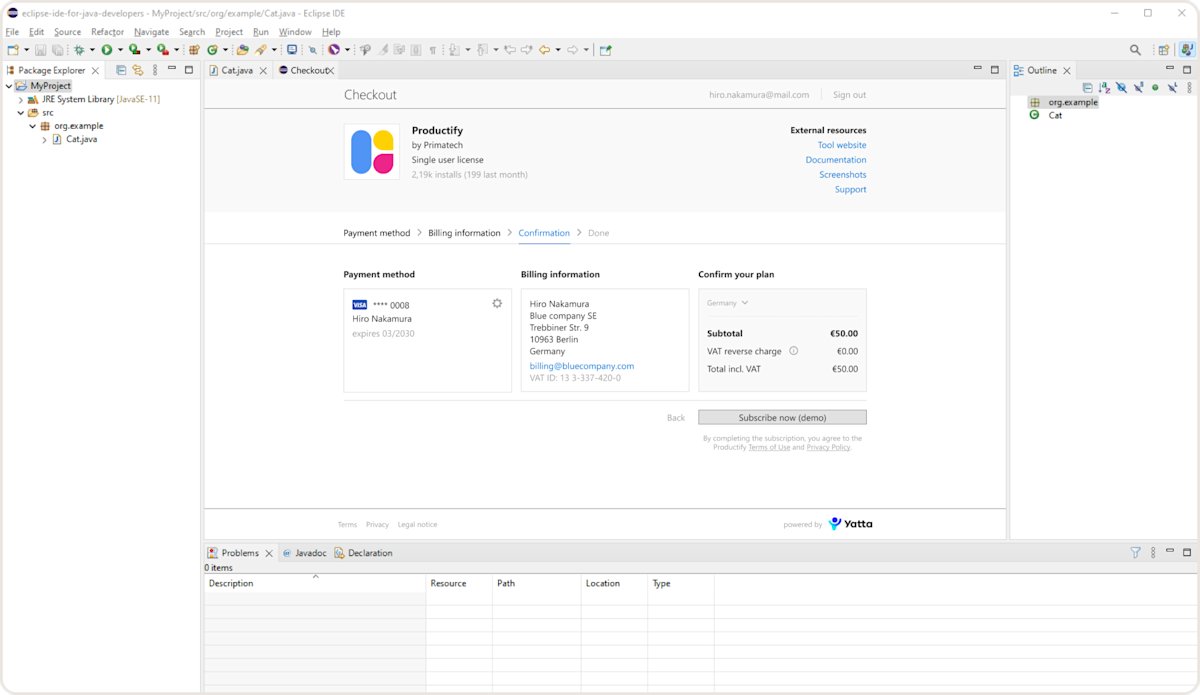
You can implement Yatta Checkout in Eclipse using the following steps:
1. If you haven't already, [set up a product](https://yatta.de/documentation/add-your-product).
2. Edit the product you would like to implement.
3. In the "Eclipse Integration" section, you can download the example code for Eclipse integration.
4. Import the source code into an Eclipse IDE with Maven. We suggest using an [Eclipse IDE for RCP and RAP Developers](https://www.eclipse.org/downloads/packages/release/2023-03/r/eclipse-ide-rcp-and-rap-developers).
5. Open the
```text
IDE-Intruders.target
```
file and click
```text
Set as Active Target Platform
```
.
6. Right click on one project and run
```text
Maven
```
>
```text
Update project
```
>
```text
Select all
```
>
```text
OK
```
.
7. Open the
```text
VendorDemoPlugin.java
```
file.
8. Copy the Product ID from the "Eclipse Integration" section in the portal. If your product's license type is... 1. **Subscription**, paste the Product ID into the constant
```text
PRODUCT_ID
```
2. **One-time purchase**, paste the Product ID into the constant
```text
PRODUCT_ID_ONETIMEPURCHASE
```
9. Copy the Vendor API Key from the "Company" section in the portal into the constant
```text
VENDOR_KEY
```
.
10. Update dependencies of the run configuration: Right click on file
```text
IDE-Intruders.launch
```
>
```text
Run As
```
>
```text
Run configurations...
```
>
```text
Eclipse Application
```
>
```text
IDE-Intruders
```
>
```text
Plug-ins
```
>
```text
Select required
```
>
```text
Apply
```
>
```text
Run
```
.
An Eclipse instance with the demo is started. The welcome page explains how to use the Checkout. You can make demo purchases using the provided demo payment and billing data. No real transactions take place.
__Note:__ No emails are sent for demo purchases, but you can download the demo invoice directly on the purchase confirmation page to see how it looks.
You can reset the demo and any purchased licenses via the banner at the bottom of the screen in the demo plugin. Alternatively, you can cancel the demo subscription or delete the demo purchase by going to [Subscriptions](https://yatta.de/account/subscriptions) or [Orders](https://yatta.de/account/orders) in _"My Account" _respectively.
---
See Yatta Checkout's complete [integration guide](https://yatta.de/documentation/integrating-yatta-checkout-in-app) for additional features, such as event handlers and license management for Eclipse.
---
---
title: Preview Yatta Checkout web
source_url: "https://yatta.de/documentation/preview-yatta-checkout-web"
---
# Preview Yatta Checkout web
# Preview Yatta Checkout on your website
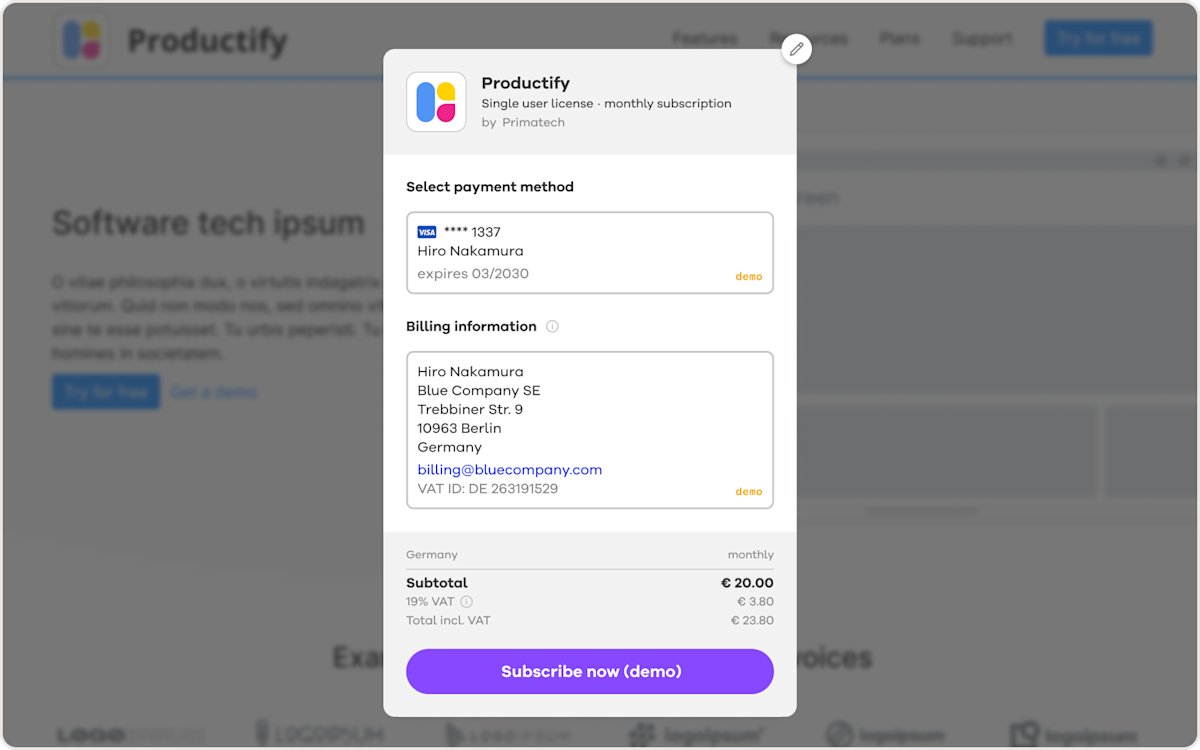
We provide a JavaScript library to integrate the Checkout on your website. The following steps show you how:
1. If you haven't already, [set up a product](https://yatta.de/documentation/add-your-product).
2. Edit the product you would like to integrate.
3. Copy the code example for web integration from the "Web Integration" section of the "Manage product" page.
4. Paste the code into the HTML of your website between the
```text
```
and
```text
```
tags. This is necessary for the Checkout to start.
5. The second line of the code snippet adds a link to start the Checkout. You can move this to where you would like the Checkout to start.
6. Run your web server and click on the newly created button.
__Note:__ Due to our security standards, Yatta Checkout only works when you run your website as a web server. You cannot open an HTML file locally. Also you have to open your website via localhost (or any other domain) — using an IP address does not work.
7. Yatta Checkout will open and you will automatically be signed in to your account.
Now you can make demo purchases using the provided demo payment and billing data.
__Note:__ No emails are sent for demo purchases, but you can download the demo invoice directly on the purchase confirmation page to see how it looks.
You can cancel the demo subscription by reopening the Checkout. Alternatively, you can cancel the demo subscription or delete the demo purchase by going to [Subscriptions](https://yatta.de/account/subscriptions) or [Orders](https://yatta.de/account/orders) in _"My Account" _respectively.
---
See Yatta Checkout's [Web API integration page](https://yatta.de/documentation/web-api) for information on additional features, such as event handlers to show users if they already have a license.
---
---
title: Provide final product information
source_url: "https://yatta.de/documentation/provide-product-information"
---
# Provide final product information
# Provide final product information
Before you can start selling your product, you have to go through the [KYC process](https://yatta.de/documentation/submit-kyc) and provide us with some final details.
This is a manual (for now) process where we add this information to your product and then perform a quality check to make sure everything is good to go.
Once approved, your integration details will work in your live environment, too.
__Note:__ Some processes require manual approval from us. This is necessary to ensure high quality standards and a frictionless experience in the long run. However, it may take 1-2 business days to fully onboard you. Thank you for your patience—we’ll make it worth it!
## List of information
To go live, the following product information must be shared with us via email. Please send it in the required format to [checkout@yatta.de](mailto:checkout@yatta.de).
## Change product information
If you want to change the information of an already published product, use the [Products ](https://yatta.de/portal/solution)page. To preview the changes, set your
```javascript
environment
```
to ['preview'](https://yatta.de/documentation/web-api#start-checkout).
Once you are happy with the updated product information, send an email to [checkout@yatta.de](mailto:checkout@yatta.de), so we can publish the updated product for you.
---
---
title: Submit KYC
source_url: "https://yatta.de/documentation/submit-kyc"
---
# Submit KYC
# Legal requirements (KYC)
In order to get payouts from your sales, we are legally obliged to verify your identity through a process called Know Your Customer (KYC).
## Verify your identity to unlock payouts
To begin the identity verification process, download and complete the KYC form on the [Vendor Portal](https://yatta.de/portal/company), then upload it along with the other required documents.
After submitting your documents, verification can take up to three working days.
## Required information
For payouts up to $999, the KYC process requires you to provide a business registration document for your company and proof of your bank account. For payouts of $1,000 or more, you must provide the photo ID of all Ultimate Beneficial Owners (UBOs).
__Note:__ UBO refers to all individuals who directly or indirectly own 25% or more of the total shares in the organization.
---
---
title: Testing Checkout integration
source_url: "https://yatta.de/documentation/testing-checkout-integration"
---
# Testing Checkout integration
# Testing Checkout integration
Each product has a preview and a live version. When you first create a product, it is always in preview mode. The information in this section applies only to the preview version and to preview purchases. The purchase process for preview products is exactly the same as for live ones. The only difference is that a preview purchase triggers no automatic emails and you will be sent no purchase invoice. For details, see the section "Invoices and emails" below.
## Switching between preview and live versions
### Checkout for web
If you're using the web version of Yatta Checkout, you don't have to do anything. The product will only use the live version for the URLs you provided for your webshop. All other domains, like your staging system or localhost, automatically use the preview version. You just have to make sure that your stage system has a different (sub-)domain to your live webshop.
### Eclipse in-app checkout
If you want to switch between the preview and live version of your Eclipse in-app checkout, just add
```text
preview.
```
in front of your API Key. The Vendor Key remains the same in both the live and preview versions.
## Test purchases
To test Yatta Checkout, simply use your [user account](https://yatta.de/account). In the checkout process, you will see demo payment methods and billing information. You cannot use real payment data here, but you can create as much demo billing information as you like to simulate purchases from different countries.
__Note:__ Currently only one (1) user can test a product's implementation. We are working on expanding this in the future.
## Manage your preview subscriptions
Access your [user account](https://yatta.de/account) to view and manage your current preview subscriptions and orders. Subscriptions can also be canceled by reopening the Checkout. This will open the normal manage product view, where you can cancel subscriptions directly. In Eclipse you can also cancel subscriptions via Preferences.

## VAT calculation
To test the verification of VAT IDs and how Yatta Checkout calculates VAT, you can use the following VAT numbers in your demo billing information. They are included in our demo billing information.
## Invoices and emails
We do not send you emails about your preview purchases. We also don't send any sample invoices for the preview via email or provide them in "[My Account](https://yatta.de/account)". You can download the invoice on Yatta Checkout's purchase confirmation screen. If you close the screen accidentally, you can just cancel the purchase and buy your product again.
---
---
title: Enter company information
source_url: "https://yatta.de/documentation/enter-company-information"
---
# Enter company information
# Enter company information
In the [Vendor Portal](https://yatta.de/portal/company), you can fill out your company information.
### Company name
Enter the legal name of your company here. It will appear on invoices generated by Yatta Checkout.
### Company website
This URL will be used to link to your company website. This should be the main landing page for your customers—usually your home page.
### Company logo
Add your company logo here. It will appear on invoices generated by Yatta Checkout. The recommended size is 300 x 120 pixels.
### Identity verification
When you want to go live with one or more products, you will need to go through an identity verification process called [Know Your Customer (KYC)](https://yatta.de/documentation/submit-kyc).
### Vendor API key
This is used for the full technical [integration of the Checkout into Eclipse](https://yatta.de/documentation/integrating-yatta-checkout-in-app).
---
---
title: Add your product
source_url: "https://yatta.de/documentation/add-your-product"
---
# Add your product
# Add your product
You can add and manage your products on the [Products](https://yatta.de/portal/solution) page.
## Product information
### Product name
The name of your product. This will appear on invoices.
### Image
This is for your product's icon or logo — a .jpg, .png or .svg smaller than 5 MB.
### Pricing
Toggle between one-time purchase and subscription license types.
__Note:__ Once you have created a product, you cannot change the license type (subscription or one-time purchase). However, you can contact us ([checkout@yatta.de](mailto:checkout@yatta.de)) to change it for you.
With subscriptions, you can choose to offer monthly, yearly, or both as subscription period options for your users.
### Pricing and currencies
Select the currencies you want to support when selling your product and add the price for each subscription period.
### Save
Once you're done, save your product.
## Integration
After saving your product you can access your API Keys in the integration tabs for testing.
### Product ID
This is the API key used to implement the web and in-app Checkout.
### Code example for web integration
This code shows a basic example of how to integrate the Checkout into your website. For the implementation details, see [Preview Yatta Checkout on your website](https://yatta.de/documentation/preview-yatta-checkout-web).
### Example code for Eclipse integration
You can download the source code for an Eclipse in-app Checkout demo. For the implementation details, see [Preview Yatta Checkout in Eclipse (in-app)](https://yatta.de/documentation/preview-yatta-checkout-in-app).
---
---
title: Create account
source_url: "https://yatta.de/documentation/create-account"
---
# Create account
# Create account
To access the area for vendors where you can enter information about your company and edit your product(s), you need to sign up to the [Vendor Portal](https://yatta.de/portal) and accept the [Vendor Agreement](https://yatta.de/vendor-agreement).
Once signed in, you can edit your profile and security options, view and manage your subscriptions and orders, and check your invoices in your [user account](https://yatta.de/account) as well.
---
---
title: Starting to use Yatta Authentication
source_url: "https://yatta.de/documentation/starting-to-use-yatta-authentication"
---
# Starting to use Yatta Authentication
# Yatta Authentication
Using Yatta Authentication, you can implement an authentication process that fulfills the requirements of the [OAuth 2.0 protocol](https://oauth.net/2/).
When setting up Yatta Authentication, keep in mind the following two roles:
- _Client_: Apps that use Yatta Authentication to handle user logins
- _User_: People who use Yatta Checkout because they are vendor customers.
## Setting up a client
The following procedure assumes you are a vendor and want to register and set up a client.
1. Open the [vendor portal](https://yatta.de/portal/) and sign in with your Yatta account if prompted.
2. In the menu on the left, click on **Authentication**.
3. Click **Create OAuth clientID**.
4. Enter the following for your OAuth client: - A client logo (.svg or .jpeg file, max 5 MB)
- A display name
- Any redirect URLs. (For example, in the demo app use http://localhost:8080/login/oauth2/code/yatta.)
__Note:__ When going live, remember to add redirect URLs for all systems using Yatta Authentication.
5. Check the box to enable PKCE (Proof Key for Code Exchange) for each login (see [https://oauth.net/2/pkce/](https://oauth.net/2/pkce/) and [web standard RFC 7636](https://datatracker.ietf.org/doc/html/rfc7636) for more information on PKCE).
6. Click **Save**. Your Client ID (username) and Client Secret (passcode) are displayed at the bottom of the screen.
7. The endpoint URLs (authorization endpoint, token endpoint and issuer endpoint) are also displayed below the Client ID and Client Secret. For a detailed description, see “[Key Yatta Authentication endpoints](https://yatta.de/documentation/starting-to-use-yatta-authentication#key-yatta-authentication-endpoints).”
You are now ready to set up your application for Yatta Authentication!
__Important:__ You will need your Client ID and Secret as well as the issuer URL and endpoints during the implementation. Below you'll find an example implementation using Spring Boot.
## Key Yatta Authentication endpoints
## Testing Yatta Authentication
__Note:__ We recommend reading the [Spring Boot and OAuth 2.0 Tutorial](https://spring.io/guides/tutorials/spring-boot-oauth2/) if you would like to see a complete example implementation.
Use our demo app to quickly test Yatta Authentication. For this process, you only need your **Client ID** and **Client Secret** (see above).
1. Clone the following GitHub repository:
[https://github.com/YattaSolutions/de.yatta.ide-intruders-webgame/](https://github.com/YattaSolutions/de.yatta.ide-intruders-webgame/)
2. Within this repository, access the subfolder /springboot-oauth2-client-sample/src/main/resources/ and open the file **application.properties**.
3. Replace
```text
```
with your **Client ID** in the following code section.
4. Replace
```html
```
with your **Client Secret** in the following code section:
```text
spring.security.oauth2.client.registration.yatta.client-id=
spring.security.oauth2.client.registration.yatta.client-secret=
spring.security.oauth2.client.registration.yatta.scope=profile, email, openid
spring.security.oauth2.client.provider.yatta.issuer-uri=https://yatta.de
```
5. Save and close the file.
6. Run the demo app in your IDE of choice or right from the command line with
```text
mvn spring-boot:run
```
.
7. Access the following address in your browser:
```text
http://localhost:8080/api/v1/sample
```
8. You are now assigned user tokens for your users. These user tokens are used to authenticate their logins on the server. The tokens include: - User ID
- User email address
- User access token
---
---
title: PCI DSS
source_url: "https://yatta.de/documentation/pci-dss"
---
# PCI DSS
# Payment Card Industry Data Security Standard (PCI DSS)
All payments handled by the Yatta Checkout are handled according to **PCI DSS Level 1 standards**.
## What is PCI DSS?
Payment Card Industry Data Security Standards are set by a security standards council (PCI SSC) comprised of representatives from companies like American Express, MasterCard and Visa to protect card and cardholder data.
[More information about PCI DSS requirements](https://www.pcidssguide.com/pci-dss-requirements/)
---
---
title: "Invoicing & Taxation"
source_url: "https://yatta.de/documentation/invoicing-and-taxation"
---
# Invoicing & Taxation
# Taxation
Depending on where your company is based, and which country the buyer comes from, different taxation rules apply. If you are located and taxed within the EU, please consult the [official EU guide](https://europa.eu/youreurope/business/taxation/vat/vat-rules-rates/index_en.htm) for more information.
Verification of the user’s VAT number and VAT calculation is handled automatically by Yatta Checkout.
__Note:__ While we do everything we can to streamline the process for you, VAT payment remains the vendor’s responsibility. We therefore cannot assume liability for the correctness of your VAT calculation.
## Invoicing
Generally, invoices are sent in PDF format to the user’s primary email address after each successful transaction. If a different billing email address is provided in the billing address form, the invoice is only sent to the billing email address. An overview of all current and past invoices is provided in the user account (IAM).
### Legal requirements
The sent invoices include legally required information about the company issuing the invoice (i.e., you), the recipient and the transaction. In addition, invoices include your logo and contact information. Please note, however, that we cannot assume liability for the correctness of the VAT calculation shown on the invoice.
### Invoice numbering scheme
Invoice numbers are generated in a way that complies with official accounting standards. Each invoice is given a unique invoice number and the invoices are numbered sequentially.
Example invoice numbering scheme for a Vendor (“Software Vendor”) with the tag
```text
SV011
```
---
---
title: Support
source_url: "https://yatta.de/documentation/support"
---
# Support
# Support
We would love to hear from you! If you have any questions or feedback about your experiences using Yatta Checkout, send us an email at [checkout@yatta.de](mailto:checkout@yatta.de)!
# Legal
---
---
title: Privacy policy
source_url: "https://yatta.de/legal/privacy-policy"
---
# Privacy policy
# 1. Introduction
Yatta Solutions GmbH, Universitätsplatz 12, 34127 Kassel, Germany (“we”, “us”, “our”) places high value on privacy, data protection, and data safety. As a matter of course, we comply with the regulations laid down in the European General Data Protection Regulation (“GDPR”), German Federal Data Protection Act and other data protection legislation. At the same time, we strive to provide brilliantly simple products and services to our users, software engineers, and developers.
In this Privacy Policy, we will inform you as to how we collect and use your Personal Data when you visit our websites (e.g. [www.yatta.de](https://www.yatta.de) and [www.uml-lab.com](https://www.uml-lab.com); together: “Our Websites”) or use our products and services (from anywhere in the world) and tell you about your privacy rights and how the law protects you.
We are the controller and are responsible for your Personal Data.
If you have any questions about this Privacy Policy, including any requests to exercise your legal rights, please contact us using the contact details set out below.
Unless otherwise stated herein, any data protection related terms shall have the meaning set forth in the GDPR ([www.gdpr-info.eu](https://www.gdpr-info.eu)).
It is important that you read this Privacy Policy together with any other privacy policy or cookie policy we may provide on specific occasions when we are collecting or processing Personal Data about you, so that you are fully aware of how and why we are using your Personal Data. This Privacy Policy supplements other notices and privacy policies and is not intended to override them.
We keep this Privacy Policy under regular review and may update it from time to time to reflect changes in Our Websites, products, or services, as well as applicable laws. This version 3.0 was last updated on 20 February 2021. Previous versions can be requested at [privacy@yatta.de](mailto:privacy@yatta.de).
# 2. The data we may collect about you
It is important that you read this Privacy Policy together with any other privacy policy or cookie policy we may provide on specific occasions when we are collecting or processing Personal Data about you, so that you are fully aware of how and why we are using your Personal Data. This Privacy Policy supplements other notices and privacy policies and is not intended to override them. We may collect, use, store, and transfer different kinds of Personal Data about you for purposes that we have outlined in detail below in section 4.2. We have grouped the Personal Data we process as follows:
- **Account Data** includes your username (optional), email address, password, and your account-ID (automatically created by us); depending on your visibility settings, your username may be shared with other users (e.g. when you create, upload, and share content on the Yatta Platform);
- **Personal Information** includes your first name, last name, postal address, billing address, telephone, and – in case of any business transactions – your Payment Information (see below); Personal Information is mostly collected on an optional basis (e.g. at the time of your registration for an account); it helps you interact with other Yatta users and/or with us;
- In case of participation in our Academic Program: Academic Program Data includes your student or faculty number and a confirmation of enrollment or other proof of entitlement (if you are a student), the name, postal address, and contact information of your academic company or organization (Academic Institution, e.g. public university, college, or high-school), as well as the Academic Institution’s URL and public internet protocol (IP) range, if you act on behalf of an Academic Institution;
- In case of any business transactions: Business Information includes your tax and VAT-number (if you are a vendor or a customer for business purposes, i.e. you are not a consumer) as well as the name, postal address, billing address, billing email address, and telephone number of the company and the company’s URL (if you act on behalf of a company or other organization);
- In case of any transactions: Transaction Data includes the product ID of the Solution(s) (each: “Solution ID”) you have sold or purchased on the Yatta Marketplace, the name of your contract partner (in case you are a merchant, the name(s) of your purchaser(s), and in case you are a purchaser, the name(s) of your merchant(s)), the date and time of conclusion of your transaction(s) on the Yatta Marketplace, the price (including applicable taxes and duties), the License ID, the license term (if applicable), a copy of the license agreement, your Personal Information, Business Information, Payment Information, and other transaction information (i.e. the transaction ID, transaction validation status “success” or “rejected”, and the reference information);
- In case of any intended sales, purchases, or other payments: Payment Information includes your payment method(s), a payment token (automatically created by us), and the corresponding payment information, i.e. in case you chose payment via credit card: your credit card details; in case you chose payment via PayPal: your PayPal account name; in case you chose payment via direct debit or similar: your bank account details (IBAN, BIC, bank name); with respect to your credit card payment information, the Payment Card Industry Data Security Standard (PCI DSS) applies; we do not store your credit card number in full (except the last four digits) on Yatta servers, but only a payment token for each payment method; instead, your credit card information is securely transferred to our payment providers (such as Adyen N.V.), and we use the payment token(s) to trigger secure payment transactions;
- In case of any purchase or use of vendor or Yatta: License Data includes the Solution ID, the date and time of your (latest) usage of the Solution(s), the license model and license agreement (version), the license status (validation), license checkout (offline counter), and license expiration as well as – in case of a multi-user license – the Business Information or the Academic Program Data (where applicable).
- In case of Yatta Profiles use: Profile Data includes the name and a description of the Profile (which is a configuration file for your development setup including your IDE (e.g. Eclipse IDE), plug-ins, workspace, and configuration), your IDE or code editor (e.g. Eclipse) setup information, i.e. list of the plug-ins that you are using and the repositories for such plug-ins (update sites), your workspace setup information, i.e. a list of SCM repository URLs and bug tracking, ALM, and task repository URLs, a list of your working sets, i.e. a list of your Profile names and connected projects, the date of installation and de-installation of your Profiles, time of beginning and ending of your use of your Profiles, the content of and the links in your Profile(s), the configuration settings that you have created in your Profile(s), and Device Data;
- In case of any installed Yatta software: Device Data includes Unique Device Identification (UDI), information about your operating system, and software applications you are using (as far as related to our products or services);
- In case of any personal, technical, or automatic requests: Technical Data includes internet protocol (IP) address, date, time and time zone of your request and the completion of your request, the requested website (URL), HTTP status code, browser information (software, manufacturer, version, language (locale), time zone, and installed plugins), proxy settings, host information (device model, operating system, screen resolution), and the license status (validation);
- In case of a bug report, crash report, support request, or similar: Failure Data includes technical information that describes the software failure, nature and severity of the software failure, hard- and software information (i.e. version, programming language, Java Version), IDE / code editor model, manufacturer, version, configuration settings (including Profile Data and workspace settings), installed Yatta Solutions and plug-ins, model and manufacturer of computer/device, capacity of the main memory of your computer and hard drive, operating system of your computer/device, language and country settings, browser version, your internet protocol (IP) address, and log files;
You can look up, edit, and delete our stored Personal Data in your [User Account Management](https://www.yatta.de/account/). We are continuously working on additional privacy features to ensure your informational autonomy.
We may also collect, use, and share Aggregated Data such as statistical or demographic data for various purposes (e.g. for research and development including open-source projects, or to provide you with better service). If Aggregated Data does not directly or indirectly reveal your identity but is only derived from your Personal Data (if at all), it is not considered Personal Data by law. For example, we may aggregate your Technical Data to calculate the percentage of users accessing a specific website feature. However, if we combine or connect Aggregated Data with your Personal Data so that it can directly or indirectly identify you, we treat the combined data as Personal Data which will be used in accordance with this Privacy Policy only.
We do not collect any Special Categories of Personal Data about you. Special Categories of Personal Data include details about your race or ethnicity, religious or philosophical beliefs, sex life, sexual orientation, political opinions, trade union membership, information about your health, and genetic and biometric data. Nor do we collect any information about criminal convictions and offenses.
# 3. How we collect your personal data.
We use different methods to collect data from and about you including through:
- Direct Interactions. You may give us your Account Data, Personal Information, Academic Program Data, Business Information, Marketing Data, and Profile Data by filling in forms or by corresponding with us by post, phone, email, or otherwise. This includes Personal Data you provide when you **create an account** for the **Yatta Platform**, request our newsletter to be sent to you, give us feedback, or contact us.
- Automated Technologies or Interactions. As you interact with Our Websites, products, and services, we will automatically collect Technical Data, Device Data, Failure Data, Profile Data, and License Data. We collect this Personal Data by evaluating our server log files, setting cookies, and reading and writing information in your browser's local or session storage or other similar technologies. Please refer to the How we use Cookies section below for further details.
- Third Parties or Publicly Available Sources. We will receive Personal Data about you from various third parties as set out below:
Technical Data from the following parties: -
analytics providers such as Google based outside the EU;
- advertising services such as Google Ads by Google, based outside the EU; and
- authentication service providers (“sign-up/sign-in” or “login with”) such as Facebook, GitHub, Google, or LinkedIn, each of them based outside the EU;
- Transaction Data, Account Data, Personal Information, Payment Information, and License Data from vendors/merchants, customers, and payment providers such as Adyen N.V. and PayPal based in- und outside the EU.
# 4. How we use your Personal Data
## 4.1 Legal Basis for processing you Personal Data
We will only use your Personal Data when the law allows us to. Most commonly, we will use your Personal Data in the following circumstances:
- When we need to perform the contract we are about to enter into or have entered into with
you. “Performance of Contract” means processing your Personal Data where it is necessary for the performance of a contract to which you are a party or to take steps at your request before entering into such a contract (Art. 6 (1) 1 (b) GDPR).
- When we need to comply with a legal obligation that we are subject to (“Legal Obligation”)(Art. 6 (1) 1 (c) GDPR).
- When you gave us your consent to the processing of your Personal Data for one or more specific purposes (“Your Consent”, Art. 6 (1) 1 (a) GDPR). You have the right to withdraw your consent at any time by contacting us, or by editing your user settings.
In the following, we have set out a description of all the ways we plan to use your Personal Data, and which of the legal bases we rely on to do so. We have also identified what our Legitimate Interests are where appropriate.
Note that we may process your Personal Data for more than one legal basis depending on the specific purposes for which we are using your data. Please contact us if you require details about the specific legal basis that we are relying on to process your Personal Data where more than one ground has been set out in the table below.
# About
---
---
title: Home
description: Welcome to the Yatta website
source_url: "https://yatta.de/"
---
# Home
Welcome to the Yatta website
## Technology to empower
Yatta is all about development and evolution. Striving for a future where software and technology surround, enrich and serve us is everyone's responsibility — we just made it our job.
## __Customers__ that have *trusted* us
- [Ionos](https://www.ionos.de/)
- [BBraun](https://www.bbraun.de/)
- [Beyonnex](https://beyonnex.io/)
- [Enercast](https://www.enercast.de/)
- [heise conferences](https://heise-conferences.de/)
- [HLB](https://hlb-online.de/)
- [Hp](https://www.hp.com/)
- [Kalo](https://www.kalo.de/)
- [Noventic](https://noventic.com/)
- [NVV](https://www.nvv.de/)
- [Qundis](https://qundis.de/)
- [Rhenus](https://www.rhenus.group/)
- [R&S](https://www.rohde-schwarz.com/de/startseite_48230.html)
- [SMA](https://www.sma.de/)
- [TYPO3](https://typo3.org/)
## Homepage quote slider
- **“State-of-the-art software engineering is essential in making the high complexity of modern IT systems manageable. Yatta enables smart software engineering by turning current scientific expertise into productive tools.”** — __Prof. Albert Zündorf__
Chairholder Software Engineering
Research Group, University of Kassel
- **“Yatta Checkout is an efficient way to promote and collect in-app payments for Eclipse-based products.”** — __Mike Milinkovich__
Executive Director of the Eclipse Foundation
- **“It is world class software with a result that insofar as I can tell is unmatched.”** — __Tim Barry__
Master Technologist Cloud Automation SW
Hewlett-Packard Development Company
- **“Yatta was chosen by the jury because the company showed the highest degree of technical innovation among the competitors.”** — __Claus Fesel__
on awarding Yatta ICT Startup of the Year
- **“Yatta's strong understanding of our goals and agile way of working led to brilliant results.”** — __Jochen Dittmar__
Managing Director UNIKIMS GmbH
- **Join us** — Tech is a team effort—and we're always looking for ambitious, driven and talented co-workers. In engineering, UI/UX design, event management—and beyond. ([See open roles](https://yatta.de/careers#open-roles))
## Latest articles
- [HiDPI in Eclipse: A deep intervention with lasting impact](https://yatta.de/thoughts/hidpi-in-eclipse-a-deep-intervention-with-lasting-impact)
- [Making waves and moving forward – Introducing new roles and welcoming new teammates](https://yatta.de/thoughts/making-waves-and-moving-forward) — Imagine the scene: A rider suits up, straps on their water skis, and gazes out across uncharted waters. Suddenly they’re off, pulled forward at exhilarating speed as they carve th…
- [NVV launches new digital ticketing system based on Yatta Platform](https://yatta.de/thoughts/nvv-launches-new-digital-ticketing-system-based-on-yatta-platform) — Not long ago, it took three clicks to buy a public transport ticket in the NVV mobile app—and at least another 10 and numerous entries to register an account. This could easily ta…
- [TechCrunch Disrupt 2024 highlights: The latest trends from San Francisco’s annual tech conference](https://yatta.de/thoughts/techcrunch-disrupt-2024-highlights)
- [WeAreDevelopers World Congress 2024 highlights: News and trends from Berlin's biggest developer conference](https://yatta.de/thoughts/wearedevelopers-world-congress-2024-highlights)
- [Our highlights from Collision 2024: The latest conference news from North America about AI, startups](https://yatta.de/thoughts/our-highlights-from-collision-2024)
See the full archive at [https://yatta.de/thoughts](https://yatta.de/thoughts).
---
---
title: Thoughts
description: Welcome to Yatta Thoughts
source_url: "https://yatta.de/thoughts"
---
# Thoughts
Welcome to Yatta Thoughts
## Articles
All 48 articles published on yatta.de/thoughts, most recent first.
- [HiDPI in Eclipse: A deep intervention with lasting impact](https://yatta.de/thoughts/hidpi-in-eclipse-a-deep-intervention-with-lasting-impact)
- [Making waves and moving forward – Introducing new roles and welcoming new teammates](https://yatta.de/thoughts/making-waves-and-moving-forward) — Imagine the scene: A rider suits up, straps on their water skis, and gazes out across uncharted waters. Suddenly they’re off, pulled forward at exhilarating speed as they carve th…
- [NVV launches new digital ticketing system based on Yatta Platform](https://yatta.de/thoughts/nvv-launches-new-digital-ticketing-system-based-on-yatta-platform) — Not long ago, it took three clicks to buy a public transport ticket in the NVV mobile app—and at least another 10 and numerous entries to register an account. This could easily ta…
- [TechCrunch Disrupt 2024 highlights: The latest trends from San Francisco’s annual tech conference](https://yatta.de/thoughts/techcrunch-disrupt-2024-highlights)
- [WeAreDevelopers World Congress 2024 highlights: News and trends from Berlin's biggest developer conference](https://yatta.de/thoughts/wearedevelopers-world-congress-2024-highlights)
- [Our highlights from Collision 2024: The latest conference news from North America about AI, startups](https://yatta.de/thoughts/our-highlights-from-collision-2024)
- [Why to be a Techno-Optimist](https://yatta.de/thoughts/why-to-be-a-techno-optimist)
- [Our highlights from the Slush 2023 conference: The tech, the trends, the takeaways](https://yatta.de/thoughts/highlights-from-the-slush-2023-conference)
- [Improving the balance between software quality and development efficiency with AI](https://yatta.de/thoughts/improving-the-balance-between-software-quality-and-development-efficiency)
- [Our highlights from TechCrunch Disrupt 2023: Tech trends from the Bay Area](https://yatta.de/thoughts/highlights-from-the-techcrunch-disrupt-2023-conference)
- [German Brand Award 2023: child and Yatta recognized for logo rebranding, with a special mention for corporate brand](https://yatta.de/thoughts/german-brand-institute-awards-our-branding)
- [How Apple could disrupt the automotive industry within a decade](https://yatta.de/thoughts/how-apple-could-disrupt-the-automotive-industry-within-a-decade)
- [Superhuman skills become reality: Our key highlights and selected projections from OMR 2023](https://yatta.de/thoughts/superhuman-skills-become-reality)
- [Prompt Engineering: How to get more out of ChatGPT and other AI tools](https://yatta.de/thoughts/prompt-engineering-how-to-get-more-out-of-chatgpt-and-other-ai-tools) — With tools like ChatGPT, AI easy to use. The challenge is crafting prompts that give useful answers to the right questions.
- [Yatta at OMR23: Meet us on Europe's biggest digital and marketing festival ](https://yatta.de/thoughts/yatta-at-omr23-meet-us-on-europes-biggest-digital-and-marketing-festival)
- [Finance 4 Startups event with Horváth Partners: How startups manage costs and finances](https://yatta.de/thoughts/how-we-manage-our-costs-and-finances)
- [Yatta releases IDE Intruders, an open-source mini game for the Eclipse community](https://yatta.de/thoughts/yatta-releases-ide-intruders-an-open-source-mini-game-for-the-eclipse)
- [Thoughts on transformation, part 2 – Struggles of the transformers](https://yatta.de/thoughts/thoughts-on-transformation-part-2)
- [Bitkom’s Software Steering Committee: Yatta co-founder Leif Geiger was re-elected as co-chairman](https://yatta.de/thoughts/bitkoms-software-steering-committee-yatta-co-founder-leif-geiger-re-elected)
- [Developer tool landscape, part 1 – The leverage of software development tools](https://yatta.de/thoughts/developer-tool-landscape-part-1)
- [Hello Checkout – A tool to sell any digital product B2B](https://yatta.de/thoughts/hello-checkout)
- [Case study: How Yatta Checkout helped us increase product revenues by 10.6x](https://yatta.de/thoughts/yatta-checkout-case-study)
- [Brand new – Going beyond our logo and website](https://yatta.de/thoughts/brand-new-going-beyond-our-logo-and-website) — Relaunching the Yatta brand
- [Thoughts on transformation, part 1 – Software companies on the rise](https://yatta.de/thoughts/thoughts-on-transformation-part-1)
- [Sunsetting Profiles Hub – Hosting service for Profiles to be discontinued ](https://yatta.de/thoughts/sunsetting-profiles-hub)
- [Brand new – (Re-)shaping our company brand](https://yatta.de/thoughts/brand-new)
- [A sneak peek behind the curtain: Thoughts on software, technology and the future](https://yatta.de/thoughts/a-sneak-peek-behind-the-curtain)
- [B Braun Melsungen AG success story – Connecting devices and processes in hospitals](https://yatta.de/thoughts/b-braun-melsungen-ag-connecting-devices-and-processes-in-hospitals)
- [Leif Geiger elected Package Maintainer of Eclipse IDE for Java Developers by the Eclipse Packaging Project](https://yatta.de/thoughts/leif-geiger-elected-package-maintainer-of-eclipse-ide-for-java-developers)
- [enercast GmbH success story – Performing online forecasts for renewable energies](https://yatta.de/thoughts/enercast-online-forecasts-for-renewable-energies)
- [Hackathon Darmstadt – Hacking for a better city](https://yatta.de/thoughts/hackathon-darmstadt)
- [Leif Geiger re-elected to lead Bitkom Working Group Software Engineering](https://yatta.de/thoughts/leif-geiger-re-elected-to-lead-wg-software-engineering)
- [Girls' Day 2017: Teens explore the world of software development](https://yatta.de/thoughts/girls-day-2017)
- [Art meets software: Works by artist Frank Kambor decorate our Frankfurt office](https://yatta.de/thoughts/art-meets-software)
- [CeBIT IoT conference guide – Internet of Things program highlights](https://yatta.de/thoughts/cebit-iot-conference-guide)
- [Digitization as the age of useless gadgets? Why inventions are not the same as innovation](https://yatta.de/thoughts/digitization-as-the-age-of-useless-gadgets)
- [15 talks you shouldn't miss at Devoxx US 2017](https://yatta.de/thoughts/15-talks-you-shouldnt-miss-at-devoxx-us-2017)
- [Yatta At OOP 2017: The latest trends in software technology](https://yatta.de/thoughts/yatta-at-oop-2017)
- [Software Engineering working group elects Leif Geiger as new chairman](https://yatta.de/thoughts/software-engineering-working-group-elects-leif-geiger-as-new-chairman)
- [Welcome, Freddy! – Frederic Ebelshäuser is now a new Yatta shareholder](https://yatta.de/thoughts/welcome-frederic)
- ["You are the rising agent of our economic growth" – Attending the Start-up Lounge with Christian Lindner](https://yatta.de/thoughts/attending-the-start-up-lounge-with-christian-lindner)
- [1&1 Internet SE success story: Customer-oriented implementation through agile software development](https://yatta.de/thoughts/1-and-1-internet-se-customer-oriented-implementation-through-agile-software)
- [Rise of the "d!conomy" – A portmanteau of the words "digital" and "economy"](https://yatta.de/thoughts/rise-of-the-d-conomy)
- [Hewlett Packard success story – Implementing Cloud Service Automation (CSA) with UML Lab](https://yatta.de/thoughts/hewlett-packard-implements-cloud-service-automation-csa-with-uml-lab)
- [Venturing into a new era: Yatta opens a new office in Frankfurt am Main](https://yatta.de/thoughts/venturing-into-a-new-era)
- [Yatta receives “ICT Start-Up of the Year” award](https://yatta.de/thoughts/yatta-receives-ict-start-up-of-the-year-award)
- [Meeting Chancellor Merkel at the IT Summit 2011](https://yatta.de/thoughts/meeting-chancellor-merkel)
- [Yatta is now a member of the Eclipse community](https://yatta.de/thoughts/yatta-is-now-a-member-of-the-eclipse-community)
---
---
title: Careers
description: "Tech is a team effort—and we're always looking for ambitious, driven and talented people. In software engineering, UI/UX design, content creation—and beyond. Visit our careers page to see how you could become part of Yatta."
source_url: "https://yatta.de/careers"
---
# Careers
## Come for the vision, stay for the team
[careers@yatta.de](mailto:careers@yatta.de) · [Open roles](https://yatta.de/careers#open-roles)
## What drives us
_To __boldly__ go where *no one* has gone before_
Yatta is about *development and evolution*. We started as a developer tool company, transformed into a software company and now help build B2B ecosystems for digital products. Striving for a future where software and technology surround, enrich and serve rather than antagonize us is everyone’s responsibility—we just made it our job.
## Working at Yatta
What we *love* about this __team__ and __company__
- **Top locations, prime equipment** — Our offices in the hearts of Frankfurt and Kassel are designed to foster connection, collaboration and community.
Together, we make sure we have the very best tools for our daily work—and when it comes to tech and equipment, we are picky.
[](https://goo.gl/maps/6nkMNHM2ENptdbFp7)[](https://goo.gl/maps/FYvcDfBHKTQq2ryE9)
- **Teamwork on and off the field** — Creativity and camaraderie are key to innovation. That's why in-person collaboration is at the core of how we work.
Outside the office, our Christmas and summer parties and team events offer plenty of chances to connect with each other.
- **Continuous improvement** — Self-reflection and continuous improvement are an essential pillar of our work. It's important to keep learning and experimenting; have a spirited debate over coffee, borrow a book from our library and participate in our Academy to deepen your knowledge in tech, communication, design, economics and more.
Selected partners of the Yatta Academy

- **...and we've got all the other perks and benefits** — From flextime and fitness offers to team breakfasts and parties—we have it all because someone like you took the initiative.
And if you need to relocate to join us, we support you through the entire process.

## Join us
### Tech
- [Software Engineer (m/f/d)](https://yatta.de/careers/software-engineer)
- [Project Lead (m/f/d)](https://yatta.de/careers/project-lead)
- [Venture Team Lead (m/f/d)](https://yatta.de/careers/venture-team-lead)
### Creative
- [UI/UX Designer (m/f/d)](https://yatta.de/careers/ui-ux-designer)
- [Interactive & Motion Designer (m/f/d)](https://yatta.de/careers/interactive-and-motion-designer)
### Working students
- [Software Developer (m/f/d)](https://yatta.de/careers/working-student-software-developer)
> "Heroes are made by the path they choose." — Tony Stark
Can't find the right role? We hire people, not positions. [careers@yatta.de](mailto:careers@yatta.de).
## Hard work beats talent if talent doesn’t work hard
- **“Find a group of people who challenge and inspire you, and it will change your life forever.”** — __Amy Poehler__
American comedian, actress, producer and director
- **“Talent wins games, but teamwork and intelligence win championships.”** — __Michael J. Jordan__
Basketball player
- **“Hard work beats talent if talent doesn’t work hard.”** — __Tim Notke__
High school basketball coach
- **“Great companies are built in the office, with hard work put in by a team.”** — __Emily Hsiu-Ching Chang__
American journalist, executive producer and author
- **“Bring your whole self to work.”** — __Sheryl Sandberg__
Ex-Meta COO
- **“We rise by lifting others.”** — __Robert G. Ingersoll (1833 - 1899)__
American lawyer, writer and orator
- **“If you leave the office in the evening and are already looking forward to your upcoming workday, that‘s the kind of company I want to work at and that‘s the kind of company Yatta is.”** — __Dr. Andreas Koch__
Software Engineer & Software Analyst
- **Meet us at ITCS Frankfurt** — 27 November 2026
Frankfurt, Germany ([Event website](https://it-cs.io/events/frankfurt/))
## Get in touch
careers@yatta.de
- **Frederic Ebelshäuser** — Frankfurt
Co-Head of Yatta Checkout
[checkout@yatta.de](mailto:checkout@yatta.de)
- **Manuel Bork** — Kassel
COO & co-founder
[careers@yatta.de](mailto:careers@yatta.de)
## FAQ
### I can't see an open role that's right for me. What now?
Apply! We hire people, not positions. So, if you think you have something valuable to add to our team and company, send an open application to [**careers@yatta.de**](mailto:careers@yatta.de)**.**
### Why can't I see any specific junior/senior roles?
We don't consider seniority (or youth) as a qualification. When we are looking for new teammates, we look for the very best candidate for the job—no matter their age. For clarification: We do value and regard experience—but the same applies for potential. In the end, it's a holistic evaluation—not based on any single criteria.
If you're interested in how we differentiate between and within roles, look up how our salaries are calculated.
### How are salaries calculated?
We pay fixed and variable salary components designed to grant everyone a fair share of our joint success. Our compensation is based on (and paid by) the added value to the team and company by serving our customers and users.
Our fixed or base salaries reflect the expected outcome of your work. They are based on the specific role (e.g., in design or engineering) and your projected proficiency (i.e., how you master your role and maximize your outputs). In any case, we never regard individual outputs alone but always consider your contributions to the joint team output.
Our incentives and loot (bonus) system then rewards your actual results. This includes your individual and team outputs, the quality of your results, the efforts you've put in, and how you have grown and developed.
In short, your total compensation rewards anything that adds value, helps us induce positive impact and enriches life at Yatta, especially when you go above and beyond expectations.
### Do you offer fully remote positions?
For the time being, we do not offer fully remote positions.
However, we offer a comprehensive relocation package to candidates who are willing to relocate to Frankfurt or Kassel, Germany. For more details about remote work and relocation, read the FAQ sections below.
### How do you handle remote work requests in the team(s)?
There is no strict remote work policy at Yatta. We do not believe in a "one size fits all" approach—each team of 4-6 finds its local optimum.
However, in general, we are available on site—at least during regular working hours. That's how we foster and facilitate collaboration and teamwork, but also our Yatta spirit. Still, flexibility and responsiveness belong together. Each of us has a life beyond Yatta and if there's a reason, it's fine to work from home. This applies to everyone from time to time, even at short notice if something urgent comes up. In certain cases, we can also discuss a longer period. In return, when push comes to shove: we're all in. We have big plans, our objectives are not a matter of course, and mistakes happen. That's why we need all hands on deck—and that also means pitching in.
Either way, it's important to us that everyone is on the same page, especially when it comes to balancing our individual responsibilities and wishes. Therefore, we try to be there and approachable for each of our teammates. That goes for everyone at Yatta.
### Do you provide support for relocation?
Absolutely! We understand that relocating can be a challenging process, so we offer a comprehensive relocation package to candidates moving to Kassel or Frankfurt, whether you're from another city or a different country.
Our relocation package includes both financial support and personal assistance:
1. Financial Support: We provide a monetary contribution towards your relocation costs. This contribution covers your travel expenses, initial accommodation costs, and any visa or authority-related fees incurred during the process. This financial support is up to the maximum income tax-free allowance, helping to alleviate your financial burden.
2. Personal Assistance: Our commitment doesn't stop at financial support. We also offer personal assistance to ensure your smooth integration into your new home. This includes helping with paperwork, administrative tasks, and navigating the local bureaucracy. For our international employees, we extend this support to include finding suitable housing and arranging German language classes to help you feel at home more quickly.
At Yatta, we firmly believe that a smooth transition paves the way for a successful journey. Hence, your comfort and ease during relocation is our priority.
### Who takes part in job interviews?
Most companies assume that people are replaceable, like parts on a product line. We don’t. Everyone matters to us. Hiring is all of our responsibility at Yatta, not an HR to-do. That's why you get interviewed by the team.
1. After a short video or phone call, we will invite you to an in-person interview starting with an office tour.
2.
You will have at least two interviews with two team members. Usually, one of them would be on your team and the other would become your lead.
3.
After each interview, we will exchange feedback and discuss the next steps. If it clicks, we will make you an offer in writing.
Usually, the whole process takes less than a month, but you set the pace. We won't rush you or leave you in suspense. We regard recruiting as something mutual. And we'll take the appropriate time to familiarize you with us, our work and culture as well as the team and co-founders.
### Do you cover travel expenses for interviews?
Of course! Just return the expenses form with your receipts—and you will be reimbursed in full. Getting to know us should cost you nothing but the time you invest. We'll give our best to make it worth your while, no matter the outcome.
## Open roles in detail
- [Careers - Working Student Software Developer](https://yatta.de/careers/working-student-software-developer) — Do you enjoy coding apps and programs outside your studies? And do you want to build software that benefits and delights users in real life? Here at Yatta, you’ll develop digital…
- [Careers - UI/UX Designer](https://yatta.de/careers/ui-ux-designer) — Do you believe software should be more beautiful? When it comes to design, do you see yourself more as a scientist than an artist? Are you looking to join a team that will go the…
- [Interactive & Motion Designer](https://yatta.de/careers/interactive-and-motion-designer) — Do you design clean, modern interfaces—and know how to make them move in ways that feel organic? Do you think in layout, typography, and hierarchy—but also timing, easing, and flo…
- [Careers - Project Lead](https://yatta.de/careers/project-lead) — Software must fulfill its purpose as well as serve and inspire people. As Project Lead you are responsible for delivering—in terms of software—brilliantly simple results in time,…
- [Careers - Software Engineer](https://yatta.de/careers/software-engineer) — Is software engineering more than a job to you? Do you love problems because you can’t wait to dig in and find a solution? Do you believe in teamwork and collaboration to become y…
- [Careers - Venture Team Lead](https://yatta.de/careers/venture-team-lead) — We are looking for Venture Team Leads who build trusting customer relationships, empower their teams and take ownership; people who understand and thrive in the software developme…
---
---
title: Checkout
description: "Yatta checkout "
source_url: "https://yatta.de/checkout"
---
# Checkout
Yatta checkout
## Everything you need to start selling—with no upfront costs
Key features
- **Embeddable
Checkout**
Hosted **web app** for frictionless purchase flows. Make _international sales_ from within **your digital environment**. Easy, out-of-the-box integration.
- Website drop-in
- In-app sales
- Multi channel
- Seamless integration
- **Payment
Processing**
**Pre-integrated** payment providers for _fast and secure_ end-to-end payment processing. **All major** payment methods & currencies.
To go **global**.
- Credit card, debit card, PayPal
- Automated payouts
- No separate integration required
- PSD2 compliant
- **Purchase &
Subscription Models**
Enables online sales for **one-time purchases** and **recurring subscription** models. Including _free trials_ and special licenses for academic purposes.
- Subscription plans
- One-time purchases
- Recurring payments
- Free trials
- **Invoicing &
Billing**
Fully **automated invoicing** and billing system. Sales tax calculation for the EU, the US and _cross-national transactions_ included. To ensure **compliance **for your digital business.
- Automated invoicing & billing
- Sales tax calculation
- For dom., nat. and int. payments
- Built for B2B
- **License
Framework**
**Ready-to-use **technical and legal license _framework _for all standard license models. Related international EULA and **privacy policy templates.** License management for vendors.
- Single & multi-user
- Subscription management
- Licensing system
- EULA templates
- **Identity and Access
Management (IAM)**
**Full-fledged IAM** for your users and enterprise accounts. Handling of _user authentication_ and _authorization _for **frictionless user experience** from trial and registration to paying customers.
- Registration, login & logout
- OAuth support
- Verification & authorization
- GDPR compliant
## Built to sell digital products
From __applications__ to __SaaS__ and *beyond*
### Tools
#### Developer tools
Whether you offer plug-ins, apps, frameworks, libraries, SDKs, AI, templates, snippets or full-fledged development environments—or tools to help with writing, modeling, testing or deploying code: Get everything you need to sell software, software products or SaaS to developers worldwide.
Built by tool developers for tool developers, Yatta Checkout puts the global developer community within reach so you can sell your products on your website or from within the Eclipse IDE. Find out more about [__Yatta Checkout for Eclipse__](https://yatta.de/checkout-for-eclipse).
### Assets
#### Digital assets
Sell digital assets like fonts, textures or 3D models—or audio and video files. Yatta Checkout empowers you with an online storefront to monetize your creations with no upfront costs.
### Applications
#### Desktop applications
Smooth selling of desktop apps, PWAs and more with a unified ecommerce solution. Integrates seamlessly into your website out of the box so you can start selling right away.
### Content
#### Paid content
Whether you want to put your premium content behind a paywall, offer a course subscription or start a paid newsletter. Customizable payment and membership options help you establish and build a community of buyers and subscribers.
### SaaS
#### Enterprise SaaS
Scale your SaaS globally with compliant invoices and automatic VAT calculation. Improve customer experience by reducing friction and accepting all major currencies. EULA templates accelerate your time to market, freeing you to innovate and explore new possibilities.
## Fewer obstacles, more innovation
Yatta __Checkout__ gives you the space to *go faster, sell more* & do what you do *best*.
### Go to market and find product-market fit
__Yatta Checkout__ includes *everything you need* to set up purchases, payment processing, licenses, invoicing, billing, IAM and more. So you can concentrate on what matters.
### Lower your customer acquisition costs
Reduced __time-to-market__ and *improved purchase experience* (not having to register each customer on your own) reduce your CAC and drive your online sales massively.
### Sell worldwide with ease
With Yatta Checkout you have all major __payment methods__ and currencies as well as *invoicing and billing* integrated. Sales tax is calculated and invoiced for you.
### Optimize your trial to paid conversion
Yatta Checkout helps you *remove friction* from your __purchase funnel__ and improves your end users' UX. With the website drop-in, everything is *integrated into your website*.
## Checkout Page - UML Lab case study
- **UML Lab case study** — Learn about the effects the Checkout had on our own digital product sales.
- Improved conversion rates by 12.7x
- Increased revenues by 10.6x ([Read more](https://yatta.de/thoughts/yatta-checkout-case-study))
## Slider on the Checkout page
- **“Anything that helps to bring more successful products and businesses into the Eclipse ecosystem is great! Yatta Checkout is an efficient way to promote and collect in-app payments for Eclipse-based products”** — __Mike Milinkovich__
Executive Director, Eclipse Foundation
- **“A lot of people have been waiting for this. This may very well be a game changer. I'm planning to use this to sell some of my own tools"** — __Torkild Resheim__
Eclipse Board of Directors & Contributing Member Representative
## Pay per transaction
__No upfront fees__. No fixed monthly charges. *No surprises*.
Need a __custom quote__ for *your enterprise*?
[Contact us](mailto:checkout@yatta.de)
## Start selling your digital products
- **Frederic Ebelshäuser** — Product page contact - Freddy
Co-Head of Yatta Checkout
[checkout@yatta.de](mailto:checkout@yatta.de)
---
---
title: Checkout for Eclipse
description: Seamless developer tool sales. Built for Eclipse.
source_url: "https://yatta.de/checkout-for-eclipse"
---
# Checkout for Eclipse
Seamless developer tool sales. Built for Eclipse.
## Seamless developer tool sales. Built for Eclipse.
Selling to developers is hard. Make it simple by offering your products right at their fingertips. With an in-app checkout integrated into the Eclipse IDE.
## Connect with millions of software developers
__Eclipse__ at a glance
Leverage the __Eclipse user community__ for your business—and contribute to an *independent open-source ecosystem*.
## Everything you need to start selling to millions of Eclipse users—with no upfront costs
Key features
- **In-app & website checkout**
An** Eclipse plugin & web** app for increased conversion rates from trial to purchase. Easy to integrate and _sell developer tools worldwide_.
- Eclipse in-app checkout
- Website drop-in
- Multi-channel sales
- Seamless integration
- **Purchase &
subscription models**
Enables sales to Eclipse users **for one-time purchases** and **recurring subscription** models. Including _free trials_ and academic licenses .
- One-time purchases
- Subscription plans
- Recurring payments
- Free trials
- **License framework**
**Ready-to-use **technical and legal license _framework _for all standard license models. Related international **EULA templates** included. Clear and simple license management for vendors.
- Single & multi-user
- Subscription management
- Licensing system
- EULA templates
- **Payment processing**
_Pre-integrated _payment providers for fast and secure **end-to-end payment processing**. All major payment methods & currencies..
To go global.
- Credit card, debit card, PayPal
- No separate integration required
- Automated payouts
- PSD2 compliant
- **Invoicing & billing**
Fully **automated invoicing **and billing system. Sales tax calculation for the EU, the US and _cross-national_ transactions included. To ensure **compliance **for your digital business.
- Automated invoicing & billing
- For domestic, national and
international payments
- Sales tax calculation
- Built for B2B
- **Identity and access
management (IAM)**
**Full-fledged IAM** for your users and enterprise accounts. Handling of _user authentication_ _and authorization _for **frictionless user experience** from trial and registration to paying customers.
- Registration, login & logout
- Verification & authorization
- GDPR compliant
- OAuth support
## Fewer obstacles,
more innovation
__Yatta Checkout for Eclipse__ gives you the space to *go faster*, *sell more* & do what you do *best*.
### Reach and sell to millions of developers
Connect with the __Eclipse user community__ and start selling to developers right at *their fingertips*. Help millions of developers to get instant access to the best tools for their job.
### Everything you need
to monetize your tools
__Yatta Checkout for Eclipse__ has *everything you need* for purchases, payment processing, licenses, invoicing, billing, IAM and more. So you can concentrate on *what matters*.
### Sell worldwide
with ease
With the Checkout for Eclipse you have all major __payment methods__ and currencies as well as *invoicing* and *billing* integrated. Sales tax is calculated and invoiced for you.
### Optimize your trial to paid conversion
Yatta Checkout for Eclipse helps you *remove friction* from your __purchase funnel__ and improves your end users’ UX. With the in-app integration, everything is *in the Eclipse IDE*.
## Checkout for Eclipse Page - UML Lab case study
- **UML Lab case study** — How the Checkout for Eclipse *improved* sales of our tool [UML Lab](https://www.uml-lab.com).
- Improved conversion rate by 12.7x
- Increased revenues by 10.6x ([Read More](https://yatta.de/thoughts/yatta-checkout-case-study))
## Mike Elcipse
- **“Anything that helps to bring more successful products and businesses into the Eclipse ecosystem is great! Yatta Checkout is an efficient way to promote and collect in-app payments for Eclipse-based products”** — __Mike Milinkovich__
Executive Director, Eclipse Foundation
## Pay per transaction
Need a __custom quote__ for *your enterprise*?
[Contact us](mailto:checkout@yatta.de)
## Start selling
your digital products
- **Frederic Ebelshäuser** — Product page contact - Freddy
Co-Head of Yatta Checkout
[checkout@yatta.de](mailto:checkout@yatta.de)
## Why did we build the
Checkout for Eclipse?
### Main obstacles when selling tools to Eclipse developers
Two-thirds of Eclipse tool vendors generate significant clickthroughs, downloads, and trials for their developer tools via Eclipse. However, they struggle with converting trial users to paying customers, citing three main obstacles:
- Lack of sales and monetization options
- UI / UX of Eclipse IDE
- Discoverability / Accessibility
We started by taking care of the first issue: The #1 way software tool vendors said would make the Eclipse ecosystem even more valuable to them is by enabling them to monetize their software tools—so that's what we did.
### Improving software tool monetization in Eclipse
The Checkout for Eclipse reduces friction in your purchase funnel—allowing developers to buy tools directly in the IDE as and when they need them. By removing the need to leave the IDE, purchasing your tool becomes a much easier prospect.
We migrated our tool UML Lab to the Checkout for Eclipse and increased our conversion rate by 12.7x. [Read the Yatta Checkout case study](https://yatta.de/thoughts/yatta-checkout-case-study).
---
---
title: Projects
description: Project page
source_url: "https://yatta.de/projects"
---
# Projects
Project page
## Hard problems need
We help enterprises build better software.
## Engineering your future with custom software
It is no longer enough to head for short-term growth. As technology shapes global markets, the advantage goes to those who adapt and evolve. That's where we come in. We help you __build__ software, __deliver__ digital products and __execute__ your digital strategy. From understanding your requirements through design and implementation to the final rollout—we've got the whole software development lifecycle covered.
- **Pilot projects** — *Lean validation and rapid prototyping* of software __ideas__, project plans, designs and mock-ups.
Whether you're starting a new software project and need help with planning and implementation, or you would like a second opinion, we will help you get the most out of your vision through initial requirements analysis, design thinking and fast prototyping.
Our aim is to give you keen technical and business insights while—if desired—laying the groundwork for your project's future success.
- **Software development** — Building __software__ that suits your business needs and *inspires* your users.
With our hand-picked teams we offer the full spectrum of software engineering and software development services for your tailor-made solution—whether it's a legacy, migration or greenfield project. We can also help you accelerate ongoing projects and get them back on track.
Our offers can be calculated as time and material, or fixed price to suit your business needs.
- **Digital products & platforms** — *Designing* and *delivering* digital products that __transform__ businesses.
Bringing digital products to market is just the tip of the iceberg. We help you build products and platforms with a laser focus on your users' needs—and your business goals.
Our commitment is to give you world-class results by combining technical expertise with creative design and management know-how.
- **Digital ventures** — Executing your __digital strategy__ with operative commitment and *entrepreneurial responsibility*.
Whether you need to evolve your business model, embark upon a digital transformation or dive deep into innovation—our economic, operational and entrepreneurial experience is at your service.
Together we will find, plan and execute a visionary strategy that propels you toward a more innovative and richer future.
## Our approach to software projects
Every company—and every project—has specific requirements and unique considerations. To bring *maximum value*, we are not limited by dogma but __tailor our methods__ and processes to *serve your specific needs*.
### Analyze
We start by asking questions to fully **understand your needs**, then propose a team and project setup.
- Listen to and investigate project needs
- Identify and involve the right people
- Establish approach, timing, scope & budget
- Find the local optimum
### Plan
We **set smart goals**, identify technologies, define lean processes and set up a feedback framework. To avoid later waste.
- Select the right technologies
- Establish feedback framework
- Set SMART targets, milestones & project deadlines
- Get a clear & ambitious roadmap
### Execute
Involve aligned developers, creatives, engineers and entrepreneurs to **tackle and complete** the mission.
- Waste no time getting started
- Do what it takes to perform
- Get into the flow
- And get the job done
### Monitor
No matter the size or type, we set up project monitoring. To meet all the deadlines, control the budget and **deliver high-quality** results.
- Gather and capitalize on user feedback
- Ongoing monitoring of progress and results
- Provide quality assurance and testing
- Inform, escalate and pivot as need be
## Project Page - Kalo Card
- **** — “They are __always available__ and you can rely __100%__ on their work. I have worked with many software developers and external service providers in my career - Yatta's team is a __front runner__!”
__Markus Lange__
Product Owner, KALO
## Brilliantly simple results, no compromises
### We do
Projects with positive impact{big}
We do work with a clear __purpose__. Our focus is on finding and *using leverage* to deliver *maximum value* and visible __results__.
---
Hand pick our teams{big}
Team *composition* at Yatta is never an accident. We build and develop __complementary teams__ enabled and guided through strong *leadership* and *culture*.
---
Take responsibility{big}
We take responsibility for __outcomes__ and __quality results__. This is part of our agreement with clients. This ensures *every* team member is *invested* in your project's success.
---
Collaborative and strategic cooperation{big}
We help you __build software__ to shape your business domain and explore *new opportunities*.
### We don’t
Waste precious resources—yours or ours{big}
We give __every project__ our all. But if we've tried everything and still cannot find a way __forward__, we *won't outstay* our *welcome* for the sake of a paycheck.
---
Do body leasing and body shopping{big}
We __don't outsource__. Our team is carefully selected *to serve* your needs. If you just want bodies to throw at a problem, we're not for you.
---
Serve as code monkeys{big}
We are __not an extended workbench__. If you've already got everything figured out and just need someone to *blindly follow orders,* you're better off somewhere else.
---
Do quick & dirty hacks{big}
We're here to __solve hard problems__ that bring you long-term value. Doesn't mean we will let a *simple fix* slide.
## Projects Page - UniKims Card
- **** — “It is particularly noteworthy that Yatta quickly *grasped* and *understood* our initial situation as well as our requirements.
Yatta's strong understanding of our goals and agile way of working led to a __custom-fit implementation__.”
__Jochen Dittmar,__
Managing Director, UNIKIMS GmbH
## __Customers__ that have *trusted* us
- [Ionos](https://www.ionos.de/)
- [BBraun](https://www.bbraun.de/)
- [Beyonnex](https://beyonnex.io/)
- [Enercast](https://www.enercast.de/)
- [Kalo](https://www.kalo.de/)
- [Noventic](https://noventic.com/)
- [NVV](https://www.nvv.de/)
- [Qundis](https://qundis.de/)
- [Rhenus](https://www.rhenus.group/)
- [SMA](https://www.sma.de/)
- [Vector Informatik](https://www.vector.com)
- [Volkswagen](https://www.volkswagen.com/)
## Why Yatta?
### A sense of ownership
We are **personally invested** in successful outcomes—_our incentives & loot system_ holds us accountable and ensures _everyone _on the team will go the **extra mile **for your success. Our teams are **backed by co-founders** with _extensive experience_ in product management and business administration, especially in the tech sector.
- Personal investment in outstanding results
- Proven track record
- Responsibility and accountability
- Backed by experienced entrepreneurs
### No compromising on team
Yatta is a brilliant **team of peers** with a balance of generalists and specialists, perfectionists and pragmatists, creatives and analytical thinkers. We focus on experience, ability and drive, making our recruiting process one of the toughest in the German tech industry. We work _intensively, extensively and in person_, prioritizing **close teamwork** supported with the most advanced tools possible.
- Strong mix of personalities
- Stringent recruiting process
- Extremely high level of expertise
- Intensive, in-person collaboration
### Know-how and performance mindset
Yatta combines an extremely high level of **technical expertise** with outstanding academic qualifications and teammates who joined us from top firms. We field teams with talent, _strength in execution_ and _relentless drive_ to improve. And we make sure to have the best work conditions and environment reasonably possible to produce **first-class results**.
- Qualified team from top firms and leading universities; Harvard, Oxford, TU Darmstadt, HPI, KIT and more...
- Assured commitment through performance clauses and team culture
- More than 80% hold a bachelor’s or master’s degree and one in five have a doctorate
### Reflection and continuous improvement
Our ambition is to build one of the most progressive tech teams on the planet. That's why we use** Hansei and Kaizen **to drive our _personal and organizational development_. We invest heavily in training for every member of the team. Not only tech-related topics, but whatever we need to give us an edge. We partner with and **learn **from the very best, such as the WHU, the Schulz von Thun Institute and the DFKI.
- Average of 57 hours of training per year for each team member
- Learning from the best partners possible
- Fostering professional and personal development with the Yatta Academy
## Let’s talk about your project
- **Manuel Bork** — Project page contact - Manuel
COO & co-founder
[projects@yatta.de](mailto:projects@yatta.de)
---
---
title: Manifesto
description: Manifesto landing page
source_url: "https://yatta.de/manifesto"
---
# Manifesto
Manifesto landing page
---
---
title: Legal notice
description: Legal imprint of Yatta Solutions GmbH
source_url: "https://yatta.de/legal-notice"
---
# Legal notice
#### Yatta Solutions GmbH
##### **Disclaimer**
Every reasonable effort has been made to ensure the accuracy of the information and links contained on this website. However, Yatta assumes no liability for the accuracy, currentness and completeness of the information contained on the website.
This website contains links to websites of third parties. These websites are subject to the liability of the respective site operators. Yatta has no influence on the content of these links, and therefore cannot assume any liability for external content. However, we will remove such links immediately upon becoming aware of any violations of the law.
##### **Copyright notice**
The content published on this website by Yatta is subject to German copyright and intellectual property law. Duplication, transfer or distribution of any content from this website outside the limits of applicable law without the express consent of Yatta is prohibited.
##### **Responsible for the content**
Johannes Jacop, Manuel Bork